

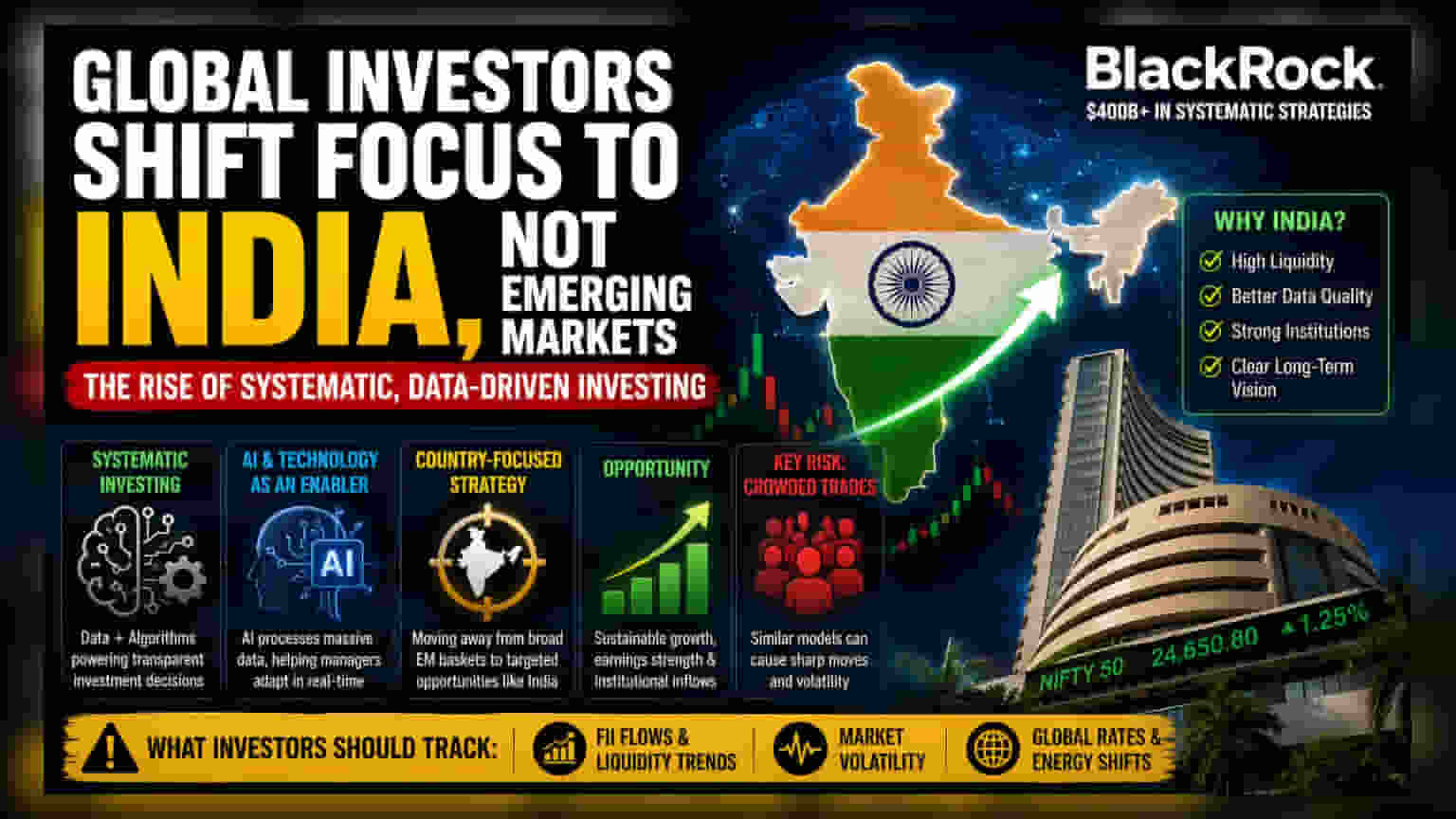
BlackRock is moving away from broad emerging market funds to focus on specific country-level investments. The asset manager highlighted India as a prime hub for systematic, data-driven investing, citing the country's market liquidity and institutional growth as key drivers for this change.
What Happened
Global investors are changing how they approach developing economies. Instead of buying broad 'Emerging Market' baskets that lump together diverse countries, large institutional investors are shifting toward specific, country-focused strategies. Ahmed Talhaoui, Head of BlackRock Systematic Group for EMEA and APAC, highlighted that India has emerged as a standout destination for this new approach. This shift is driven by a preference for markets that offer clear long-term visions and strong institutional frameworks, rather than broad regional exposure.
Understanding Systematic Investing
Systematic investing is a data-driven approach that relies on rules and algorithms to make investment decisions, rather than relying solely on human intuition or manual research. In this model, thousands of data points—such as company earnings, valuation, momentum, and sentiment—are fed into a scoring framework. This framework then identifies stocks that meet specific criteria. For investors, this method offers transparency because the reasons for buying or selling a stock are clearly defined by the investment model. BlackRock currently manages over $400 billion in these types of strategies.
Why India Fits This Model
For a systematic investor, two things are critical: liquidity and data quality. Liquidity ensures that large orders can be bought or sold without causing extreme price swings, and data quality allows models to accurately analyze company health. Talhaoui noted that India’s market has become more liquid and easier to navigate for institutional players. As Indian companies improve their financial reporting and the market attracts more institutional capital, it creates the ideal environment for these systematic models to function effectively compared to other, less transparent emerging markets.
The Role Of AI And Technology
Artificial Intelligence (AI) and advanced computer models are playing a growing role in this process. According to BlackRock, AI does not replace the human manager. Instead, it acts as a powerful tool to process massive amounts of financial data faster than any human could. This allows investment firms to refine their ideas and adapt to changing market conditions in real-time. Unlike the speculative nature of past tech bubbles, the firm suggests that today’s AI-focused leaders often possess strong earnings and tangible business models, which makes the growth trajectory more sustainable.
Risks And What Investors Should Track
While this inflow of systematic capital can provide a boost to market liquidity and valuations, it introduces new dynamics for individual investors to consider. A key risk with systematic or algorithmic investing is the 'crowded trade' phenomenon. If many large global funds use similar data models, they may all decide to buy or sell the same stocks at the same time based on the same signals. This can lead to increased short-term volatility.
Investors should track the consistency of foreign institutional flows and any significant changes in market volatility. If global interest rates fluctuate or energy market adjustments occur, systematic models may react quickly. Watching how these models navigate periods of uncertainty will be a critical monitorable for the market's long-term stability.