

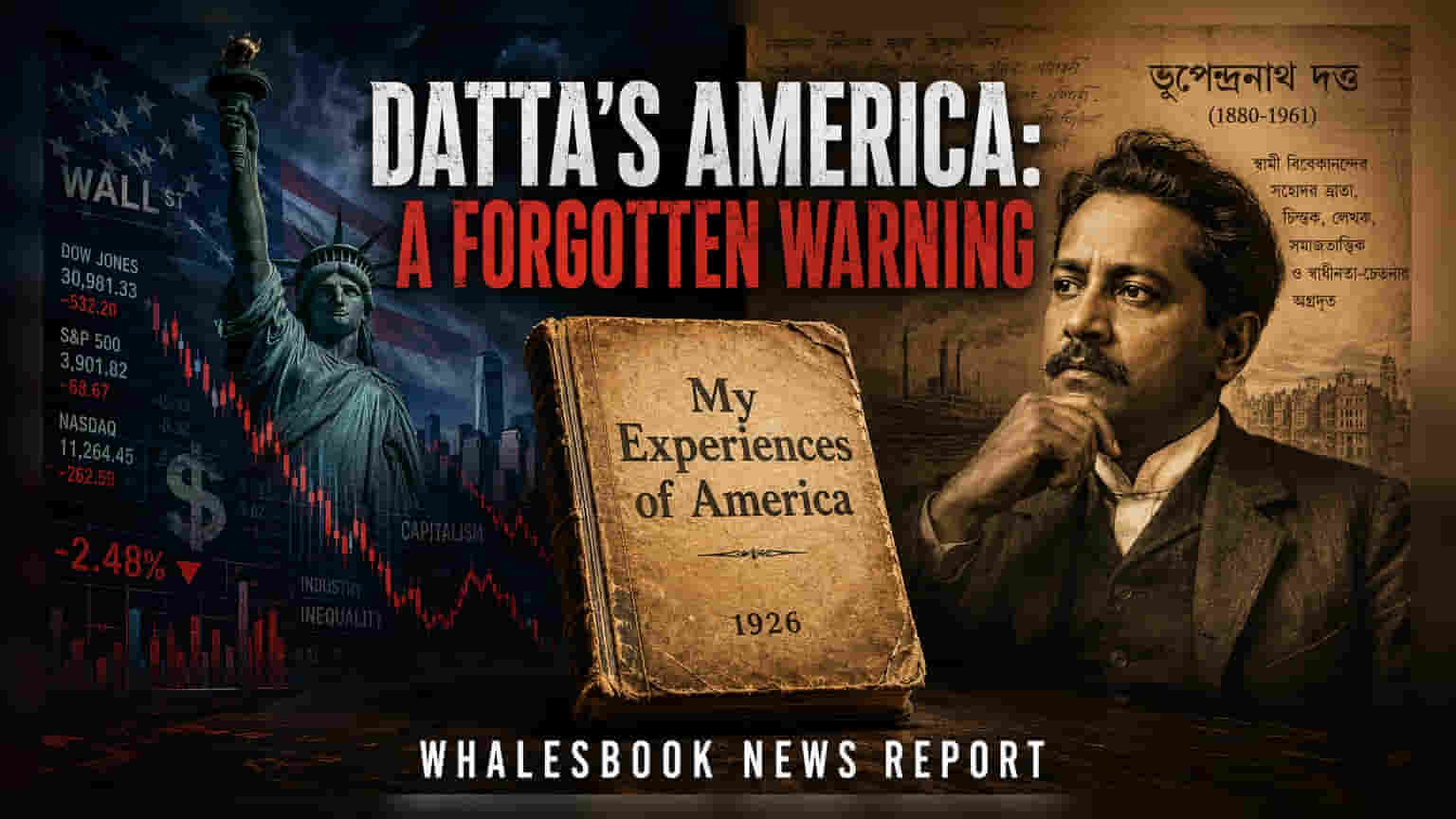
Bhupendranath Datta's 1926 book, 'My Experiences of America', reaches its centenary as the US observes its 250th anniversary. The work provides a rare sociological critique of early 20th-century American capitalism and racial inequality from an Indian perspective. Although largely unknown in the West, the text offers historical context on systemic social issues that remain relevant in modern economic and civil rights discussions.
The centenary of Bhupendranath Datta’s book, 'Amar Amerikar Abhijnota' ('My Experiences of America'), coincides with the United States' 250th anniversary, offering a unique opportunity to revisit a critical historical perspective. Published in 1926, the book presents a detailed sociological examination of American society during its early 20th-century Progressive Era. Datta, a revolutionary nationalist and the brother of Swami Vivekananda, lived in the United States between 1908 and 1914 after leaving India due to sedition charges. During his residence, he pursued academic studies in sociology and anthropology in New York, which provided the foundation for his analytical observations.
Observations on American Capitalism and Society
Datta’s work stands apart from other contemporary accounts because of its focus on the structural contradictions within American democracy. While many visitors of the era highlighted the nation’s civic culture and freedoms, Datta maintained a more detached and analytical stance. He argued that the intersection of unrestrained capitalism and deep-seated racial hierarchies served to undermine the country’s core founding principles of equality. His direct engagement with the social realities of the time led him to challenge the symbolic meaning of institutions like the Statue of Liberty, which he viewed as disconnected from the actual experiences of marginalized populations.
Historical Context and Obscurity
One of the primary reasons Datta’s work has remained largely absent from global discourse is that it was written in Bengali and never widely translated. This linguistic barrier meant that his critique did not reach a broader international audience, unlike other contemporary publications such as Katherine Mayo’s 'Mother India', which gained significant global attention in 1927. Furthermore, because Datta did not conform to the typical profile of a martyred nationalist figure in the eyes of historical record-keepers, his intellectual contributions in the field of sociology were often overlooked.
Relevance for Modern Analysis
For students of history and socio-economic development, Datta’s observations serve as an early, rigorous analysis of systemic issues that continue to influence modern debates. By identifying the roots of racial segregation and the influence of capital on governance, his work provides a framework for understanding how economic and social inequalities can persist over decades. While the book has remained in relative obscurity, its resurgence in historical discussions highlights the value of diversifying the perspectives used to study global democratic systems. Investors and policy analysts often look at these historical sociopolitical trends to understand the long-term stability and social risks inherent in different economic environments.