

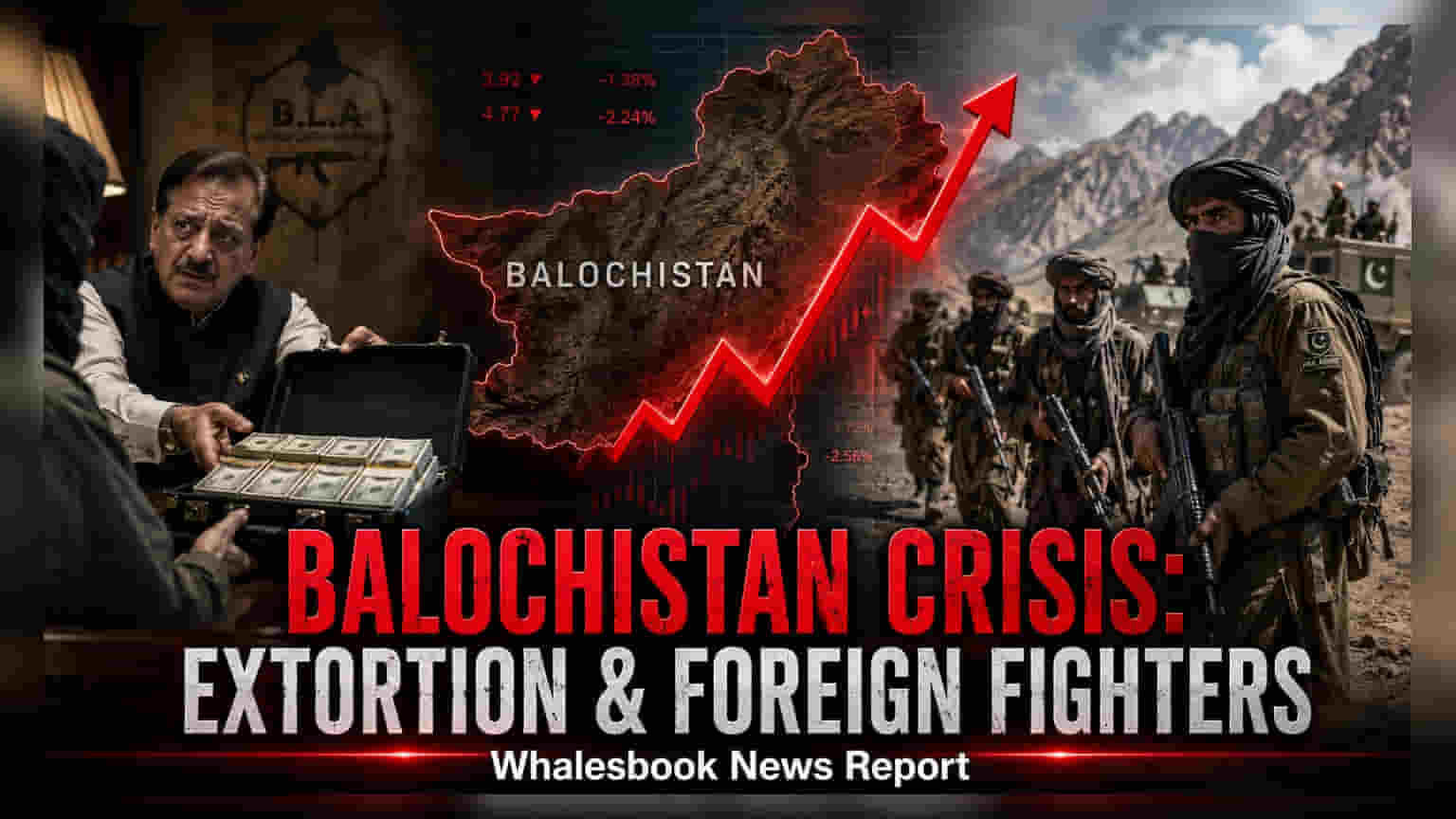
Rising security challenges in Balochistan, including reported extortion of officials and businesses, are threatening the region's mining and logistics sectors. The recent attack on the Home Minister's convoy highlights the breakdown in local order, raising operational risks for essential supply chains and economic stability in the province.
The security situation in Balochistan has intensified significantly, with recent reports indicating a breakdown in control that is now directly impacting the province's economic activities. On August 14, 2026, the convoy of Balochistan Home Minister Mir Ziaullah Langove was targeted in an attack in the Mastung district, leaving six people injured. This incident, combined with widespread reports of extortion targeting government officials and business owners, points to a deteriorating environment for trade and industry.
Extortion Threats to Essential Industries
For the business and investment community, the primary concern is the systematic extortion—locally known as 'bhatta'—that has reportedly infiltrated critical sectors. Mining operations and transportation networks, which are vital to the local economy, have been under consistent pressure. Earlier this year, the Pakistan Minerals Development Corporation informed a Senate committee that mining activities in the region were being forced to pay levies to militant groups to continue operations.
When business operators are coerced into paying these unauthorized costs, the immediate effect is a sharp rise in the cost of doing business. This pressure threatens to make local mining projects unviable and forces logistics companies to reconsider routes. As of July 2026, the Central Traders Association of Balochistan has explicitly warned that these organized extortion networks are placing essential supply chains, including food, fuel, and medicine, at risk of major disruption.
Security Strategy and Operational Uncertainty
Adding to the economic uncertainty are reports regarding the deployment of state-backed 'lashkars,' or armed groups, allegedly composed of former Afghan military personnel. These groups are reportedly being utilized to counter pro-independence factions in the region. For investors and observers, this approach introduces a complex variable into the security equation. While the goal is to stabilize the region, the reliance on external armed groups often creates unpredictable dynamics, potentially worsening the risk profile for infrastructure projects and regional commerce.
Investor and Economic Impact
The province of Balochistan occupies a strategic position, serving as the gateway for major connectivity projects, including those linked to the China-Pakistan Economic Corridor (CPEC). Sustained instability and the loss of state authority in enforcing law and order directly affect the viability of these capital-intensive projects. When local government officials are reported to be negotiating with, or yielding to, armed groups, it signals a significant governance risk. This erosion of authority makes the operating environment hostile for both local and external investment.
Moving forward, the key monitorable for those tracking the region’s economic health will be the ability of the provincial and federal governments to secure national highways and industrial sites. Investors and stakeholders should track updates from trade associations regarding supply chain halts, as well as any official government directives intended to restore the writ of law in mining and trade corridors.