 Whalesbook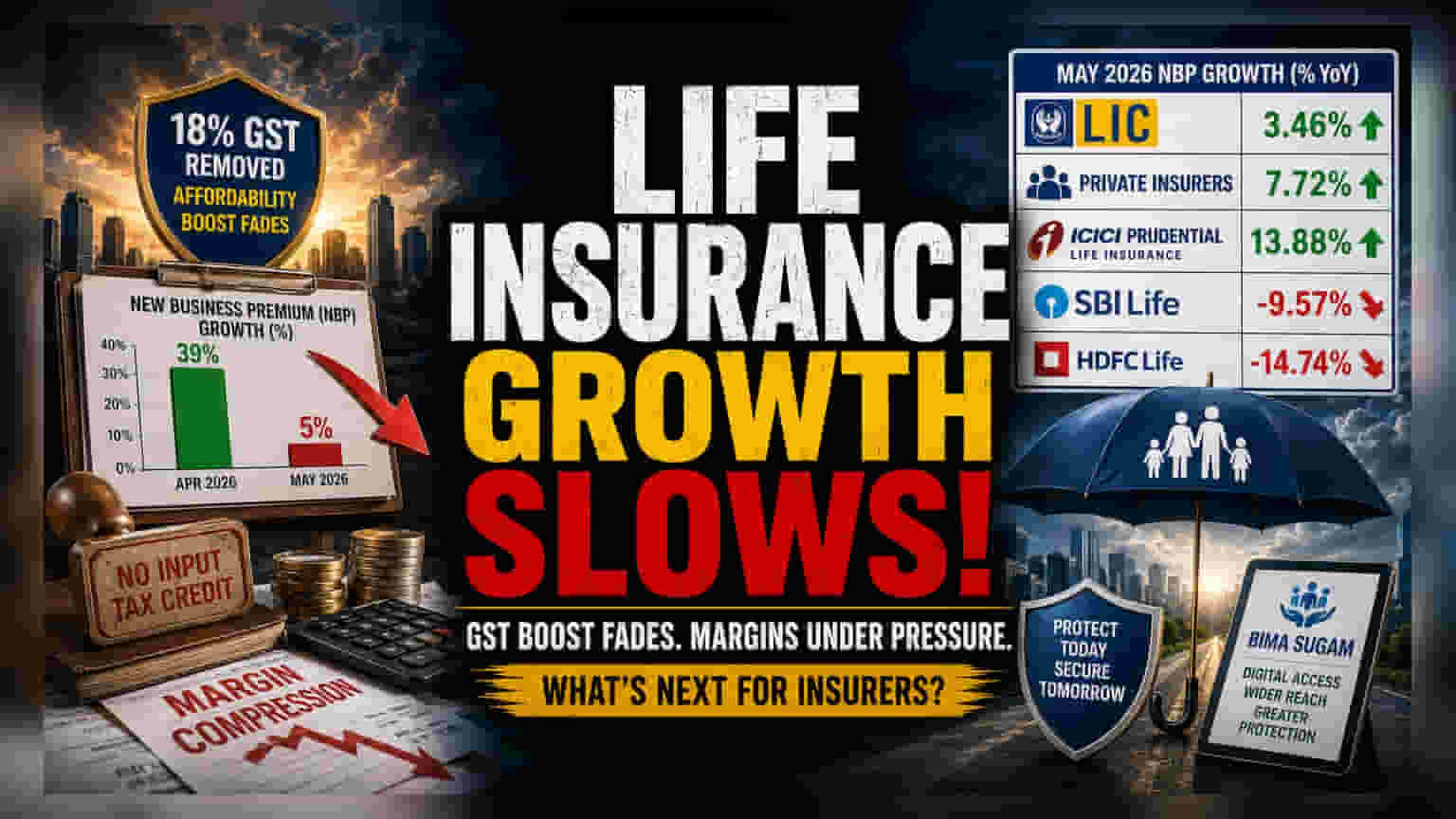


The Fading Catalyst
After a blistering start to the fiscal year, the Indian life insurance sector is witnessing a marked cooling in performance. The industry recorded a 5% year-on-year growth in new business premiums (NBP) for May 2026, the weakest expansion observed in over eight months. This performance shift follows a robust April, where industry-wide NBP climbed 39% year-on-year. The immediate impetus for the earlier double-digit growth was the removal of the 18% Goods and Services Tax (GST) on individual life and health insurance products, which took effect in late 2025. As the novelty of this tax-driven affordability boost wanes, the industry is returning to more normalized, albeit subdued, growth patterns.
Divergent Performance and Group Segment Drag
The broader industry slowdown in May was compounded by structural weakness in group insurance premiums. This segment, often sensitive to macroeconomic sentiment and corporate spending, saw notable deceleration across both state-owned and private players. State-owned Life Insurance Corporation of India (LIC) reported a modest 3.46% year-on-year NBP growth for May, while private insurers managed a 7.72% increase. Among the major listed players, the disparity in individual performance was stark: ICICI Prudential Life Insurance stood out with a 13.88% year-on-year rise in NBP, whereas SBI Life and HDFC Life faced a challenging month, reporting declines of 9.57% and 14.74%, respectively. Analysts suggest that the ongoing West Asian geopolitical tensions have caused some corporate and high-net-worth clients to defer insurance commitments, a trend that may recover as market volatility settles.
The Forensic Bear Case: Margin Compression and Regulatory Risks
While the GST exemption initially improved affordability, it introduced a persistent risk: the loss of Input Tax Credit (ITC) for insurers. Without the ability to offset costs through ITC, insurers face structural margin compression. If companies fail to pass these costs onto consumers through adjusted pricing or commission structures, profitability will remain under pressure. Furthermore, the reliance on bancassurance—a dominant distribution channel for players like SBI Life and HDFC Life—leaves them vulnerable to shifts in banking liquidity and regulatory scrutiny regarding distribution architecture. Unlike insurers with more diversified sourcing, those tethered tightly to a single bank's distribution network may find their growth trajectories more sensitive to their partner's lending cycles.
Forward-Looking Market Outlook
Despite the recent monthly slowdown, the long-term fundamentals remain supported by India’s low insurance penetration rate of approximately 2.7%. Industry projections from various rating agencies anticipate a compound annual growth rate of 8% to 11% through 2027. Future expansion is expected to be dictated by the effectiveness of digital adoption, specifically through government-backed initiatives like the Bima Sugam platform, which aims to reduce the 'protection gap.' For investors, the focus remains on companies capable of defending Value of New Business (VNB) margins while navigating this period of regulatory normalization and shifting retail demand.