 Whalesbook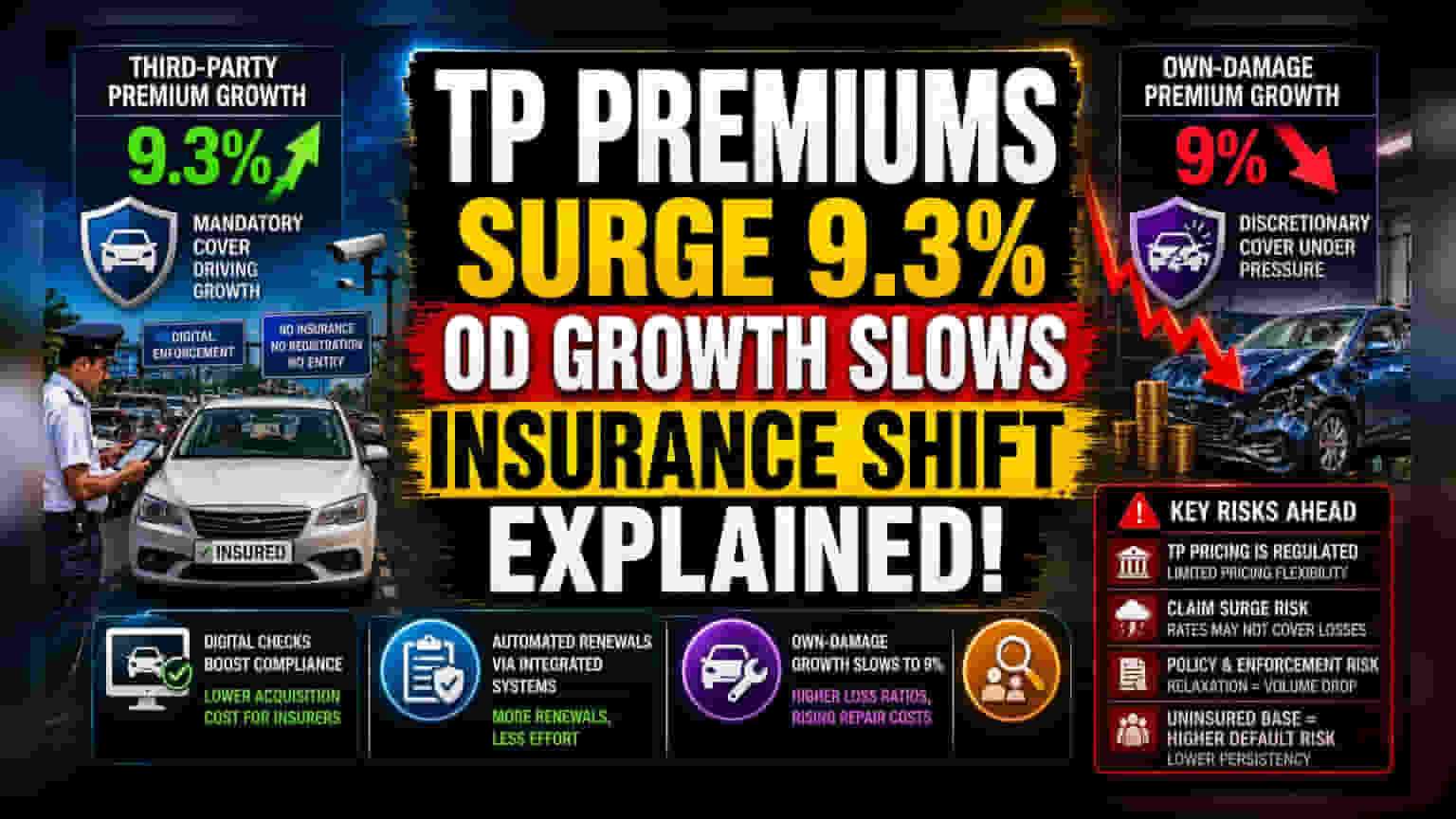


The Shift Toward Mandatory Revenue
The growth inversion between mandatory third-party premiums and discretionary own-damage covers signals a maturing yet restrictive environment for Indian non-life insurers. While own-damage segments previously acted as the primary engine for top-line expansion, the 9.3% growth in third-party premiums underscores a fundamental pivot. Insurers are no longer relying solely on the upsell of comprehensive packages; they are benefiting from a systemic cleanup of the uninsured vehicle backlog. This transition essentially moves the sector toward a utility-like revenue model where compliance, rather than consumer sentiment, dictates inflow.
Digital Enforcement and the Compliance Gap
The acceleration in third-party penetration is less about market demand and more about the integration of centralized vehicle registration databases with insurance policy issuance platforms. This infrastructure linkage prevents the historic practice of vehicle owners skipping renewals. From an institutional perspective, this lowers the customer acquisition cost for insurers since the mandate removes the need for persuasive marketing. However, this relies heavily on the continued commitment of state authorities to maintain high-frequency digital checks. As enforcement becomes pervasive, insurers that have invested in API-led integration with transport portals are seeing a distinct advantage in capturing renewals automatically.
The Profitability Paradox in Own-Damage
While the mandatory segment provides volume, the own-damage segment remains the battleground for net margins. The current deceleration to 9% growth in OD premiums is a direct response to rising loss ratios. With the costs of specialized components and repair labor climbing, insurers have abandoned the aggressive pricing wars that characterized the post-pandemic recovery. Instead, underwriting desks are tightening their risk selection criteria, effectively pricing out high-risk profiles. This conservative stance is a necessary reaction to inflationary pressure on claim settlements, ensuring that the shift toward mandatory TP coverage does not lead to a dilution of overall portfolio quality.
The Forensic Bear Case: Structural Limitations
Investors should remain cautious regarding the long-term scalability of the third-party segment. Because TP premiums are regulated by the Insurance Regulatory and Development Authority of India (IRDAI), insurers lack the flexibility to adjust pricing in response to sudden inflationary shocks or catastrophic loss events. If the frequency of third-party claims increases, insurers may find themselves locked into premiums that do not cover the risk. Furthermore, the reliance on government-mandated enforcement creates a policy risk; any relaxation in traffic or registration compliance could result in a sharp, sudden contraction in new business volume. Finally, the massive uninsured vehicle base is not necessarily a guarantee of future profit, as these vehicles often belong to lower-income segments with higher default rates or lower policy persistency.