

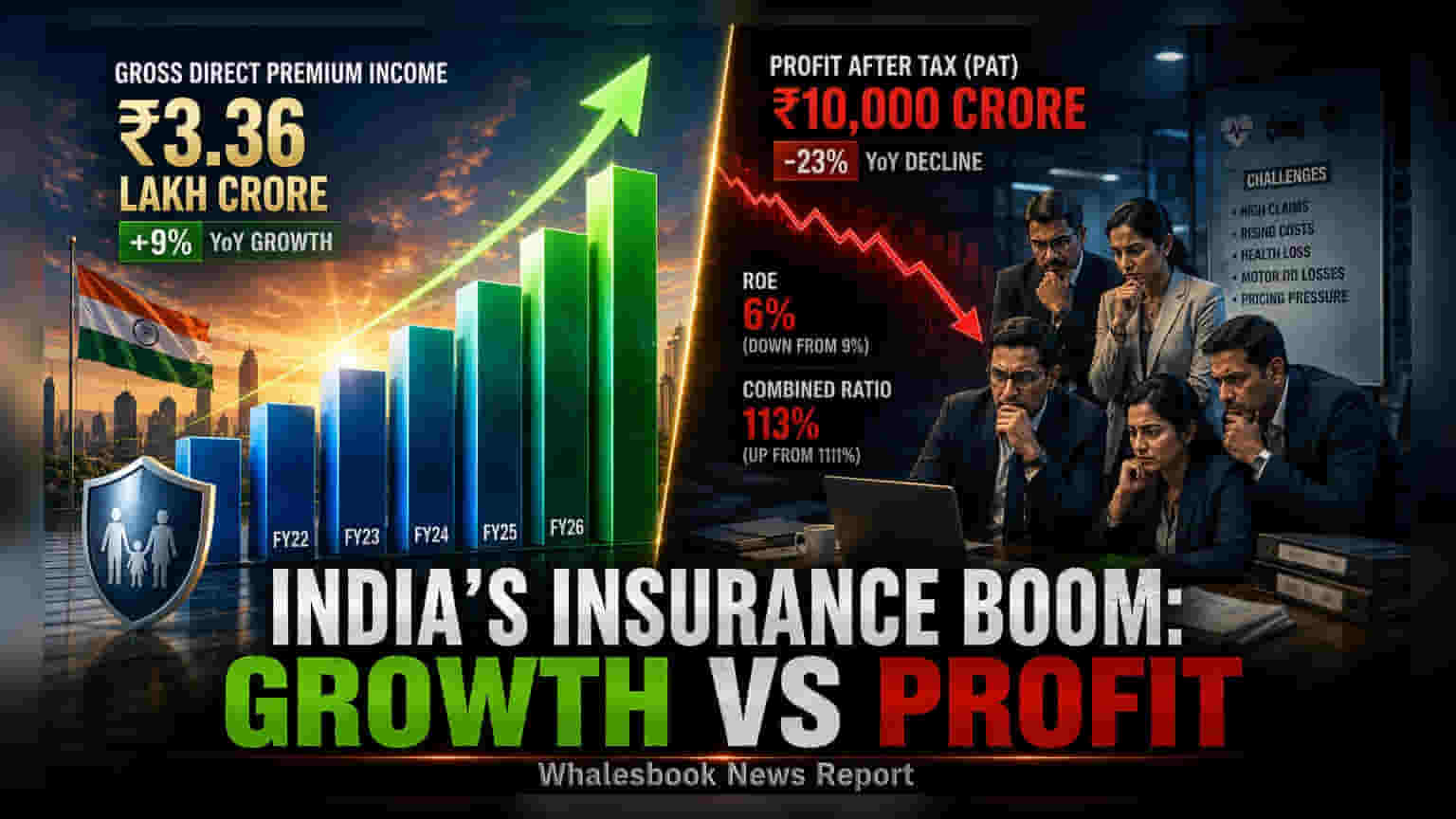
India's general insurance sector grew by 9% in FY26, with premium income reaching ₹3.36 lakh crore led by health insurance. Despite this, industry-wide profits dropped 23% to ₹10,000 crore as high claims and operating expenses weighed on performance. Investors are now closely watching how companies manage underwriting discipline and cost structures to restore profitability.
The Indian general insurance industry reached a significant milestone in fiscal year 2026, with Gross Direct Premium Income (GDPI) expanding 9% year-on-year to ₹3.36 lakh crore. This growth signals a healthy appetite for insurance products across the country, particularly as the sector moves toward deeper penetration in both urban and semi-urban markets.
However, the headline growth figures mask a difficult year for profitability. While the industry expanded in size, profit after tax (PAT) across the sector fell by 23% to ₹10,000 crore. The industry's Return on Equity (ROE), a key measure of efficiency, declined to 6% from 9% in the previous year. This discrepancy between revenue growth and bottom-line performance is a primary concern for market observers.
Where Growth is Coming From
Health insurance remains the powerhouse of the industry, recording a 17% surge in growth for the year. This shift reflects rising awareness and the need for coverage, though it comes at a cost. The rapid expansion in health insurance requires heavy spending on distribution networks and infrastructure, which has pressured margins industry-wide. In fact, the health insurance segment reported an industry-wide ROE of -7%, illustrating the challenges of balancing rapid growth with profitable underwriting.
Motor insurance, another major contributor, saw growth of roughly 9%. However, insurers struggled to pass on increased costs due to a portfolio heavy with renewals. The performance within this segment is highly uneven: while Third Party coverage proved strong with a 22% ROE, the Own Damage category faced significant pressure, yielding a negative ROE of -34%.
The Profitability Hurdle
The most important metric for investors to watch is the combined ratio, which climbed to 113% in FY26. In simple terms, a combined ratio above 100% means that for every 100 rupees collected in premiums, insurers are paying out more than 100 rupees in claims and operating expenses. A two-percentage-point increase in this ratio indicates that expenses and claims are growing faster than the premiums being collected.
Private sector insurers generally outperformed their public sector counterparts, recording 10% growth compared to 8% for the public sector. Public insurers faced greater difficulty, with their combined ratio deteriorating to 128% and ROE falling to -4%, reflecting the ongoing struggle to address legacy pricing and claims issues.
What Investors Should Track Next
Moving forward, the primary focus for stakeholders will be the industry's ability to shift from a focus on pure volume to disciplined underwriting. Companies that can effectively manage their combined ratios and optimize costs in high-growth segments like health insurance will likely stand out. Investors should monitor quarterly updates for signs of better pricing power, improved claims management, and reduced dependence on loss-making categories to determine which insurers are best positioned to navigate these profitability challenges.