 Whalesbook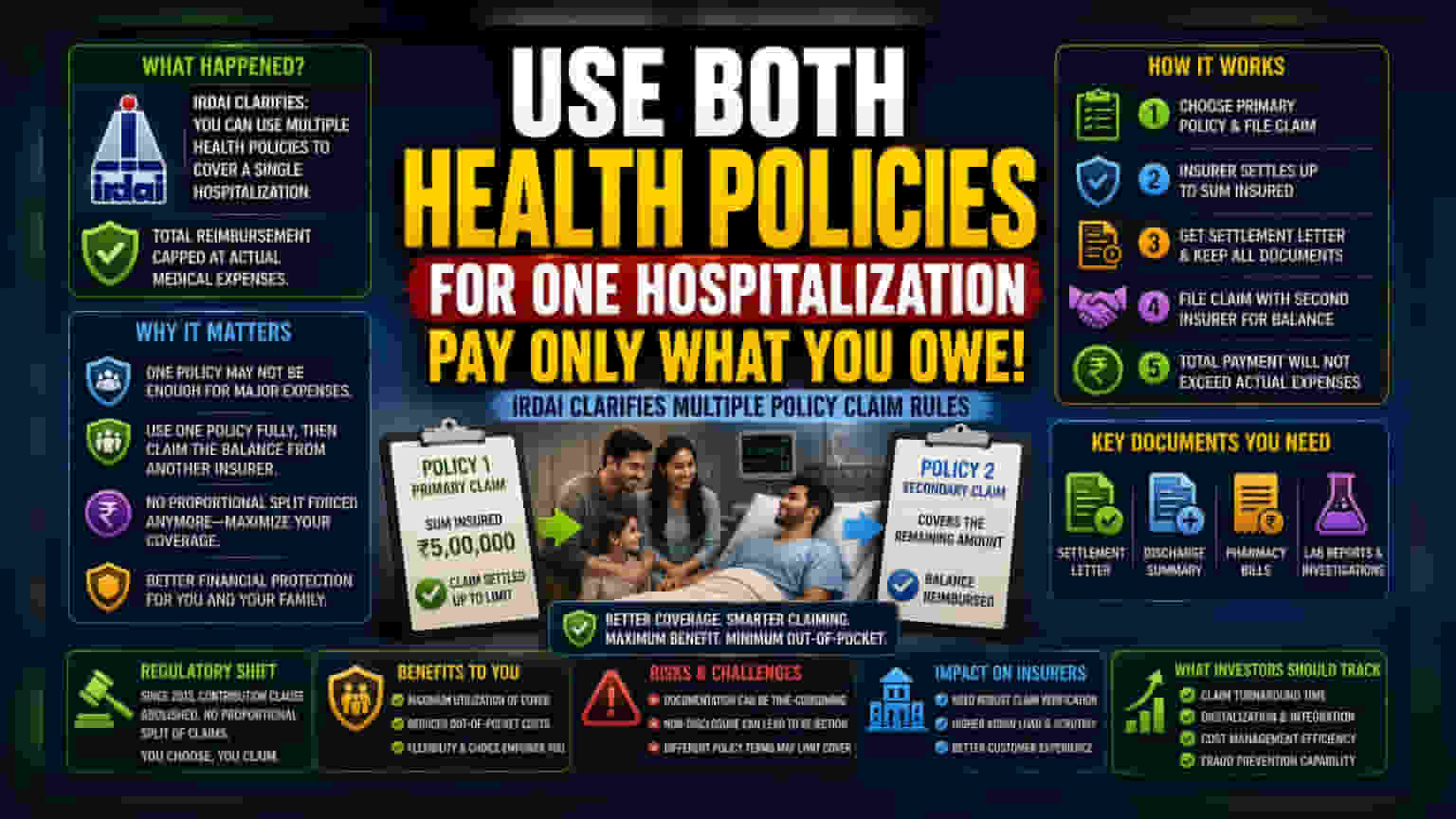


What Happened
The Insurance Regulatory and Development Authority of India (IRDAI) has clarified that policyholders holding multiple health insurance policies—such as a personal plan and an employer-provided policy—can utilize both to cover a single hospitalization event. If a medical bill exceeds the sum insured of the primary policy, the remaining balance can be claimed from a second insurer. The total reimbursement, however, is strictly capped at the actual medical expenses incurred.
Why This Matters For Policyholders
For many families, a single health insurance policy may not be enough to cover a major medical emergency. In the past, claiming from multiple insurers was often confusing, and sometimes insurers would force a proportional split of the claim, which reduced the benefit available to the policyholder. Current rules allow patients to use one policy fully up to its limit before approaching another insurer for the remainder. This provides a safety net, ensuring that excess costs are not paid out-of-pocket if the total coverage amount across all policies is sufficient.
The Shift in Claim Processing
Since 2013, the regulator abolished the 'contribution clause' that used to force insurers to split claims proportionally. Now, policyholders have the freedom to select which insurer processes the initial claim. The first insurer settles the bill up to the available sum insured. Once the claim is settled, the patient receives a settlement letter, which is the key document required to approach a second insurer for the balance. This shift empowers the consumer to maximize the utility of their premiums paid across different plans.
How the Process Works
To manage this effectively, the policyholder must treat one policy as the primary claim and the other as a secondary claim. It is important to inform all insurance providers involved about the existence of multiple plans. When filing the first claim, the policyholder should ensure they receive a detailed claim settlement letter and keep certified copies of all original documents, including discharge summaries, pharmacy bills, and lab reports. These documents are then used to support the claim with the second insurer, who will assess the request based on their specific policy terms.
Operational Impact on Insurers
For listed health insurance players like Star Health, ICICI Lombard, and HDFC Ergo, this regulatory clarity means that claim processing systems must be robust. While this improves the customer experience, it also places the onus on insurers to verify documentation from other companies thoroughly to prevent fraudulent or duplicate claims. Investors tracking the health insurance sector may monitor how efficiently these companies manage the increased administrative load of verifying previous settlements and cross-verifying medical expenses.
Potential Risks and Challenges
The primary challenge for policyholders is the documentation process. Managing multiple claims can be time-consuming and prone to errors. Failing to disclose multiple policies at the start or misplacing the settlement letter from the first insurer can lead to delays or rejections in the second claim. Additionally, since every policy has different terms and conditions, a treatment covered by the first insurer might not be covered by the second, leaving some expenses ineligible for reimbursement.
What Investors Should Track
Investors and policyholders should watch for further digitalization in claims processing. As the industry moves toward more integrated digital health records, the ease of filing secondary claims is expected to improve. Key monitorables include the average turnaround time for claim settlements across the sector and how insurance companies leverage technology to handle multi-policy verification without increasing costs or processing times.