

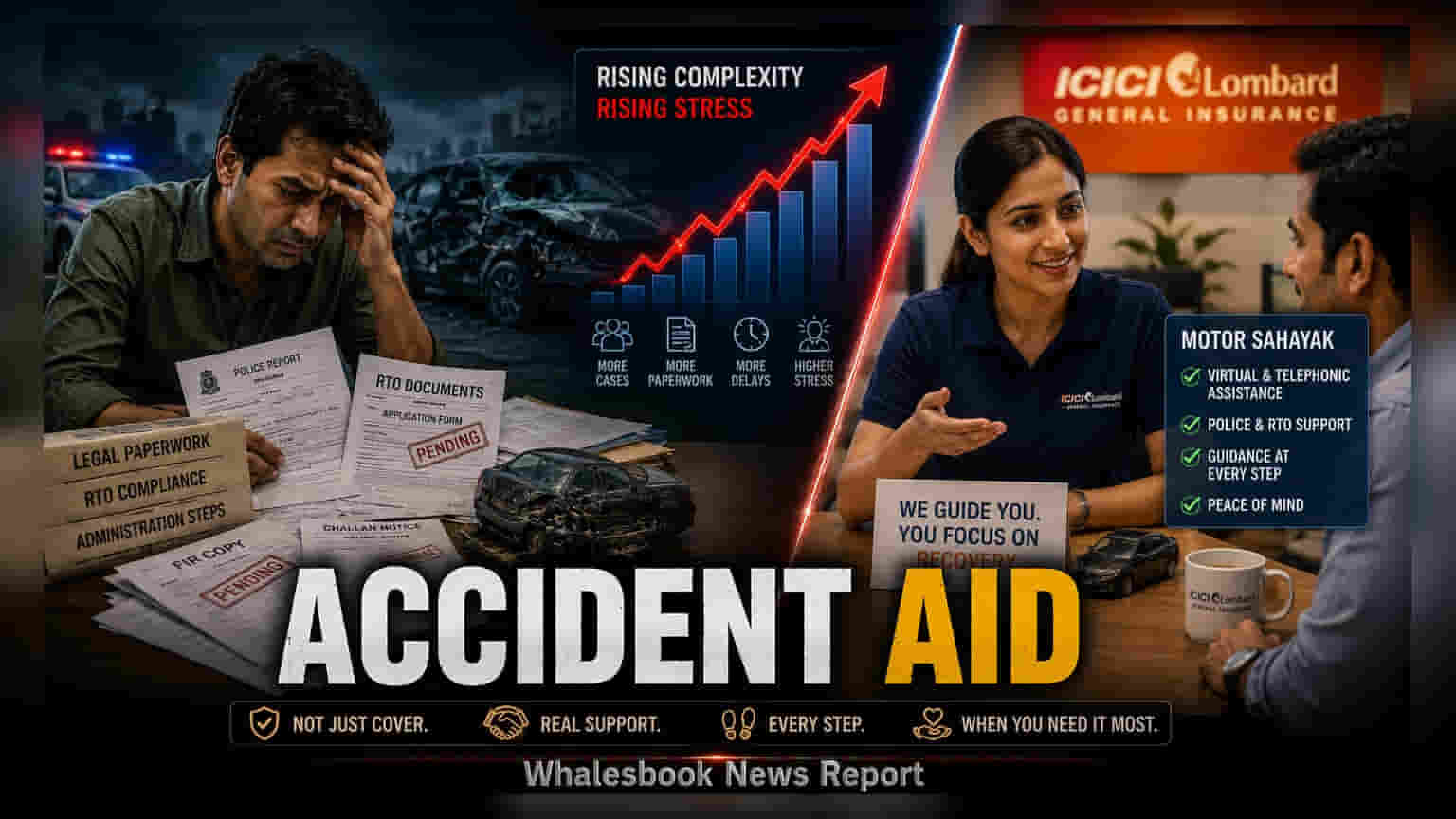
ICICI Lombard has introduced "Motor Sahayak," an optional add-on to assist policyholders with legal and administrative formalities after a road accident. This launch occurs as the insurer faces margin pressure, having reported a 46% year-on-year decline in Q1 FY27 profit to ₹403 crore. Investors are watching whether such value-added services can improve customer retention and support profitability.
ICICI Lombard General Insurance has introduced "Motor Sahayak," an optional rider designed to guide policyholders through the complex legal and administrative procedures that follow a road accident. Unlike standard insurance, which covers the financial cost of vehicle repairs or third-party liabilities, this service focuses on procedural support. It helps customers navigate police requirements, RTO paperwork, and administrative steps involved in the aftermath of a crash.
The service offers virtual and telephonic assistance for police and RTO interactions. However, it is essential for policyholders to understand that this is a facilitation service rather than legal insurance. The company has clarified that "Motor Sahayak" does not cover legal fees, traffic challans, or court penalties. These costs remain the responsibility of the vehicle owner. The initiative is part of a broader series of 25 product and service launches marking the company’s 25th anniversary.
For investors, the launch comes at a time when the insurer is navigating significant financial challenges. In the recently reported first quarter of the 2027 fiscal year, the company’s net profit declined by 46% year-on-year to ₹403 crore. A key metric investors are tracking is the combined ratio—a measure of how much an insurer spends on claims and operating costs compared to the premiums it earns. The company’s combined ratio was reported at 107.2% for the quarter, indicating that total expenses and claim payouts are currently exceeding the income from premiums.
The strategy behind launching service-focused add-ons is typically to improve customer retention and service quality in a competitive market. However, in the current environment, the primary focus for the company remains its underlying profitability and underwriting performance. The risk for shareholders lies in whether such value-added services can successfully improve retention without significantly adding to the operating expenses that are already pressuring the company's margins.
Moving forward, market participants will likely look for updates on the company’s underwriting performance. The critical monitorable for investors will be whether future quarterly results show a stabilization or improvement in the combined ratio and a recovery in profit margins.