

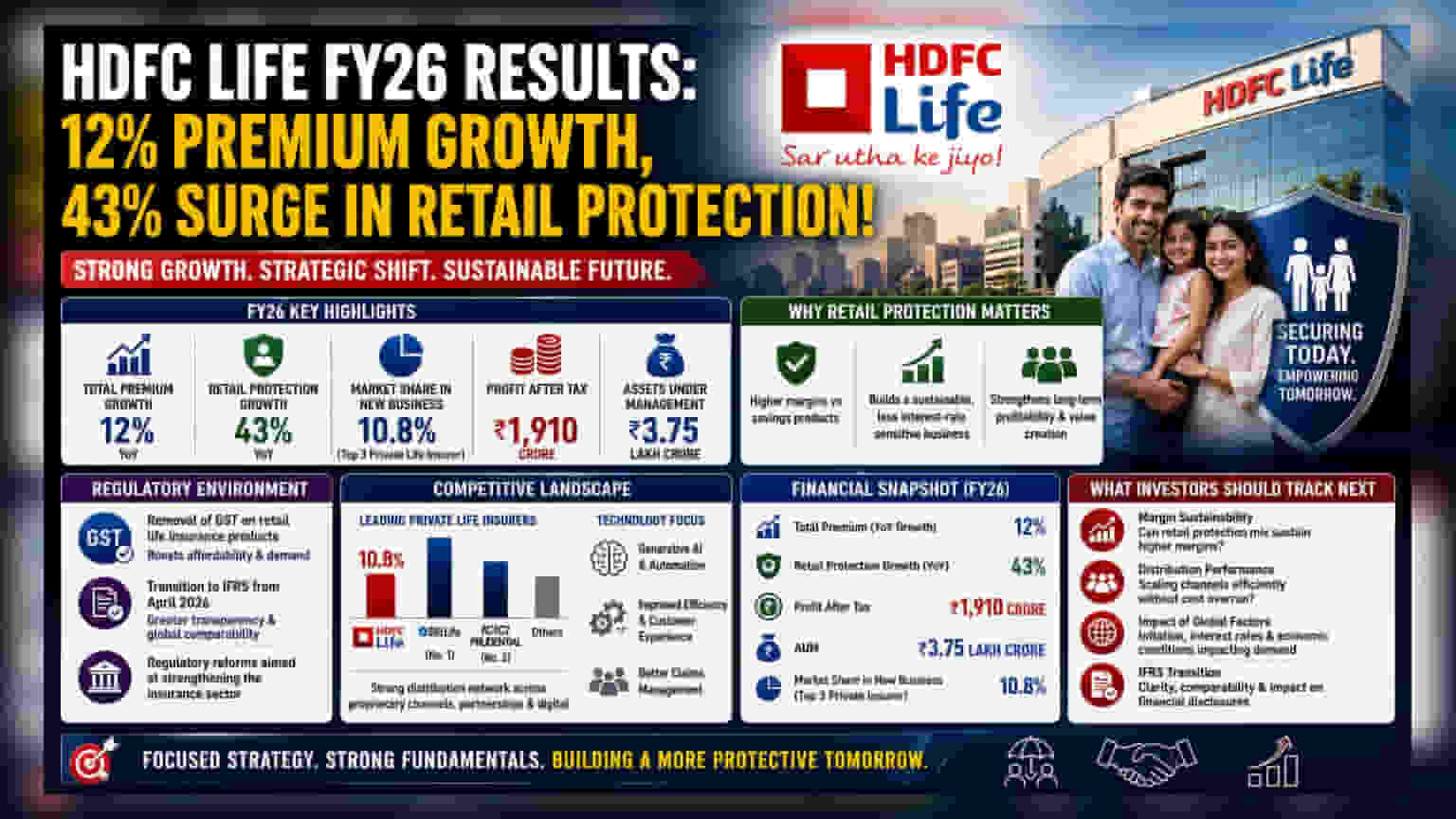
HDFC Life Insurance reported a 12% rise in total premium for FY26, driven by a 43% increase in its retail protection business. The insurer closed the year with a 10.8% market share and a net profit of ₹1,910 crore. Investors may focus on how this shift toward higher-margin protection products impacts the company's profitability in the coming quarters.
What Happened
HDFC Life Insurance Company has announced its financial results for the fiscal year 2026, reporting a 12% year-on-year growth in its total premium collections. A standout feature of the annual performance was the retail protection segment, which saw a 43% increase. This growth trajectory highlights the company's efforts to diversify its product mix. By the end of March 2026, the company held a 10.8% market share in new business, keeping it among the top three private life insurers in India. The insurer reported a profit after tax of ₹1,910 crore, with total assets under management reaching ₹3.75 lakh crore.
Why Retail Protection Matters
In the life insurance business, the type of product sold often dictates the profit margin. Retail protection products, such as term insurance plans, generally offer higher margins compared to traditional savings-oriented insurance products. The company's strategic decision to prioritize this segment is an attempt to improve overall profitability. By focusing on protection, insurers aim to build a more sustainable and less interest-rate-sensitive business model, which can be an important signal for long-term investors tracking margin quality.
The Regulatory Environment
The life insurance sector is currently navigating significant regulatory changes that could influence demand. The recent removal of GST on certain retail life insurance products is expected to make these plans more affordable for consumers, potentially acting as a catalyst for demand in the coming year. Additionally, the industry is preparing for the transition to International Financial Reporting Standards (IFRS) effective from April 2026. This shift is designed to improve financial transparency and align Indian insurance reporting with global standards, allowing for better comparability between insurers.
Sector Context and Competition
India’s life insurance market remains highly competitive, with established players like SBI Life and ICICI Prudential Life Insurance constantly vying for market share. HDFC Life’s ability to maintain a 10.8% market share in a crowded landscape reflects the strength of its distribution network, which includes proprietary channels, partnerships, and digital platforms. While the company is focusing on technological upgrades like generative AI and automation to improve efficiency, it operates in an environment where success depends heavily on the ability to retain customers and manage claims efficiently against aggressive competition.
What Investors Should Track Next
While the growth numbers are positive, the real test for investors will be whether this momentum can be sustained. Key monitorables include:
- Margin Sustainability: Whether the shift toward retail protection can consistently offset potential volatility in other product segments.
- Distribution Performance: The ability of the company to scale its various distribution channels without significantly increasing costs.
- Impact of Global Factors: Any potential shifts in economic conditions, such as those arising from regional conflicts or domestic inflation, which could influence household savings and insurance demand.
- IFRS Transition: How the new accounting standards affect the clarity and comparability of the company's financial disclosures in the next fiscal year.