 Whalesbook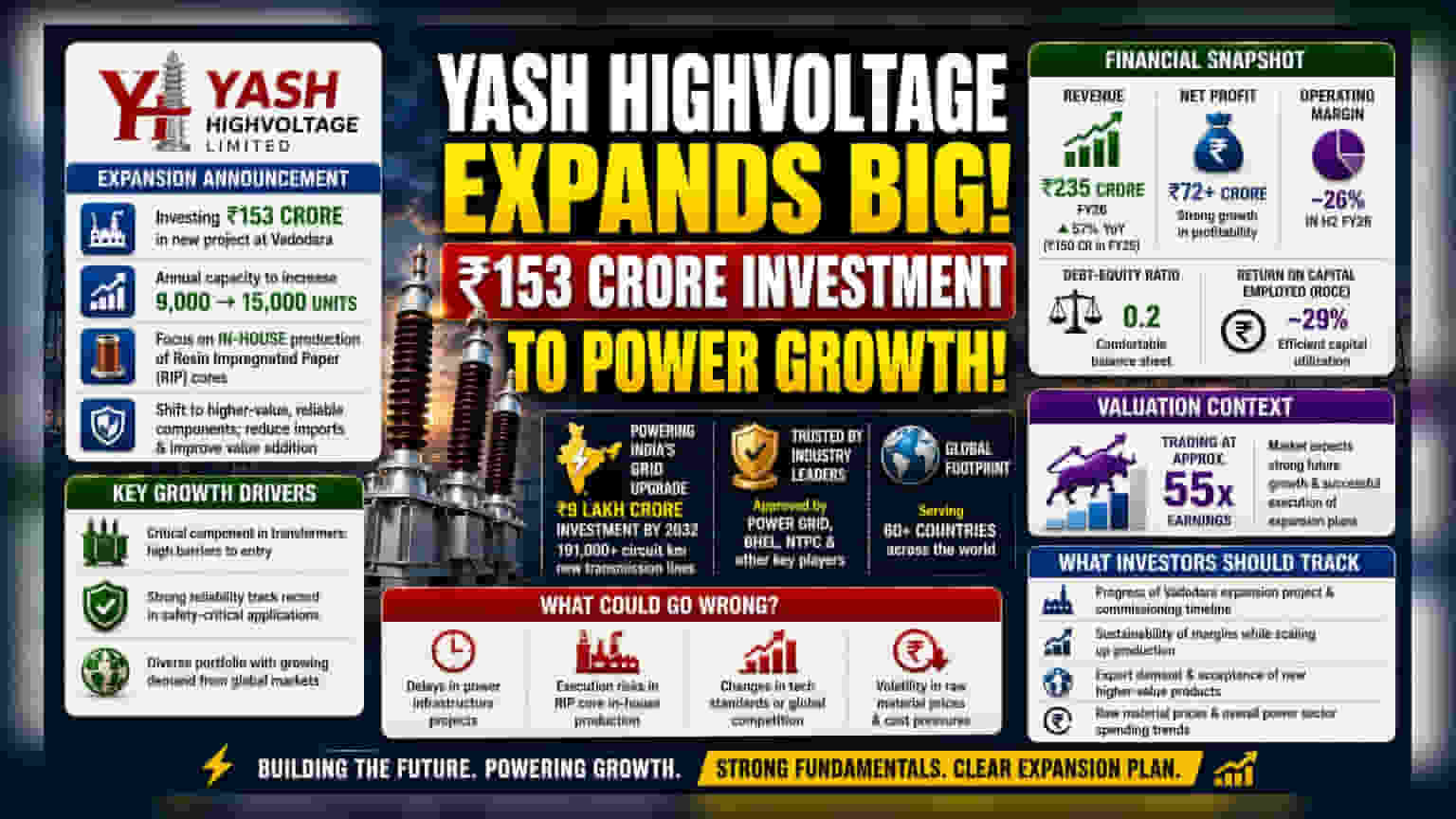


Yash Highvoltage is scaling up its manufacturing capacity with a Rs 153 crore investment, aiming to tap into the massive demand from India's power grid expansion. The company, a specialist in transformer bushings, reported a 57% jump in annual revenue. While its strong growth and healthy margins are attracting attention, investors are weighing this performance against a premium valuation of 55 times earnings. The key monitorable is the company’s ability to execute its expansion while moving toward higher-value products.
What Happened
Yash Highvoltage Ltd has announced a significant expansion plan to increase its production of transformer bushings. The company is investing Rs 153 crore in a new project in Vadodara. This initiative is designed to boost its annual manufacturing capacity from 9,000 units to 15,000 units. A central part of this strategy is shifting toward in-house production of critical parts, specifically Resin Impregnated Paper (RIP) cores. By moving away from older technology and focusing on these higher-value, more reliable components, the company aims to reduce its reliance on imports and improve its overall value addition.
Why This Matters For Investors
India is currently undergoing a massive power sector upgrade, with plans to invest roughly Rs 9 lakh crore in grid infrastructure by 2032. This includes adding over 191,000 circuit kilometers of new transmission lines. While large manufacturers of transformers and cables often take the spotlight, Yash Highvoltage plays a vital role in this ecosystem. It manufactures condenser-graded bushings, which act as the entry and exit points for electricity in transformers. Because these components are safety-critical and failure can cause massive damage, the industry has high barriers to entry. Establishing a track record of reliability is essential, and Yash has already secured approvals from major players like Power Grid Corporation of India, Bharat Heavy Electricals, and NTPC.
The Financial Health Check
The company has reported a period of strong financial momentum. Between FY2025 and FY2026, its revenue grew by approximately 57%, rising from Rs 150 crore to Rs 235 crore. Operating profits and net profits have kept pace with this growth. The company’s ability to manage costs is reflected in its margins, which reached around 26% in the latter half of FY2026. From a balance sheet perspective, the firm appears to be in a comfortable position with a debt-to-equity ratio of 0.2 and a return on capital employed of about 29%. These numbers suggest that the company is using its capital efficiently to generate profit.
The Valuation Question
Investors are currently pricing the stock at approximately 55 times its earnings. This valuation suggests that the market has high expectations for the company's future growth and its ability to maintain its niche market position. When a company trades at such a valuation, there is little room for error. The market is effectively betting that the expansion project will be completed on time and that the shift to higher-value RIP technology will be successful. Whether this valuation is justified will depend on the company's ability to maintain its profit margins and grow its export business beyond the 60 countries it currently serves.
What Could Go Wrong
The company operates in a sector that is highly dependent on infrastructure spending cycles. While the current outlook for the power grid is positive, any major delay in government-led infrastructure projects could impact demand for transformer components. Additionally, the move to produce RIP cores in-house introduces execution risk. If the technology adoption or the manufacturing process faces delays or quality issues, it could impact both costs and customer trust. Furthermore, because it is a niche player, the company faces the risk of changing technology standards or competitive pressure from global manufacturers, though it currently faces limited direct competition in the Indian market.
What Investors Should Track
Moving forward, the primary monitorable for investors will be the progress of the Vadodara expansion project. Investors will look for updates on the commissioning date and whether the company can maintain its current profit margins while scaling up production. Management commentary on export demand and the acceptance of their new higher-value product lines will also be key factors. Any significant change in raw material prices or a slowdown in the broader power infrastructure sector will be important to watch, as these factors could influence the company’s revenue growth and profitability in the coming years.