 Whalesbook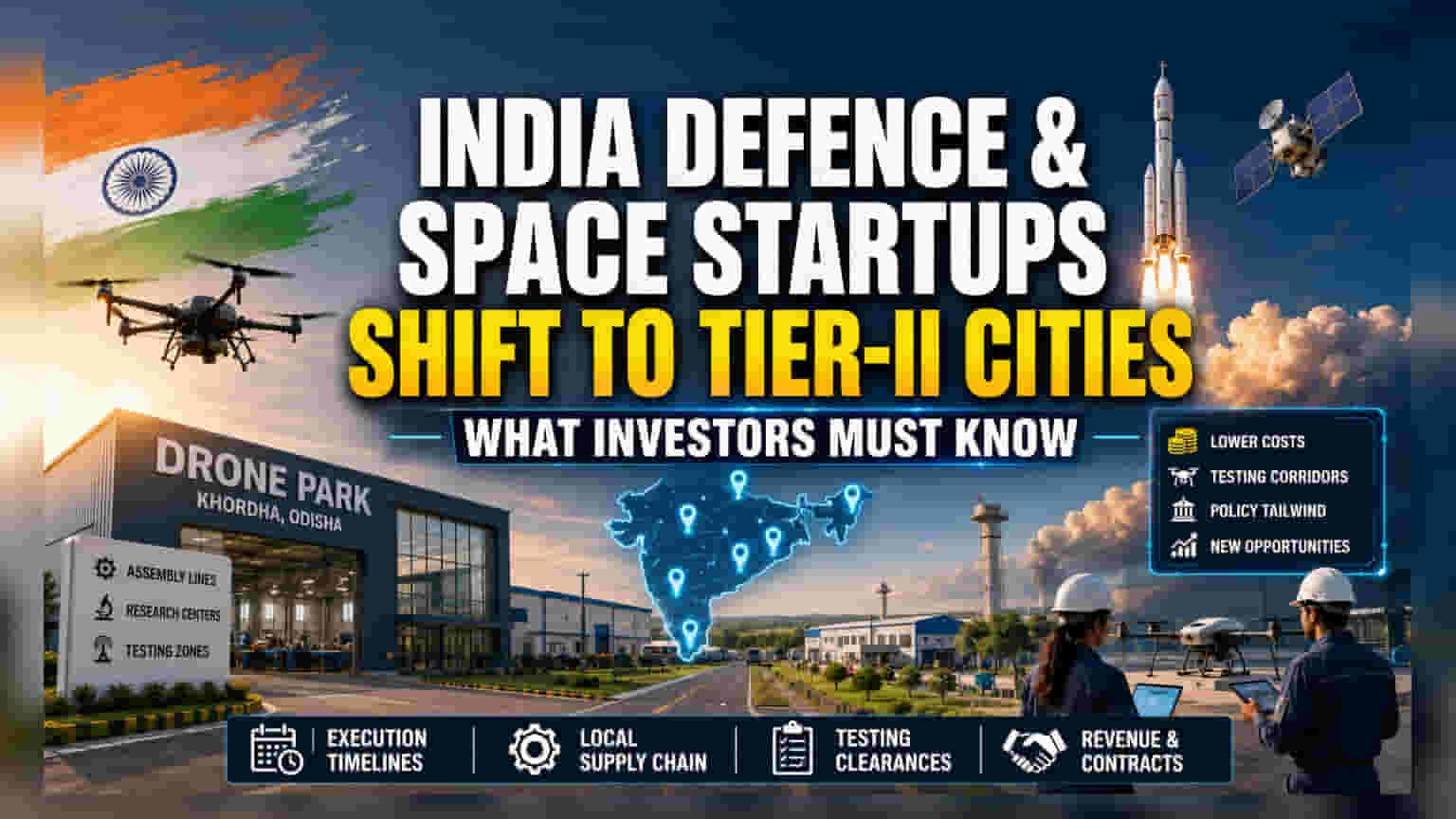


Indian defence and space-tech startups are shifting manufacturing and testing to Tier-II and Tier-III cities to access cheaper land, open airspace, and strategic policy support. This decentralization helps hardware-focused firms reduce operating costs, but success depends on managing supply chain and talent gaps in smaller regions.
What Happened
India’s defence and space-technology startup ecosystem is undergoing a major structural shift. Companies that were traditionally centered in major metro hubs like Bengaluru, Delhi-NCR, and Mumbai are increasingly setting up critical manufacturing, testing, and training facilities in Tier-II and Tier-III cities. This move marks a transition from software-centric innovation to hardware-intensive operations, where physical space and access to testing corridors are becoming competitive advantages.
A prime example of this trend is BonV Aero, which has launched a Rs 300 crore drone park in Khordha, Odisha. This facility, spanning over 30 acres, is designed to house assembly lines, research centers, and testing zones. Similarly, other firms are establishing testing grounds in regions like Uttar Pradesh and Maharashtra to perform sensitive propulsion tests and large-scale drone operations that are restricted in densely populated metropolitan areas.
Why This Matters For Investors
For investors tracking this sector, the decentralization trend signals a maturation of the business model. In the early stages of India’s drone and space-tech boom, startups often focused on software or assembly in lab-like settings within cities. Now, as these companies scale, they face the need for 'field-ready' manufacturing. Setting up in smaller cities is not just a cost-saving measure; it is an operational necessity.
Hardware manufacturing is capital-intensive. By moving to smaller cities, these startups can lower their fixed costs—such as land and labor expenses—and redirect that capital into R&D and scaling infrastructure. Additionally, access to dedicated 'testing corridors' allows these firms to conduct Beyond Visual Line of Sight (BVLOS) operations, which are essential for testing autonomous systems that cannot be safely operated in urban airspace.
The Strategic Trade-Off
While the move to smaller cities offers clear benefits, it also presents new operational risks that investors should monitor.
Infrastructure and Connectivity: Unlike established metro hubs, Tier-II and Tier-III locations may face challenges regarding the consistency of high-speed internet, reliable power, and efficient transport logistics for specialized components. Hardware manufacturing relies on a precise 'just-in-time' supply chain. If a startup cannot easily source high-tech components because it is far from major supplier clusters, production timelines could slip.
Talent Sourcing: Defence and space-tech require highly specialized engineering talent. While these startups aim to create local jobs through skilling centers, they often still need to relocate senior technical experts from metros. Retention of this talent in smaller cities can be a long-term challenge.
Funding and Ecosystem: Traditionally, venture capital and angel investment in India have been concentrated in a few metro hubs. While government schemes like iDEX (Innovations for Defence Excellence) and various state-level policies provide significant support, startups operating outside main hubs may face more hurdles in connecting with the broader private investment community.
The Bigger Business Context
This shift is heavily supported by national policies like 'Aatmanirbhar Bharat' and specific state-level aerospace and defence manufacturing policies. State governments are now competing to attract these startups by offering land, infrastructure, and simplified regulatory sandboxes. For investors, this creates a 'policy tailwind' that reduces some of the initial risks associated with setting up large manufacturing units.
However, the ultimate success of these companies will not be determined solely by their location. The core monitorables remain: the ability to execute complex manufacturing at scale, securing reliable long-term government or commercial contracts, and maintaining a healthy balance sheet while investing in heavy infrastructure. The transition to Tier-II cities is a sign of scale, but it must be backed by rigorous operational management.
What Investors Should Track
Investors may look for updates on project execution timelines and whether these new facilities actually reach the intended production capacity. Another key area is the development of the local supply chain. Does the startup rely on local MSMEs for parts, or are they still dependent on imported or distant suppliers? Finally, watch for regulatory clearances for their testing corridors, as these are critical for validating new technology and moving products from the 'prototype' phase to the 'revenue-generating' phase.