

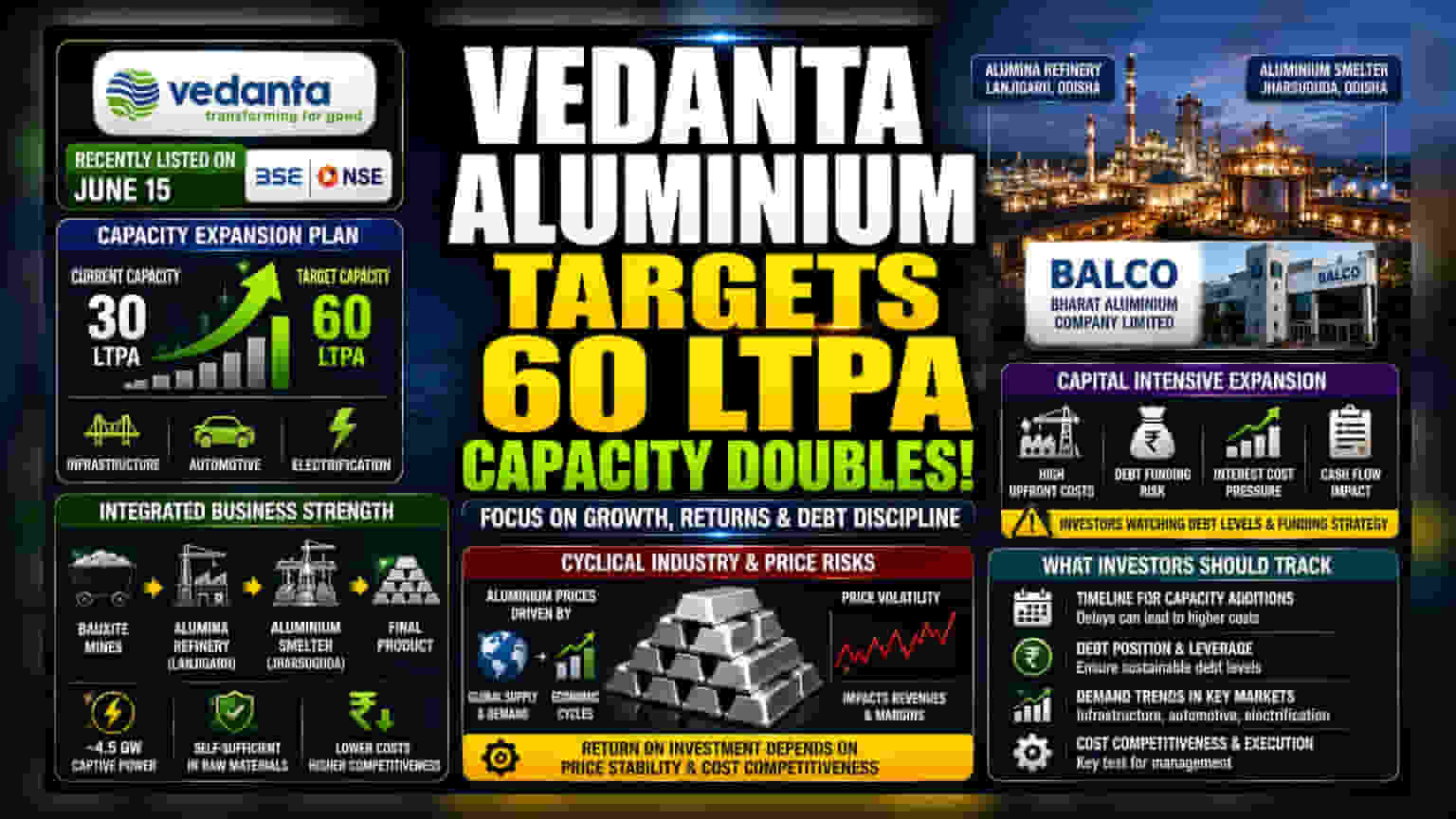
Vedanta Aluminium Metal Ltd has announced plans to double its production capacity to 60 lakh tonnes per annum. This expansion follows the company’s recent stock market listing and aims to meet rising demand in infrastructure and automotive sectors. Investors are evaluating the impact of such large-scale capital spending on the company’s balance sheet and operational efficiency.
What Happened
Vedanta Aluminium Metal Ltd (VAML), which recently listed on the BSE and NSE on June 15, has announced plans to increase its production capacity to 60 lakh tonnes per annum (LTPA). The company is currently operating at a capacity of 30 LTPA and intends to double this figure to strengthen its position in the aluminium market. This growth strategy focuses on sectors that consume significant amounts of aluminium, such as infrastructure development, automotive manufacturing, and the electrification industry.
Business Strength And Integration
VAML operates an integrated business model. This means it controls key parts of the production process, from sourcing raw materials to final output. The company operates a large alumina refinery at Lanjigarh and a major aluminium smelter at Jharsuguda in Odisha. It also owns Bharat Aluminium Company Limited (BALCO) in Chhattisgarh. A key part of its business advantage is its self-sufficiency in power, with nearly 4.5 gigawatts of captive power generation. Access to captive bauxite and coal mines helps the company manage costs, which is important in the aluminium industry where energy and raw material prices can change rapidly.
The Capital And Debt Question
Doubling production capacity requires significant money spent on expansion. While the company aims to become a global leader, investors typically look closely at how such large projects are funded. Building new smelters and refineries involves high upfront costs and debt. If the company takes on significant debt to fund this expansion, it could increase interest payments and pressure cash flow. Shareholders will likely look for updates on the funding structure, project timelines, and how the company plans to manage its debt levels while scaling up.
Cyclical Demand And Price Risks
The aluminium industry is known for being cyclical, meaning it is sensitive to the ups and downs of the global economy. Prices of aluminium on global exchanges change based on supply and demand, which directly impacts the company’s revenue and profit margins. While the move to increase capacity aims to capture future growth, the actual return on this investment will depend on how stable aluminium prices remain and how efficiently the company can keep its production costs low compared to global competitors.
What Investors Should Track
Investors may track several key factors as the company moves forward with its expansion plans. First, the timeline for completing new capacity additions is critical; any delays could lead to cost increases. Second, the company’s debt position will be a key monitorable to ensure it remains sustainable. Third, the management's commentary on demand trends in key markets like infrastructure and automotive will provide clues on how quickly the company expects to sell its increased output. Finally, the ability to maintain cost competitiveness while executing these large projects will be a central test for the management.