

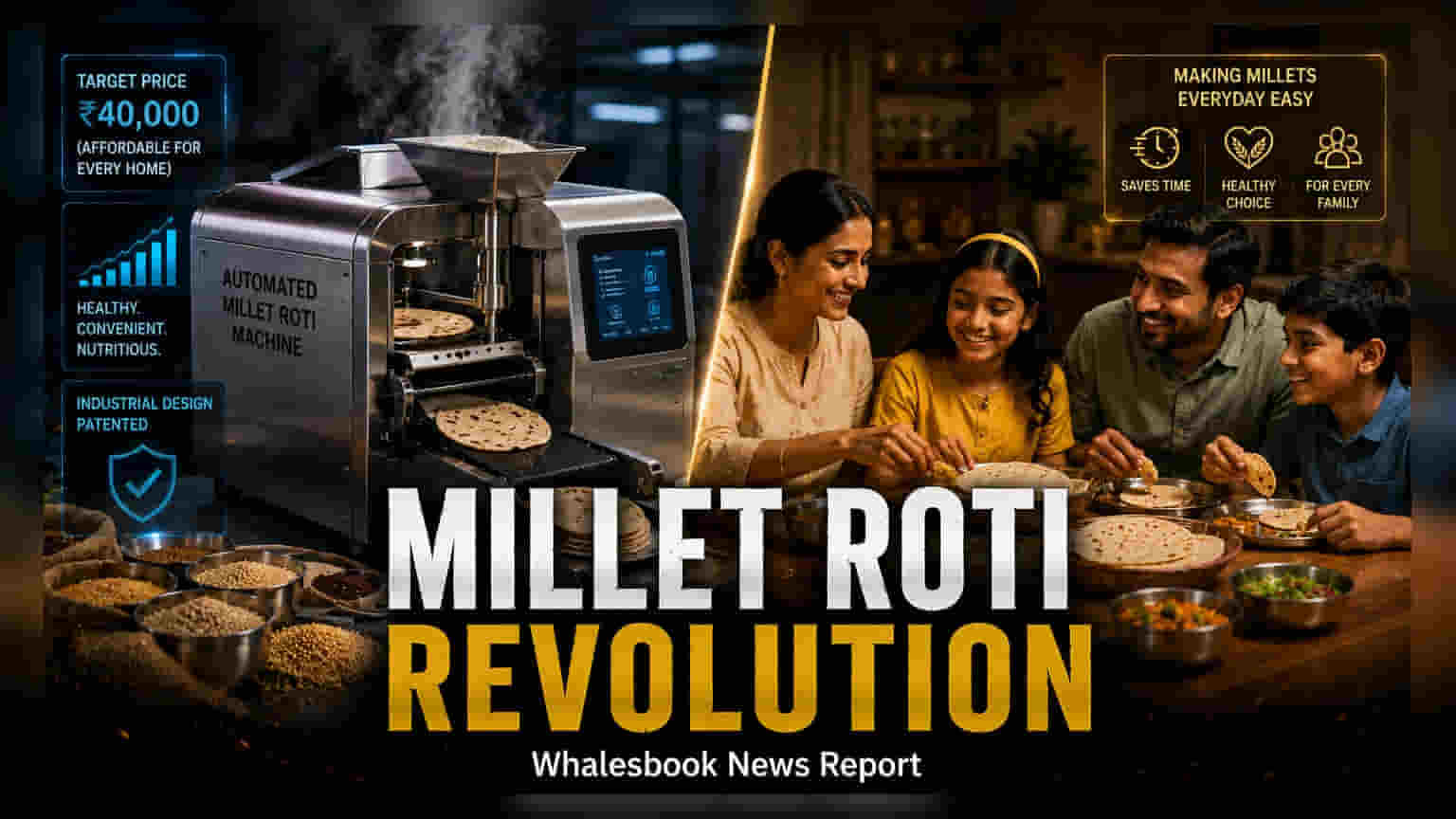
Researchers at VNRVJIET and the Indian Institute of Millets Research have secured a design patent for an automated millet roti maker. The project aims to make millet-based diets easier for households by reducing preparation time and targeting a price point significantly lower than current market alternatives.
Researchers at the VNR Vignana Jyothi Institute of Engineering & Technology (VNRVJIET) in Hyderabad, in partnership with the Indian Institute of Millets Research (IIMR), have secured an industrial design patent for a new automated machine designed to make millet rotis. This invention aims to solve a long-standing challenge in food processing: making healthy millet-based flatbreads easier and faster to prepare at home.
Preparing rotis from millet flour is traditionally labor-intensive. Because millet flour lacks the gluten content found in wheat, the dough is often harder to knead and roll, requiring significant manual effort and time. This difficulty has been a major barrier for many Indian households that want to include more nutritious millets in their daily diet but struggle with the preparation process.
To bridge this gap, the development team received a ₹3 lakh grant from NUTRI-Hub, the incubation center associated with the Indian Institute of Millets Research. The project focuses on creating a machine that simplifies the entire process, from kneading to shaping the roti, potentially making daily consumption more convenient for busy families.
One of the most important aspects of this innovation is its focus on cost. While current automated roti-making machines available in the market can cost around ₹1.5 lakh, the researchers have set an ambitious target to bring the retail price of their invention down to approximately ₹40,000. This lower price point is intended to make the technology more accessible to a broader range of consumers, which is a common challenge for new hardware in the food technology sector.
It is important for readers to note that VNRVJIET is an academic institution and not a publicly traded company. This project is currently in the research and prototyping stage. For this technology to reach household kitchens, the institution would likely need to transition the invention from a lab-based prototype to a commercial product. This process typically involves securing manufacturing partners, licensing the technology to private firms, or setting up a dedicated business entity.
While the patent is a strong step forward, moving from a successful prototype to a mass-market product carries common business risks. These include the difficulty of scaling hardware production while keeping costs low, ensuring consistent machine performance across different batches of millet flour, and competing against existing, well-funded players in the kitchen appliance industry. The next steps for the project will likely involve testing the machine’s reliability in real-world conditions and finding a commercial partner to handle large-scale manufacturing and distribution.