

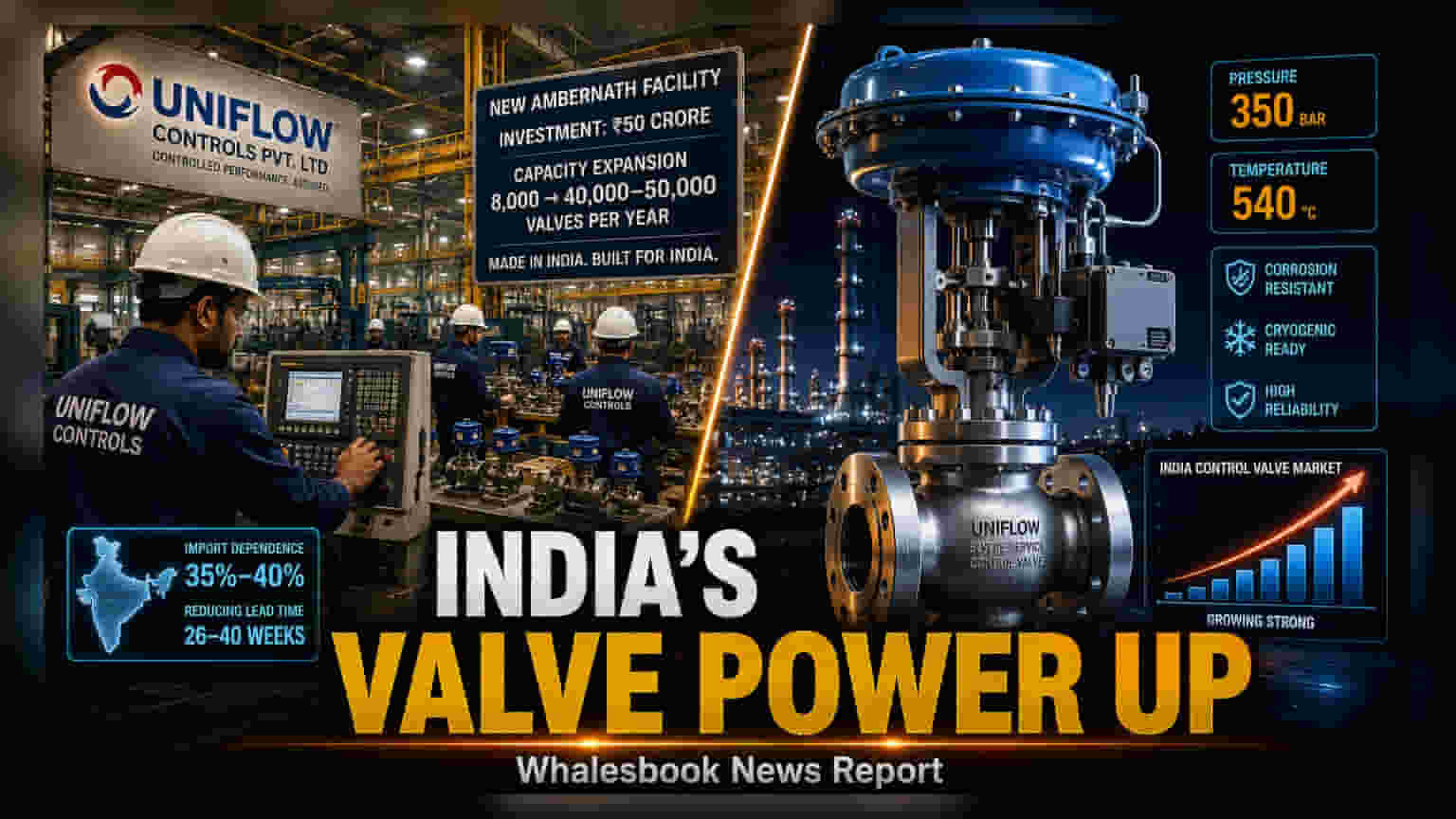
Mumbai-based Uniflow Controls is investing ₹50 crore to expand its valve manufacturing capacity fivefold, targeting sectors like LNG and nuclear energy. The expansion aims to reduce reliance on long-lead imports. Please note that Uniflow Controls is a private company and is not listed on public stock exchanges.
Uniflow Controls Pvt Ltd is setting up a new facility in Ambernath, Maharashtra, with an investment of ₹50 crore to increase its annual control-valve production capacity from 8,000 to between 40,000 and 50,000 units. This fivefold expansion aims to address a critical gap in the Indian industrial landscape: the heavy dependence on imported valves for high-precision projects.
Targeting Import Substitution
Currently, the Indian market for severe-service control valves—used in harsh environments like refineries, power plants, and petrochemical units—relies on imports for approximately 35% to 40% of its requirements. These imported components often come with long procurement lead times, ranging from 26 to 40 weeks. By increasing domestic manufacturing capacity, the company aims to help local industries reduce these wait times, which can often stall the commissioning of new infrastructure projects.
Industry participants often face difficulties when critical equipment is delayed by global supply chain disruptions. By localizing production of these high-pressure, corrosion-resistant, and cryogenic valves, Uniflow intends to provide Indian operators in the refining, petrochemical, and power sectors with faster access to parts and engineering support.
Strategic Shift to High-Tech Sectors
The new facility is designed to meet the strict technical standards required for the LNG and nuclear energy sectors. These industries demand equipment that can operate under extreme temperatures and pressures without failure. To achieve this, the company is incorporating Industry 4.0 technologies into the new plant, including AI-enabled maintenance systems and automated storage. This move represents a strategic attempt to move up the value chain, shifting from standard industrial valves to more complex, higher-specification products.
Risks and Execution Challenges
While the expansion is significant, scaling manufacturing capacity fivefold carries inherent operational risks. Successfully entering the nuclear and LNG segments will require Uniflow to obtain rigorous certifications and prove the reliability of its products compared to established global suppliers. Investors and industry observers will be watching to see if the company can maintain consistent quality control while managing the massive increase in production volume.
Additionally, the company will face stiff competition from both established domestic manufacturers and global players who already hold deep relationships with India's large public and private sector energy companies. The success of this project will depend heavily on the company's ability to execute its production timeline, secure the necessary technical certifications for high-end applications, and successfully displace long-standing import arrangements.