 Whalesbook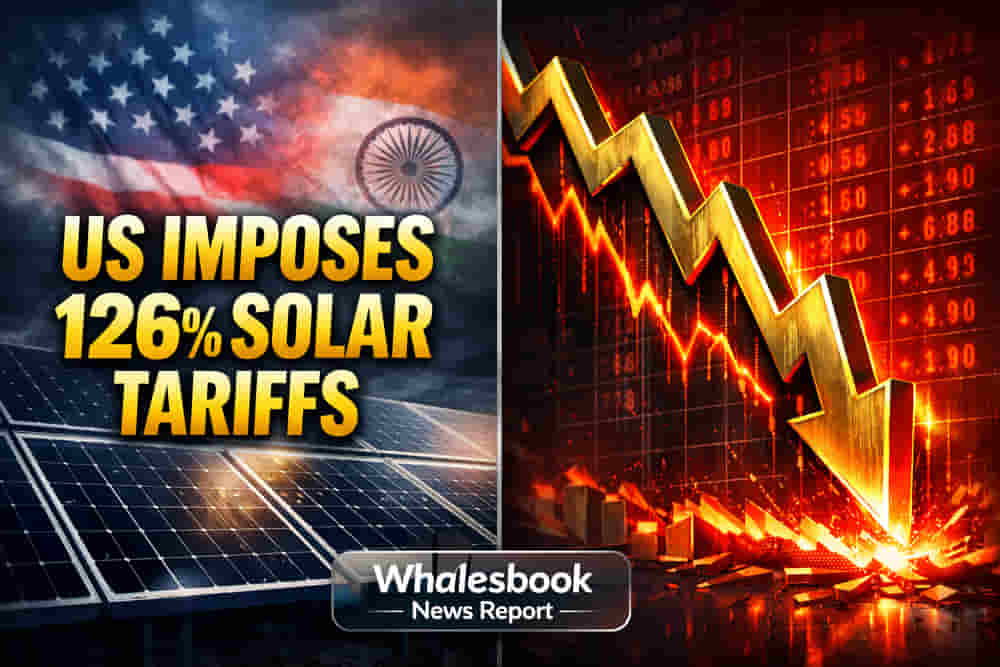


1. THE SEAMLESS LINK (Flow Rule):
The reverberations of the U.S. Commerce Department's preliminary countervailing duties on Indian solar imports are creating significant turbulence for the nation's renewable energy sector. The steep tariff imposition, designed to offset alleged unfair government subsidies, has immediately translated into substantial market value erosion for key Indian solar firms, signaling a critical juncture for the industry's export-driven growth model.
2. THE STRUCTURE (The 'Smart Investor' Analysis):
The Core Catalyst: Tariffs and Trade Enforcement
The U.S. Commerce Department has levied preliminary countervailing duties averaging 125.87% on solar cells and panels originating from India [22, 26]. This aggressive measure stems from a trade case initiated by the Alliance for American Solar Manufacturing and Trade, a coalition including U.S.-based First Solar and South Korea's Hanwha Qcells [11, 26]. The department found that Indian manufacturers benefited from unfair government subsidies, allowing them to export products at artificially low prices, thereby harming domestic U.S. producers [15]. This decision follows similar actions against solar imports from Indonesia and Laos, with preliminary duties set at 104.38% and 80.67% respectively [22, 26]. The total value of these imports from India, Indonesia, and Laos was approximately $4.5 billion last year, representing nearly two-thirds of U.S. solar imports in 2025 [26]. A subsequent determination next month will address potential anti-dumping duties related to sales below production costs [11].
The Analytical Deep Dive
The Competitive Fallout: The immediate market reaction saw significant stock declines. Waaree Energies shares plummeted by up to 14.6%, while Premier Energies saw over 12% shaved off its market value. Vikram Solar, Waaree Renewable Technologies, Solex Energy, and Saatvik Green Energy also experienced notable drops, though losses were uneven. Borosil Renewables saw a more modest decline. Notably, Servotech Renewable Power System traded marginally higher, and Sterling and Wilson Renewable Energy saw mild losses, suggesting selective rather than sector-wide panic. This differential impact underscores varied exposure to the U.S. market and company-specific resilience. Globally, First Solar, a key petitioner, is well-positioned with its U.S.-based manufacturing and thin-film technology, benefiting from trade policies like the Foreign Entity of Concern (FEOC) restrictions [19]. In contrast, Chinese giants like Longi and JinkoSolar, despite facing market adjustments and price pressures, maintain immense scale and cost advantages, with Longi's production cost per watt at approximately $0.22 compared to First Solar's $0.27 [30]. Indian manufacturers, while possessing labor cost advantages, have historically exported modules at higher prices than Chinese or Malaysian counterparts, making them vulnerable to escalated tariffs [47].
Historical and Macro Context: This event is not an isolated trade dispute; it's part of a broader global trend toward supply chain regionalization and protectionism within the solar industry [32]. India's solar exports to the U.S. surged significantly between FY2022 and FY2024, driven by the "China Plus One" strategy and the allure of premium pricing in developed markets [14]. This growth also highlighted a degree of reliance on the U.S. market, which accounted for a substantial portion of these exports [14]. The global solar market is entering a phase of adjustment in 2026, with stabilizing installation growth and increasing emphasis on system integration, rather than just volume expansion [40]. India itself is a major solar market with a rapidly growing renewable energy capacity, aiming for 100 GW of solar module manufacturing by 2030 [3, 21]. However, increased protectionist barriers are compelling global manufacturers to fragment supply chains into regional hubs [32].
Analyst View and Strategic Response: Analysts note that the high duty rates will likely render the U.S. market largely inaccessible for Indian solar panel manufacturers in the short term [24]. This forces a critical strategic pivot. Some Indian firms, including Waaree Energies and Vikram Solar, are already planning to establish manufacturing facilities in the U.S., leveraging incentives from the Inflation Reduction Act (IRA) to build capacity locally [14]. This strategy of "building where you sell" aims to circumvent tariffs. Concurrently, India's solar export strategy is increasingly looking towards diversifying into emerging markets in Africa and West Asia, seeking new avenues amidst geopolitical shifts and trade tensions [21].
⚠️ THE FORENSIC BEAR CASE
Export Dependency and Margin Squeeze: The immediate and most pressing risk is the severe curtailment of access to the lucrative U.S. market, which has been a significant growth driver and premium pricing opportunity for Indian solar exporters [14, 24]. This forces a strategic shift towards markets like Africa and West Asia, which may offer lower margins or present different competitive challenges, such as navigating the entrenched dominance of Chinese manufacturers [21].
Competitive Disadvantage: Despite cost advantages over some Western producers, Indian manufacturers face a significant competitive gap against Chinese counterparts like Longi and JinkoSolar, which benefit from immense economies of scale and lower production costs [30, 47]. The current duties, while aimed at leveling the playing field, could also lead to increased costs for U.S. consumers and developers reliant on inexpensive imported panels [24].
Geopolitical Escalation Risk: The imposition of substantial duties could escalate trade tensions between India and the U.S., potentially impacting broader economic relations. This follows a period where the U.S. administration has shown a willingness to use trade policy aggressively, including previous tariffs on solar products from Southeast Asia [11, 24].
Structural Weaknesses: While India has rapidly expanded its solar manufacturing capacity, there remains a reliance on imported cells for some production lines [29]. Furthermore, the price competitiveness of Indian modules in international markets has been a challenge compared to Chinese exports [47]. Companies like Borosil Renewables are showing negative ROCE and ROE, indicating underlying operational efficiency concerns [41]. Servotech Renewable Power System, while growing, trades at a high P/E ratio (51.96-63.31), suggesting high market expectations that could be threatened by external shocks [27, 39].
3. THE FUTURE OUTLOOK:
The U.S. countervailing duties mark a significant inflection point for India's solar export ambitions. The industry must now navigate a complex global trade environment, balancing the need to establish domestic U.S. production capabilities with the imperative to aggressively diversify into new international markets. This strategic recalibration will define the sector's trajectory, shifting focus from mere volume expansion to sophisticated market access and competitive positioning amidst evolving geopolitical and trade dynamics. The long-term viability for Indian solar manufacturers will hinge on their agility in adapting to these new trade realities and reinforcing their global value chain integration.