

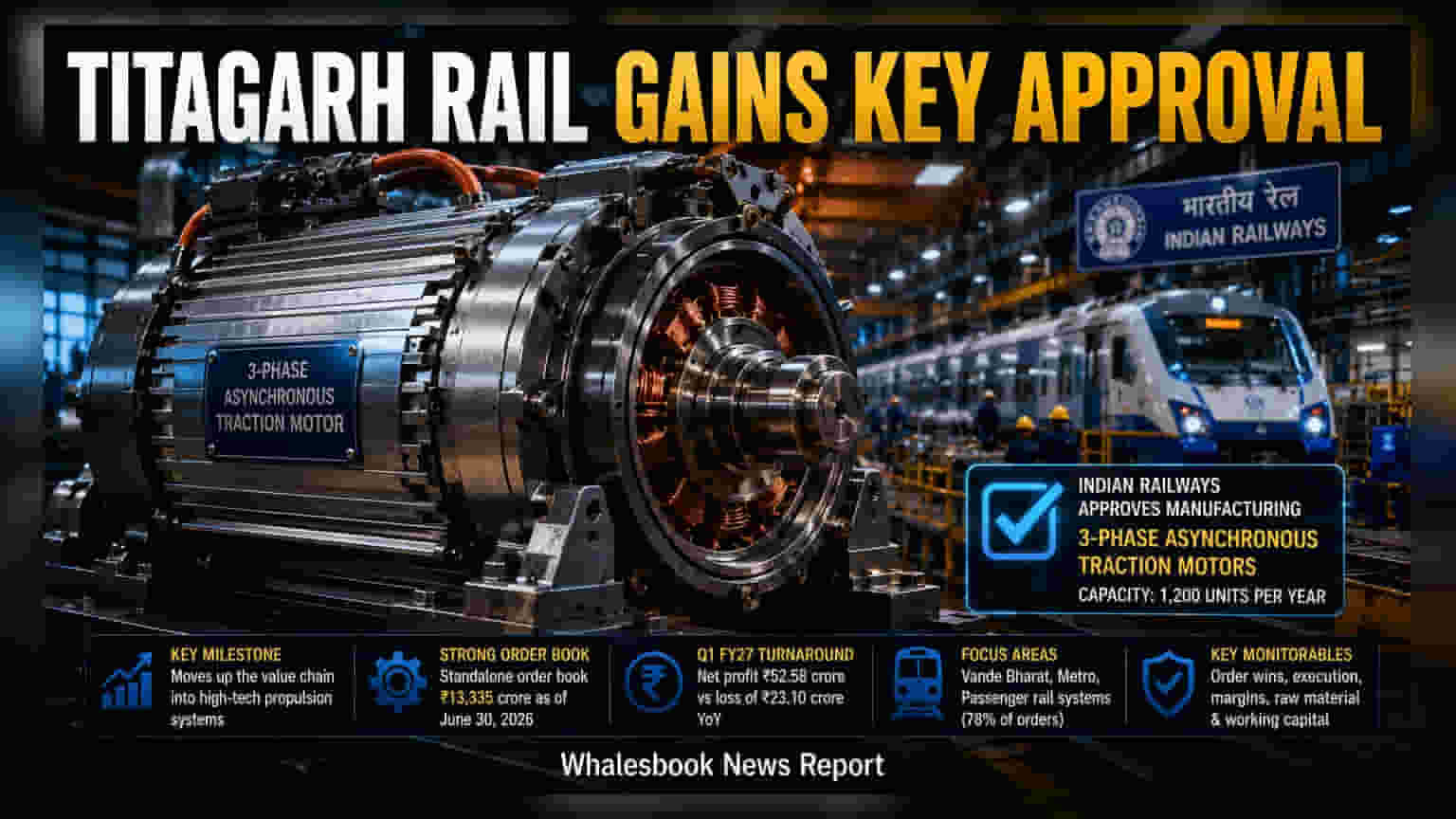
Titagarh Rail Systems has secured official approval from Indian Railways to manufacture its own traction motors. This move supports the company's shift toward high-margin propulsion systems and allows it to produce key components in-house. Investors will monitor how this integration impacts upcoming tender wins and operating margins.
Titagarh Rail Systems (TRSL) has cleared a key hurdle in its mission to become a technology-focused engineering firm. On August 19, 2026, the company received official approval from Indian Railways to manufacture 3-phase asynchronous traction motors, a critical component for modern locomotives. This validation is a significant step in the company's strategy to move up the value chain by producing complex propulsion technology rather than just manufacturing wagon bodies.
The traction motor is effectively the heart of an electric train, driving its movement. Historically, many wagon manufacturers relied on importing these components or buying them from external vendors. By gaining the ability to manufacture these in-house with an authorized annual capacity of 1,200 units, the company aims to reduce its reliance on external suppliers. This vertical integration is designed to improve operating margins by capturing a larger portion of the value chain, as producing core technology often yields higher profits than traditional fabrication work.
The company’s financial trajectory has shown a positive turnaround in recent quarters. In the first quarter of the 2027 fiscal year, Titagarh reported a consolidated net profit of ₹52.58 crore, a significant recovery from the loss of ₹23.10 crore recorded in the same period a year ago. A major strength remains the company's standalone order book, which stood at approximately ₹13,335 crore as of June 30, 2026. With passenger rail systems making up nearly 78% of these orders, the move toward in-house propulsion technology is timed to align with the production cycles of high-profile projects like the Vande Bharat and metro rail networks.
While this approval is a positive strategic development, it is not a direct guarantee of immediate revenue. The financial benefit will depend on the company's ability to successfully secure and execute orders under Indian Railways’ competitive tender process. Investors should note that moving into the production of high-tech electro-mechanical components involves execution risks. Scaling up production, maintaining strict quality standards, and managing exposure to raw material prices—such as copper and steel—will be essential. Additionally, the company operates in a space with stiff competition from both established multinational corporations and large domestic public sector entities like BHEL, who are also vying for the same propulsion market.
Moving forward, the key factor for investors will be the speed at which Titagarh translates this vendor status into actual order wins for its new propulsion systems. Market participants will likely track the company’s ability to manage its working capital efficiently while balancing its expansion into high-tech manufacturing, as these factors will ultimately determine the impact on its bottom line.