

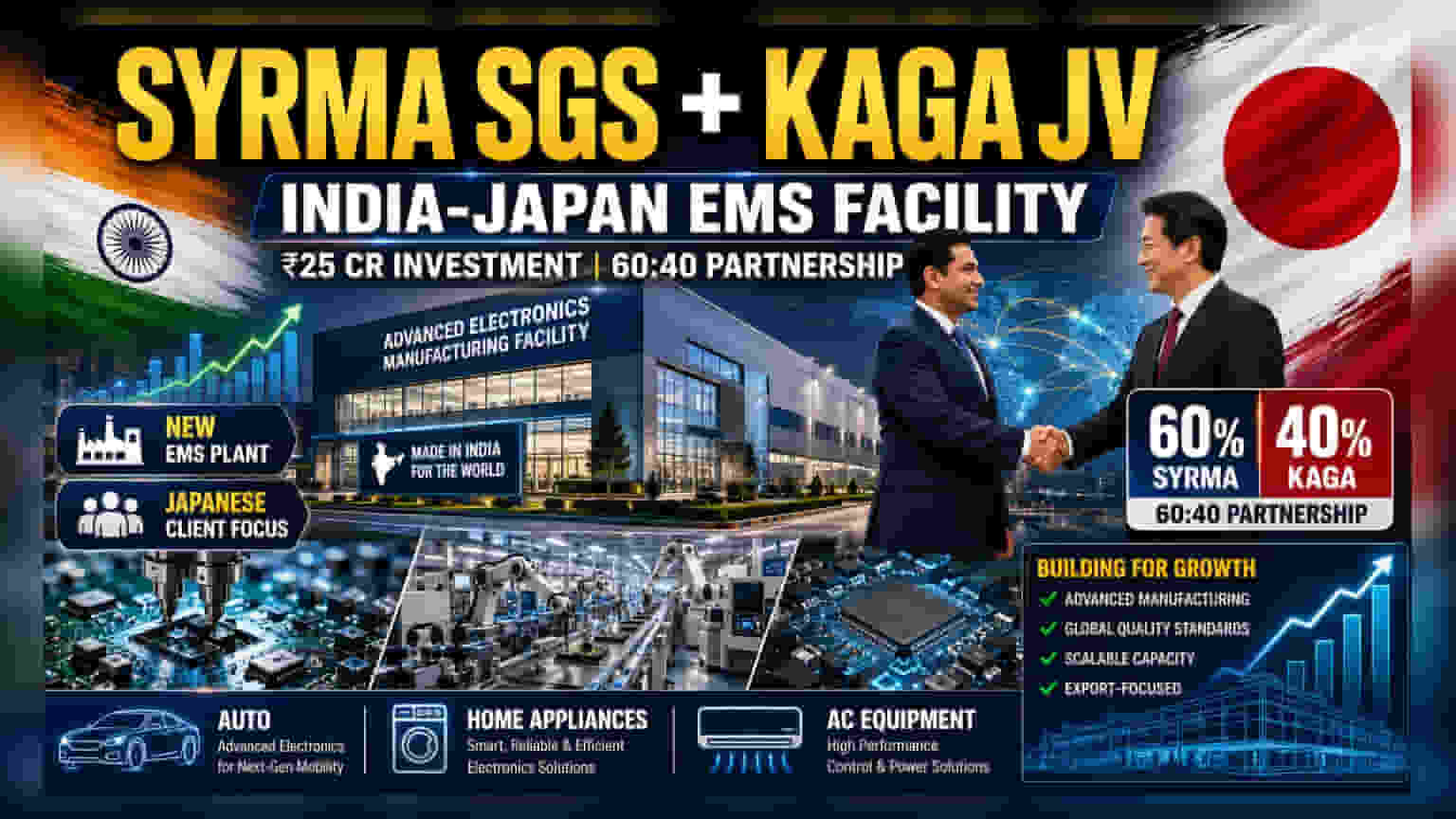
Syrma SGS Technology has formed a joint venture with Kaga Electronics India to establish an advanced electronics manufacturing facility. Syrma SGS will hold a 60% stake in the entity, with an initial equity investment of approximately ₹15 crore from the company and ₹10 crore from Kaga. This partnership targets Japanese clients and aims to strengthen Syrma’s presence in the global electronics supply chain.
What Happened
Syrma SGS Technology Limited has entered into a strategic joint venture (JV) with Kaga Electronics India, the local subsidiary of Japan-based Kaga Electronics. Under this agreement, the two companies will establish a new entity to build and operate a technologically advanced electronics manufacturing services (EMS) facility in India. Syrma SGS will hold a 60% controlling stake in the venture, with Kaga Electronics India holding the remaining 40%. The companies have committed an initial equity investment of approximately ₹25 crore, with Syrma SGS contributing about ₹15 crore and Kaga Electronics investing ₹10 crore.
Why It Matters For The Business
The joint venture is a strategic move to tap into a specific client base: Japanese companies looking to diversify their manufacturing supply chains away from traditional hubs. By partnering with Kaga Electronics, which brings extensive relationships with Japanese firms, Syrma SGS gains a direct pipeline to international business that would otherwise require significant time and competition to acquire. This aligns with Syrma’s broader strategy of moving up the value chain—shifting from basic assembly to high-complexity, high-margin manufacturing. The facility will focus on producing components for in-car devices, home appliances, and air-conditioning equipment, sectors where Kaga Electronics has deep expertise.
Financial And Strategic Context
This partnership follows a period of rapid growth for Syrma SGS. The company has been aggressively expanding its footprint, driven by the government's Production Linked Incentive (PLI) schemes and the broader 'China Plus One' global supply chain diversification trend. In recent months, the company has communicated ambitious long-term revenue targets, backed by a strong order book and increased capacity in sectors like data centers, automotive, and healthcare electronics. Management has emphasized that moving into regulated, high-margin verticals is a core part of its roadmap to scale revenue.
The Industry Reality Check
The electronics manufacturing services industry is currently benefiting from strong domestic and export demand. However, the sector is also capital-intensive and requires significant management of working capital. For a company undertaking such a joint venture, success will depend on the speed of execution and the ability to maintain quality standards that meet the specific requirements of Japanese clients. While the Indian EMS sector is growing, it remains dependent on imported components, making supply chain resilience a critical factor for operational efficiency. Risks in this sector typically include potential delays in facility commissioning, fluctuations in raw material availability, and the challenge of managing multiple high-value client projects simultaneously.
What Investors Should Track
Moving forward, investors may track the progress of the facility’s construction and its eventual commissioning date. Key monitorables will include management commentary on the ramp-up of operations, the addition of new Japanese clients to the order book, and any updates on capital expenditure requirements as the facility expands. The financial performance of the new joint venture entity, once it begins operations, will also provide a clearer picture of how this partnership impacts the company's consolidated margins and return ratios.