

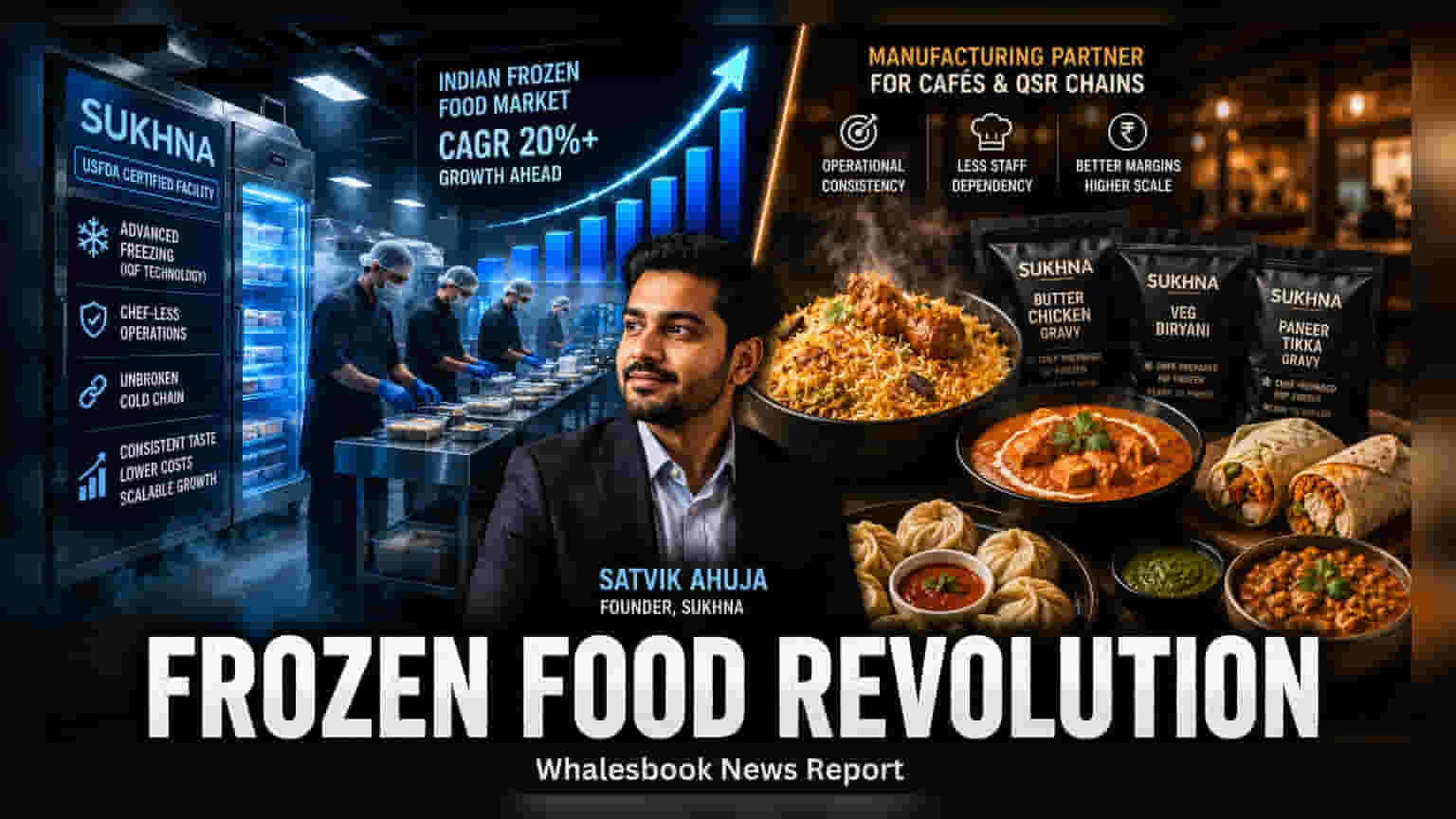
Sukhna, a private food-tech venture, provides specialized frozen manufacturing solutions to help QSRs and cafés maintain quality standards. The company aims to solve operational challenges like labor dependency and inconsistency. Please note that Sukhna is a private enterprise and is not listed on the NSE or BSE, with no public stock market data available.
Sukhna is making inroads into the B2B food services market by positioning itself as a manufacturing partner for Indian café and quick-service restaurant (QSR) chains. Founded by Satvik Ahuja, a former consultant at McKinsey & Company, the firm focuses on a 'chef-less' operational model. By utilizing advanced freezing techniques—often referred to as Individual Quick Freezing or similar methods—within its USFDA-certified facility, the company manufactures pre-prepared menu items such as gravies, biryanis, and snacks for distribution to retail outlets.
The core value proposition for clients is operational consistency. Managing multiple restaurant locations often leads to challenges in maintaining uniform taste, managing staff turnover, and controlling food costs. Sukhna aims to address these pain points by centralizing the food preparation process. Once the food is produced and frozen under controlled conditions, it is shipped to the client's outlets or dark stores through an unbroken cold chain. This model allows restaurants to reduce their reliance on skilled kitchen staff, as the final step involves only finishing the pre-prepared product rather than cooking from scratch.
For investors and market participants tracking the evolving Indian food-tech ecosystem, it is essential to clarify that Sukhna operates as a private limited company. It is not listed on the National Stock Exchange (NSE) or the Bombay Stock Exchange (BSE). Consequently, details regarding its revenue growth, profitability, debt-to-equity ratio, and cash flow are not available for public analysis. Without public filings, the company's financial health remains internal information, and it does not trade on public stock markets.
The business model faces several industry-specific risks that are common in the frozen food and supply chain sector. The most significant is the dependence on a robust and continuous cold chain. Any failure in temperature control during transport or storage can result in product spoilage, which directly impacts the bottom line and client relationships. Furthermore, the food safety and manufacturing sector in India is subject to stringent regulatory oversight. Maintaining compliance with food authority standards is a non-negotiable operational cost that requires constant monitoring.
From a competitive standpoint, Sukhna enters a space where established large-scale commissary models and captive kitchen operations are already prevalent. While the company offers a specialized B2B solution, it must compete with both in-house production capabilities of large QSR chains and other third-party food processors. The long-term scalability of the business will depend on its ability to sign large-volume contracts, maintain operational margins against rising raw material costs, and ensure consistent product quality across various geographic locations. Market observers typically track these operational KPIs to gauge the success of similar B2B food-tech providers as they scale their manufacturing footprints.