

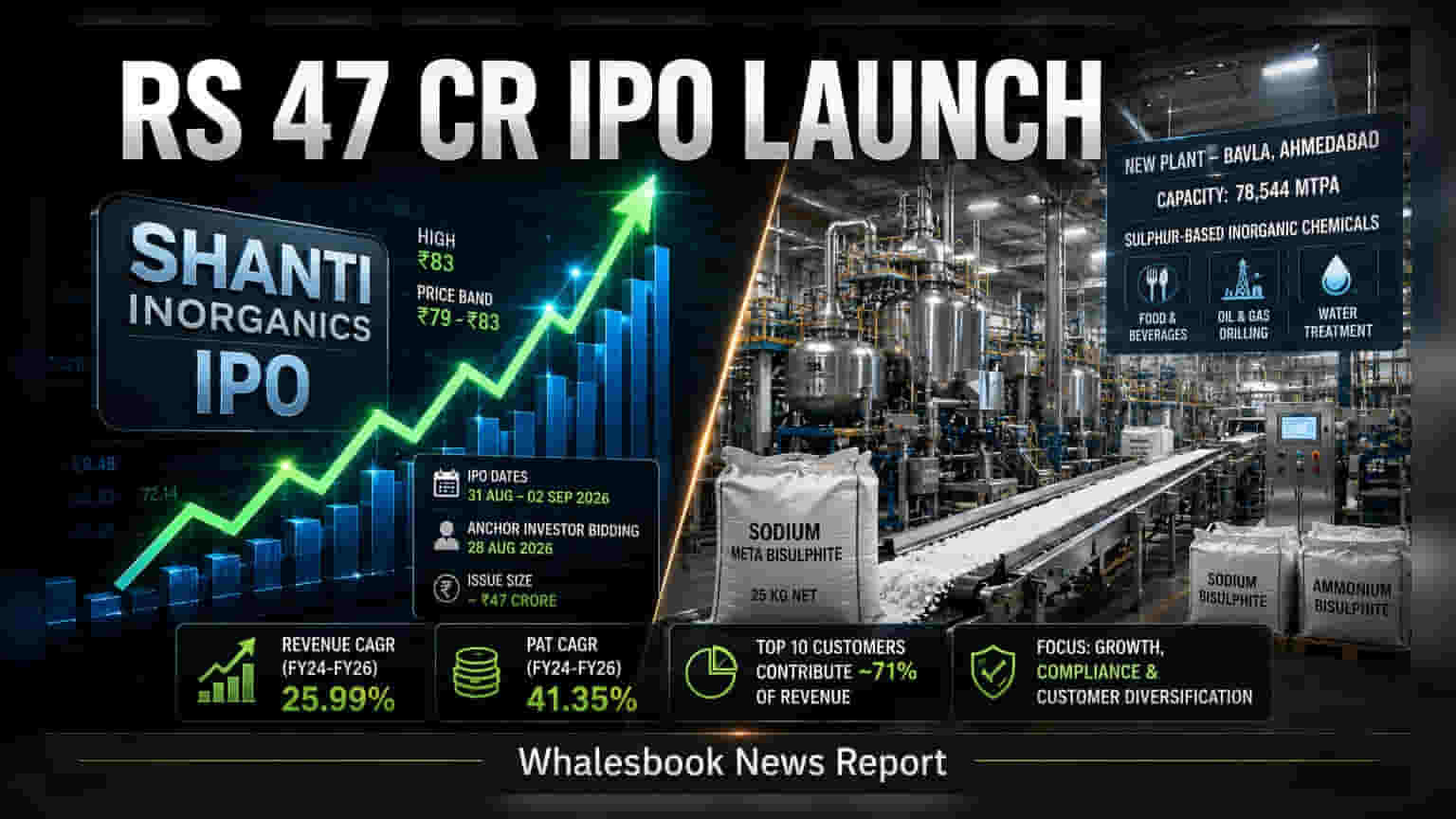
Shanti Inorganics is launching its SME IPO on August 31, 2026, to raise Rs 47 crore for a new manufacturing facility in Ahmedabad. While the company reports strong profit growth, investors should consider risks like high customer concentration and raw material price volatility.
Shanti Inorganics Limited is set to open its Initial Public Offering (IPO) on the NSE Emerge platform, aiming to raise approximately Rs 47 crore. The subscription window for the public will run from August 31, 2026, to September 2, 2026, with the anchor investor bidding scheduled for August 28. The company has set a price band of Rs 79 to Rs 83 per share for the issue.
Scaling Up Production
The primary reason for this share sale is to fund a new manufacturing plant in Bavla, Ahmedabad. This facility is planned to have a capacity of 78,544 metric tonnes per annum (MTPA). The company manufactures sulphur-based inorganic chemicals, including Sodium Meta Bisulphite, Sodium Bisulphite, and Ammonium Bisulphite. These chemicals are used by various industries, such as food and beverages, oil drilling, and water treatment. By adding this new capacity, the company aims to increase its production volume to meet demand from these sectors.
Financial Performance
The company has reported a period of rapid financial growth. Between the 2024 and 2026 financial years, its revenue grew at a compound annual growth rate (CAGR) of 25.99%, while profit after tax grew at a CAGR of 41.35%. In the 2026 financial year alone, the company recorded a revenue of Rs 71.22 crore and a net income of Rs 10.22 crore. This history of growth will be a key point for potential investors as they assess the company’s ability to manage its finances while scaling operations.
Risks to Consider
While the company is expanding, investors should also consider the specific business risks involved in its operations. A significant portion of the company’s business is concentrated among a few clients, with the top 10 customers contributing approximately 71% of its revenue. This reliance on a small group of customers means that losing any of these relationships could impact revenue.
Furthermore, the company does not have long-term contracts with many of its customers, which makes revenue predictability more challenging. The chemical manufacturing sector is also capital-intensive and subject to risks such as raw material price volatility. Since chemical production involves complex processes, the company must also manage strict environmental and safety compliance regulations. Any failure to meet these standards or significant fluctuations in the cost of raw materials could put pressure on profit margins.
Investors looking at this offering should track how effectively the company executes its new project in Bavla. The successful commissioning of this facility and the ability to maintain or expand the client base without over-relying on a few top customers will be important factors to monitor after the company begins trading.