

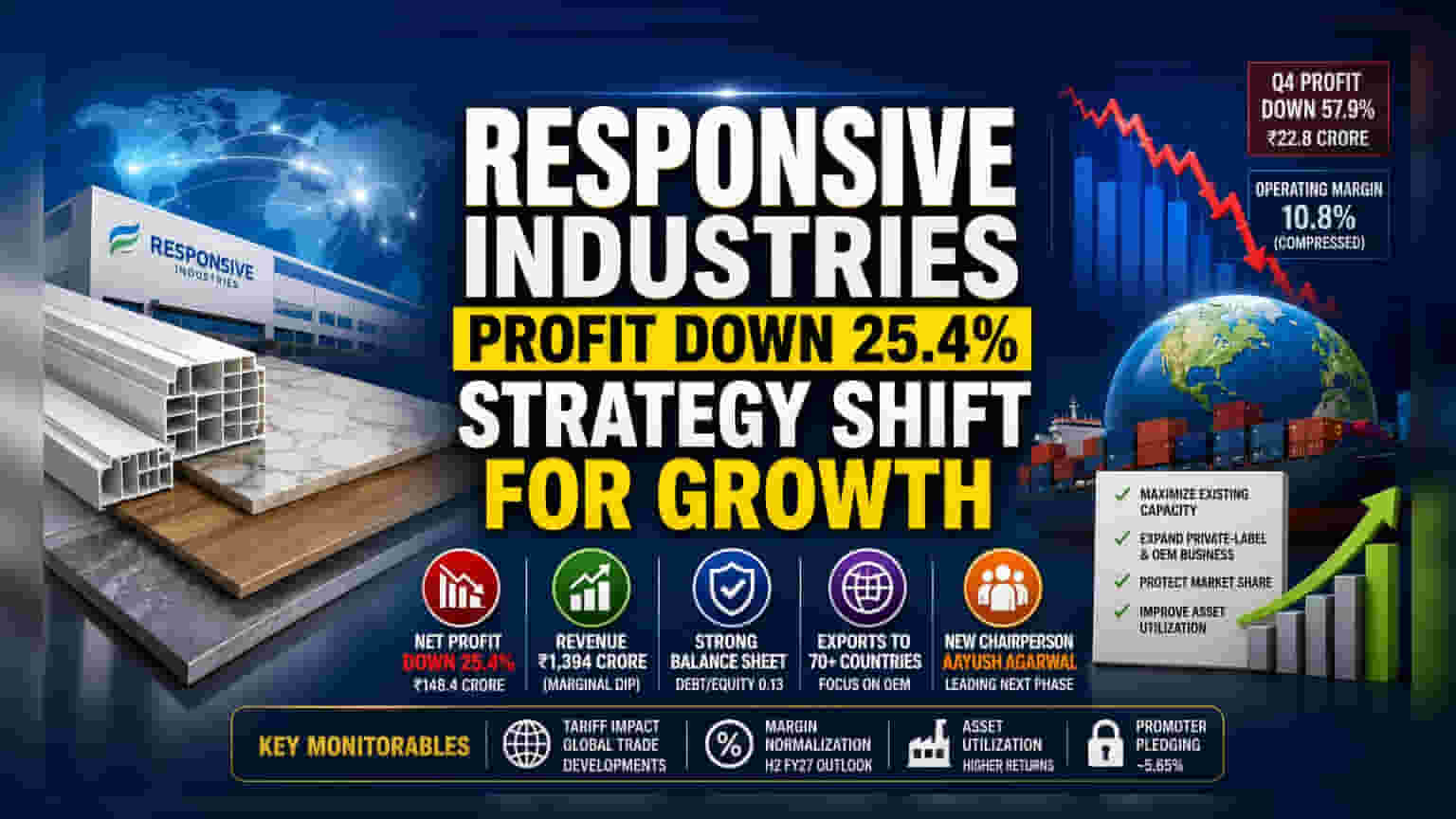
Responsive Industries reported a 25% decline in annual profit to ₹148 crore, hit by global tariff pressures and higher costs. Amid this financial dip, the company appointed Aayush Agarwal as Chairperson. The firm is now prioritizing existing factory utilization and export-led OEM partnerships to stabilize margins and support growth.
What Happened
Responsive Industries, a manufacturer of PVC-based building materials, reported a 25.4% decline in consolidated net profit for the financial year ended March 2026, totaling ₹148.4 crore compared to ₹198.9 crore in the previous year. The company’s revenue also saw a marginal dip to ₹1,394 crore. In the fourth quarter, the profit fell 57.9% year-on-year to ₹22.8 crore, as rising global import tariffs and pricing adjustments placed significant pressure on operating margins, which compressed to 10.8%.
Simultaneously, the company announced a key leadership transition, appointing Aayush Agarwal as the new Chairperson in May 2026. This change comes as the business looks to navigate a challenging global environment while shifting its strategy toward maximizing existing infrastructure rather than investing in new capacity.
The Financial Picture
Despite the recent pressure on profits, the company maintains a solid balance sheet. Reserves remain healthy at approximately ₹1,532 crore, and total borrowings have been reduced to ₹195 crore, resulting in a low debt-to-equity ratio of 0.13. This financial strength provides the company with some flexibility to absorb short-term volatility.
However, the recent margin compression highlights the impact of external factors. Management has indicated that increased U.S. import tariffs on Indian exports have necessitated pricing adjustments, affecting profitability. The challenge for the company is to prove that these margin issues are temporary, as investors are currently pricing the stock based on expectations of future growth and recovery in asset utilization.
Strategic Pivot: Exports And OEM
Responsive Industries is currently moving away from heavy capital spending on new factories. Instead, the focus has shifted to increasing the output from its existing manufacturing footprint in India and China.
A central pillar of this strategy is a push into the export market, which the company already serves in over 70 countries. By expanding its private-label and Original Equipment Manufacturer (OEM) manufacturing business, the company aims to partner with global brands to drive higher production volumes. This approach is designed to help absorb fixed costs and protect market share in the luxury vinyl and stone plastic composite flooring segments, even when domestic or international pricing environments are difficult.
Leadership Transition
The appointment of Aayush Agarwal as Chairperson signals a focus on operational evolution. With a background in business transformation and automation, his role will be to oversee the next phase of the company's growth. Investors often monitor such transitions to see if there is continuity in the strategic direction or if the company adopts new operational efficiencies.
What Investors Should Track
Going forward, the most important factor to watch is the recovery of operating margins. Investors will be looking for signs of stabilization in the second half of the 2027 fiscal year, as signaled by management. Other monitorables include:
- Tariff Impact: Continued updates on how U.S. and other global trade policies are affecting export realizations.
- Margin Normalization: Whether the shift to OEM and private-label partnerships successfully offsets the pressure from higher raw material or tariff-related costs.
- Asset Utilization: Updates on whether the move to rely on existing capacity is improving returns on capital.
- Promoter Pledging: Investors may continue to watch the status of promoter pledges, which currently stand at around 5.65%.