 Whalesbook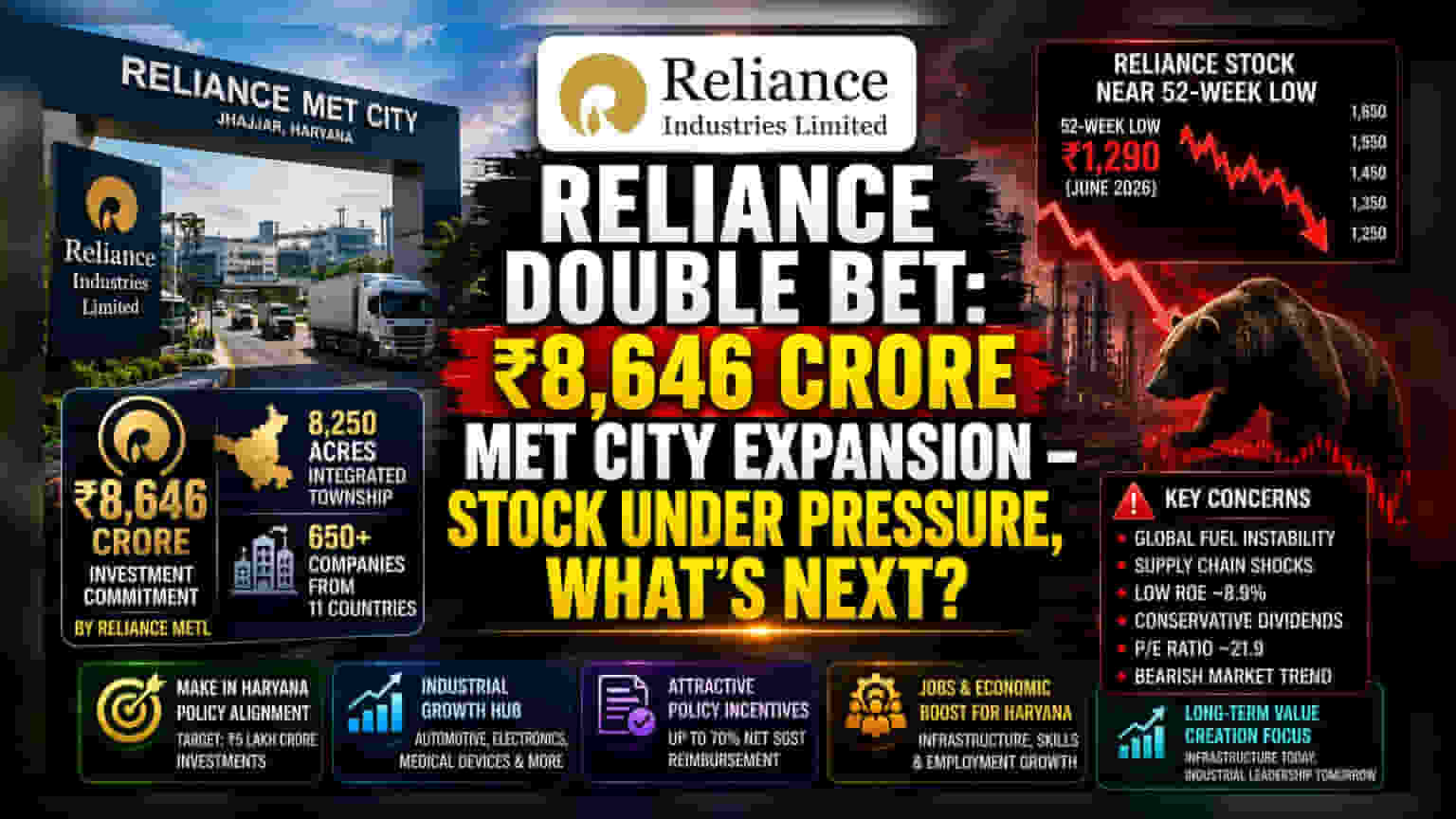


The Capital Allocation Strategy
Reliance Industries, through its subsidiary Model Economic Township Ltd (METL), has solidified a significant expansion of its Jhajjar-based 'Reliance MET City' industrial hub. The commitment of ₹8,646 crore coincides with the state government's newly launched 'Make in Haryana' industrial policy, which aims to secure ₹5 lakh crore in statewide investments. This initiative involves both direct capital expenditure by METL and the projected facility development by companies currently occupying plots within the 8,250-acre integrated township.
Industrial Expansion vs. Market Momentum
Despite the scale of the commitment, Reliance’s stock is grappling with significant bearish sentiment. As of early June 2026, the equity is hovering near its 52-week low of ₹1,290. Market participants have observed a sustained downtrend, with the stock trading below all key moving averages—5-day, 20-day, 50-day, 100-day, and 200-day. While the MET City development signals long-term infrastructure value, the immediate market reaction reflects broader sector-specific pressures, with the oil-to-telecom conglomerate underperforming major domestic indices in recent sessions.
The Forensic Bear Case
Investors remain cautious regarding the conglomerate's capital intensity. While METL hosts over 650 companies from 11 nations, the broader macroeconomic landscape presents hurdles. Global fuel instability and domestic supply chain shocks have historically impacted consumer confidence and industrial capacity utilization. Furthermore, the company’s return on equity (ROE) of approximately 8.9% and dividend payout ratios that have remained conservative over the past three years provide limited immediate upside for income-focused investors. The stock's current price-to-earnings (P/E) ratio, oscillating around 21.9, suggests that despite the underlying industrial growth, valuation remains sensitive to institutional flow and the prevailing risk-off environment in the energy sector.
Future Trajectory
Management is positioning MET City as a critical node in Haryana's ambition to become a leading manufacturing hub. With policies offering up to 70% Net SGST reimbursements and streamlined regulatory portals, the project is designed to attract high-value manufacturing in automotive, electronics, and medical devices. Whether this investment will serve as a catalyst for a structural turnaround depends largely on broader market stability and whether the company can translate these industrial infrastructure commitments into tangible margin improvements in coming quarters.