

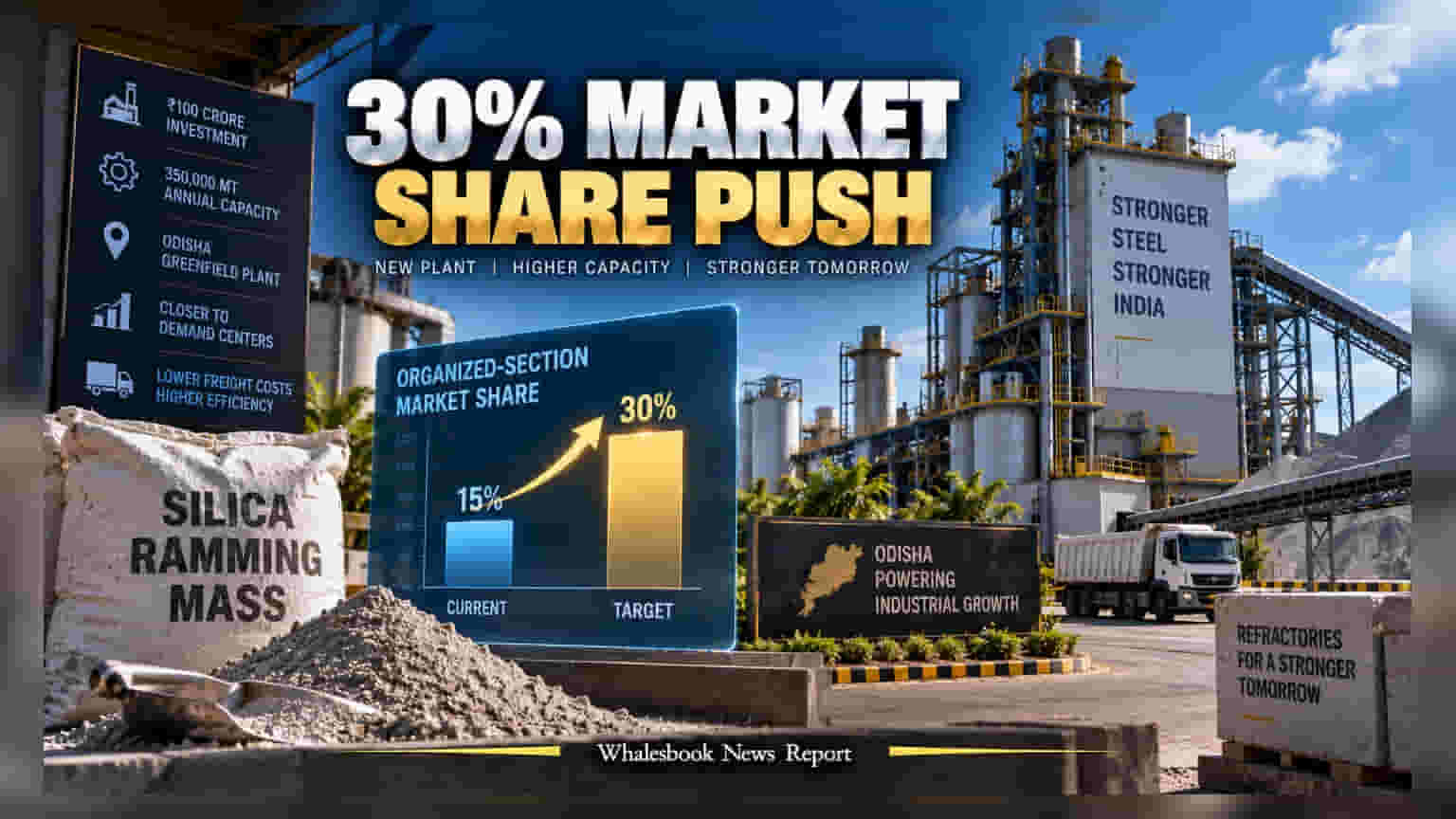
Raghav Productivity Enhancers has announced an 80:20 joint venture with TRL Krosaki to build a new ₹100 crore manufacturing plant in Odisha. The facility aims to double the company's organized market share to 30% by cutting logistics costs. Despite the expansion news, the stock declined approximately 7% on September 7, 2026.
Raghav Productivity Enhancers Limited (RPEL) has announced a strategic joint venture with TRL Krosaki Refractories to establish a greenfield production facility in Odisha. The project involves an investment of approximately ₹100 crore and is designed to manufacture silica ramming mass, a key material for the steel industry. The joint venture structure is split 80:20, with Raghav Productivity holding the majority stake.
The primary business objective behind this expansion is to improve operational efficiency by moving production closer to demand centers. Currently, a significant portion of India’s induction furnace market is concentrated in the eastern region. By shifting or expanding manufacturing capabilities to Odisha, the company aims to reduce high freight costs associated with transporting products from its existing facilities in Rajasthan. The new plant will have an annual production capacity of 350,000 metric tonnes, which is expected to support the company’s target of increasing its organized-sector market share from the current 15% to 30%.
Financial and Market Context
Raghav Productivity has maintained a strong financial profile, characterized by its status as a virtually debt-free company with healthy operating margins and return on capital employed (ROCE). Despite the positive outlook regarding capacity expansion and market share growth, the company’s share price experienced a decline of approximately 7% on September 7, 2026. This downward movement suggests that investors may be weighing the potential impact of high valuation multiples against the benefits of the new capacity addition.
Operational Risks and Monitorables
While the project aligns with long-term growth objectives, investors may want to monitor several execution-related factors. The company has laid out a 12-month timeline for commissioning the plant, followed by a two-and-a-half-year period to reach full capacity utilization. Delays in construction or challenges in ramping up production outside of the company’s home region of Rajasthan could impact short-term financial performance. Furthermore, because the company trades at premium valuation multiples, any deviation from the projected growth trajectory or a slowdown in the steel furnace sector could influence investor sentiment. Tracking the progress of the Odisha facility, the commissioning schedule, and the stability of raw material supply through the new partnership will be important steps for shareholders in the coming quarters.