

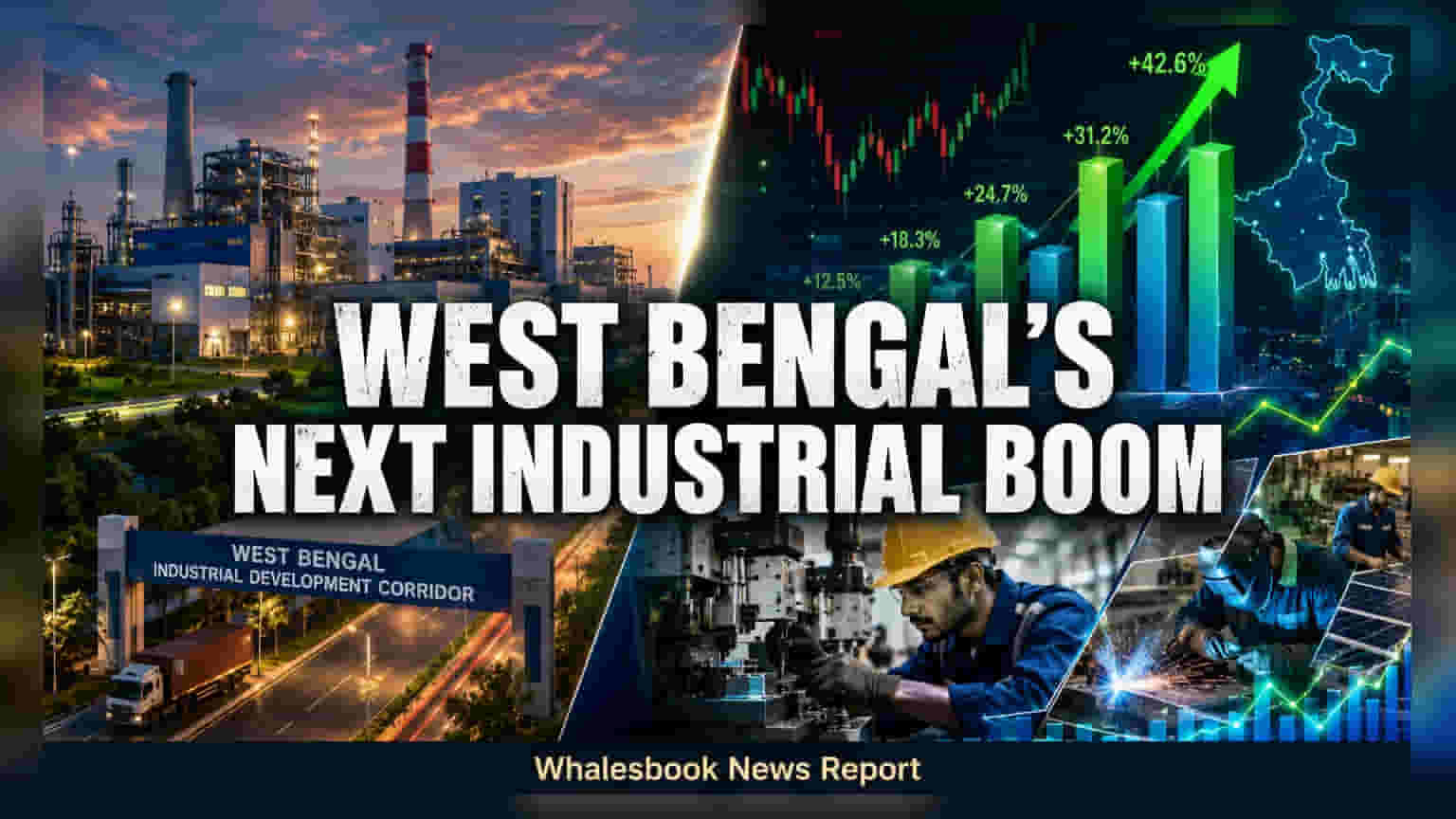
A new PHDCCI report identifies key sectors for West Bengal's industrial expansion, stressing the need for 5,000–10,000 acres of investment-ready land. The analysis highlights opportunities in precision engineering, electronics, and renewable energy, while noting challenges like skill gaps and fiscal debt.
The PHD Chamber of Commerce and Industry (PHDCCI) has released a new study titled 'West Bengal: Mapping Agriculture and Industrial Investment Opportunities,' detailing a strategic roadmap for the state's industrial future. The report provides a blueprint for leveraging the state’s human and natural resources to create integrated manufacturing and export hubs, aiming to accelerate the state's economic progress.
Economic Foundations and Growth Potential
The state has seen its Gross State Domestic Product (GSDP) rise from ₹6.10 lakh crore in FY15-16 to ₹9.42 lakh crore by FY24-25, representing a growth rate of approximately 4.95% per year. Currently, the service sector remains the largest contributor, accounting for roughly 42% of the Gross State Value Added (GSVA), while the industrial sector contributes about 23%. The report suggests that there is substantial opportunity to expand the industrial base by aligning the state's existing service and knowledge capabilities with manufacturing activities.
To support this shift, the PHDCCI highlights the importance of infrastructure. As of April 2026, central government investments in the state, covering projects across railways, roads, ports, and power, total approximately ₹1.47 lakh crore. The report suggests these investments are vital for the development of an industrial belt connecting Kolkata, Haldia, Durgapur, Kharagpur, and Howrah.
Industrial Land and Sectoral Strategy
A central focus of the report is the availability of industrial land. To successfully attract large-scale investment, the study emphasizes that West Bengal needs a reliable supply of 5,000–10,000 acres of investment-ready land. It proposes a 'Mega Industrial Parcel Programme' to identify and prepare large, clear land parcels that are ready for immediate development. This land readiness is often a critical factor for companies deciding where to set up new factories.
The report points to several promising sectors, including precision engineering, electronics, automotive components, food processing, and renewable energy. It specifically envisions parts of the state becoming an integrated electronics and hardware hub. For the renewable energy sector, it sees potential in manufacturing components like solar modules and batteries, which could cater to both domestic and international demand.
Challenges to Monitor
While the report is optimistic about growth, it also highlights structural challenges that investors and policymakers need to manage. One major issue identified is the skills-industry mismatch, where technical training does not always align with the current needs of the manufacturing sector. Addressing this is seen as necessary to boost employment for the state's large youth population.
Additionally, from a broader economic perspective, the state faces challenges regarding fiscal sustainability, with high outstanding debt levels that require consistent economic growth to manage effectively. The historical experience of policy transitions also underscores the importance of long-term institutional stability to give businesses confidence in their investments. For investors, the speed at which the state can secure and develop contiguous land parcels will be a key factor to watch, as this will determine the success of the proposed industrial corridors.