

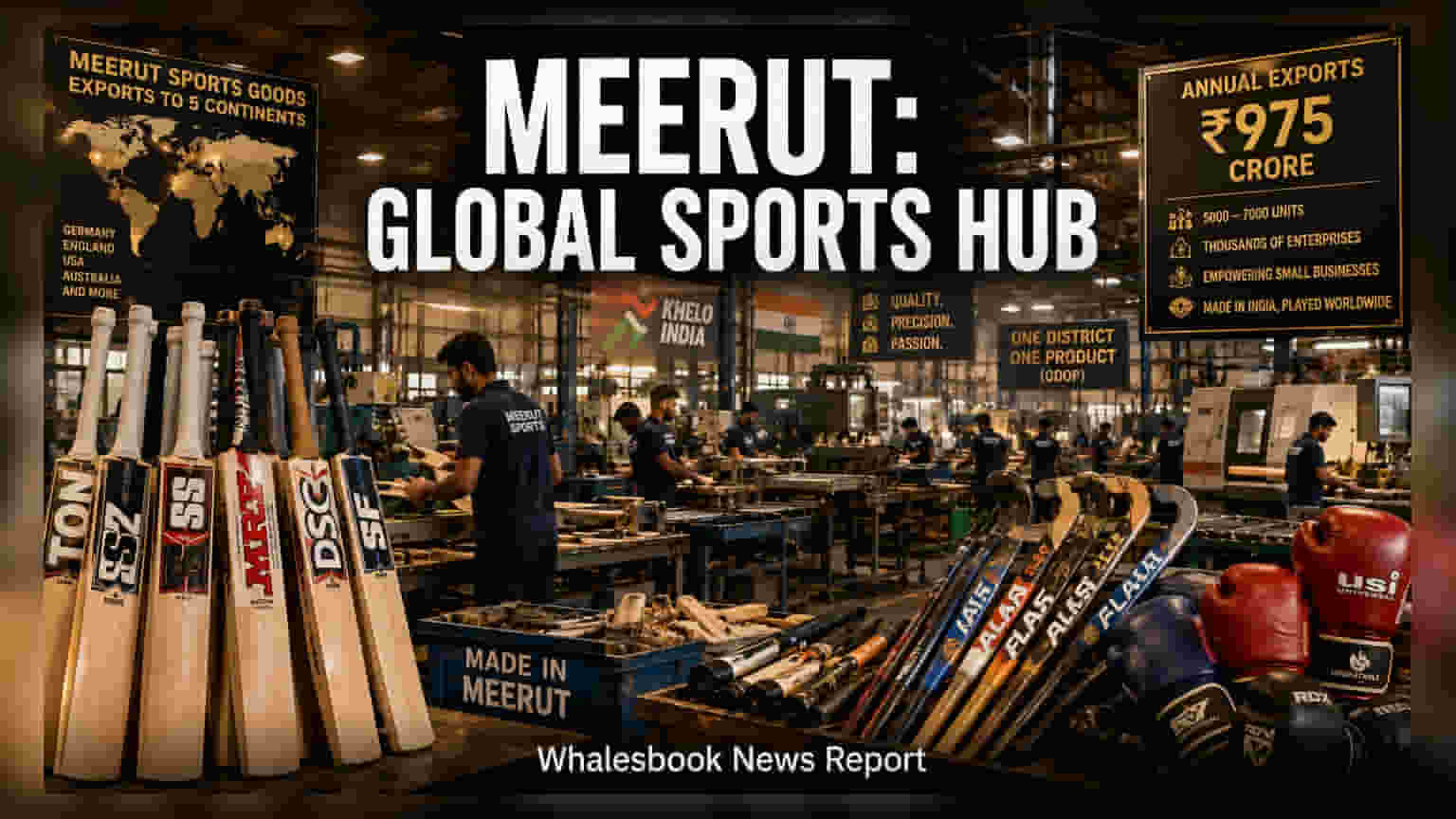
Meerut has grown into a major sports manufacturing hub, reaching Rs 975 crore in annual exports across its thousands of small-scale units. Driven by government schemes like ODOP and Khelo India, the cluster has diversified beyond cricket equipment into global categories like gym and boxing gear. This industry-wide growth highlights a shift in manufacturing, though the sector remains highly fragmented with no single listed entity dominating the space.
Meerut has established itself as a significant manufacturing powerhouse, with its sports goods sector recording annual exports of approximately Rs 975 crore. This growth marks a transformation for the city, which has long been known for cricket equipment but has now diversified into a broad range of products including hockey sticks, boxing gloves, and commercial gym equipment. Products from the region are now reaching markets across five continents, including major destinations like Germany, England, the United States, and Australia.
It is important for market observers to note that this is an industrial cluster consisting of roughly 5,000 to 7,000 small and medium-sized units, not a single corporation. There is no individual "Meerut Sports" company listed on the national stock exchanges. The sector is composed of thousands of independent enterprises, ranging from small family-run workshops to medium-sized manufacturing firms. Consequently, the export figures represent the combined output of this fragmented industrial ecosystem rather than the performance of a single business entity.
The scaling of this industry is heavily influenced by government policy. The Uttar Pradesh government’s 'One District One Product' (ODOP) scheme has provided a framework for these small units to professionalize their operations. Complementing this, central initiatives like 'Khelo India' have helped boost domestic demand, providing manufacturers with the stability needed to diversify their product portfolios. Government support, including interest-free loans and subsidies for machinery, has enabled many of these units to upgrade their production lines to meet international quality standards.
Despite this growth, the industry faces structural challenges that form its risk profile. The primary hurdle is extreme fragmentation. Because the sector is made up of thousands of small units, it is difficult for any individual firm to invest heavily in large-scale research, development, or global brand marketing. Additionally, being an inland manufacturing hub presents logistical disadvantages; producers in Meerut often face higher transportation costs and longer delivery times to reach ports compared to manufacturers based in coastal regions.
The sector also contends with intense pressure from large-scale, highly mechanized international competitors who can often produce goods at higher volumes and lower costs. The continued success of the Meerut cluster will depend on whether these small enterprises can successfully transition from manual-intensive processes to more automated, efficient production methods to remain price-competitive. For those tracking the industrial development of the region, the key monitorables include the sustainability of government support, the industry’s ability to improve logistics efficiency, and the progress made in scaling operations to better compete with global players.