

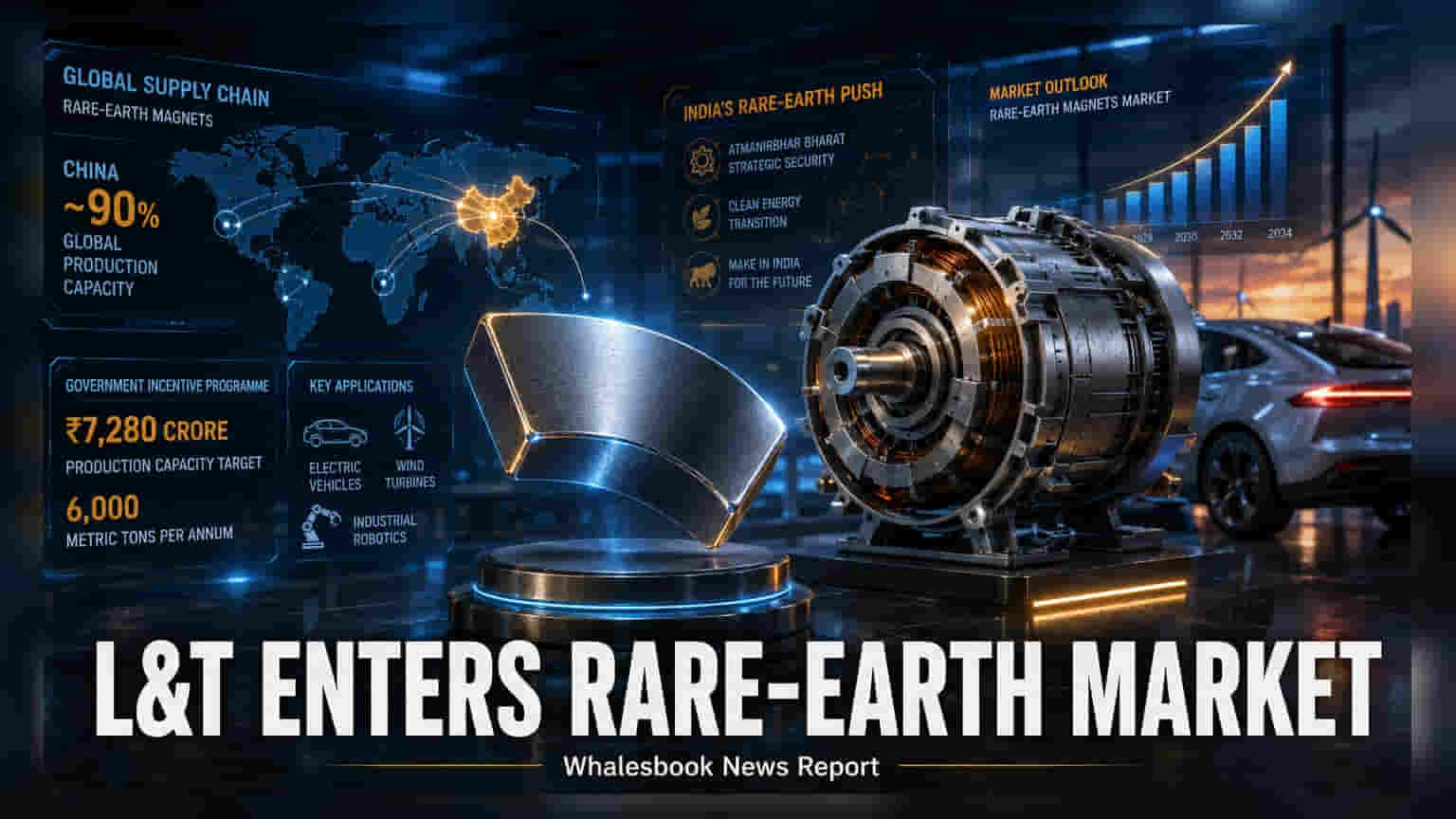
Larsen & Toubro has joined the race for a government incentive program to manufacture rare-earth magnets, targeting an annual capacity of 6,000 metric tons. This move aims to build a local supply chain for electric vehicles and wind energy, challenging China's 90% market dominance. Investors will monitor the competitive bidding process and potential technology partnerships.
Larsen & Toubro is moving to manufacture rare-earth magnets, submitting a bid for a government incentive programme valued at ₹7,280 crore. This initiative marks a strategic shift for the industrial giant, moving beyond its core construction and engineering roots to produce high-precision components essential for modern infrastructure and clean energy.
Rare-earth magnets are critical parts used in the motors of electric vehicles, wind turbines, and industrial robotics. Currently, China controls nearly 90% of the global production capacity for these materials. By localising this production, L&T aims to build a secure supply chain, reducing dependence on international markets that have faced supply restrictions in recent years. The government’s programme seeks to establish a domestic production capacity of 6,000 metric tons per annum to support these growing sectors.
Strategic Diversification and EV Ambitions
For L&T, this move is a form of vertical integration. The company is already active in the electric vehicle space through the development of traction motors, a partnership it has pursued with Israel-based EVR Motors. By manufacturing its own magnets, the company could theoretically strengthen its position in the EV supply chain, moving from being a system integrator to a component manufacturer.
However, entering this space involves significant challenges. The company is competing against 15 other bidders for the government support package, which creates an intense competitive environment. One notable participant in this space is a consortium involving Japan-based Proterial Ltd., indicating that established international players are also vying for a share of the Indian market.
Operational Risks and Market Challenges
Investors should note that this is not a simple expansion. Producing high-grade rare-earth magnets requires sophisticated technology and significant capital investment. The company will need to secure reliable technology partners to meet the strict quality standards required for EV motors and industrial equipment.
Furthermore, competing with the established scale and lower costs of the Chinese manufacturing ecosystem remains a long-term challenge. Profitability in this segment will depend on the company's ability to maintain a cost-competitive production process while managing the technical complexity of the manufacturing setup.
The next important update for shareholders will be the outcome of the bidding process. If L&T is selected, the market will likely track the capital spending required for the project, the timeline for commissioning the facility, and any updates on technology partnerships that will be needed to bring this specialized production to scale.