

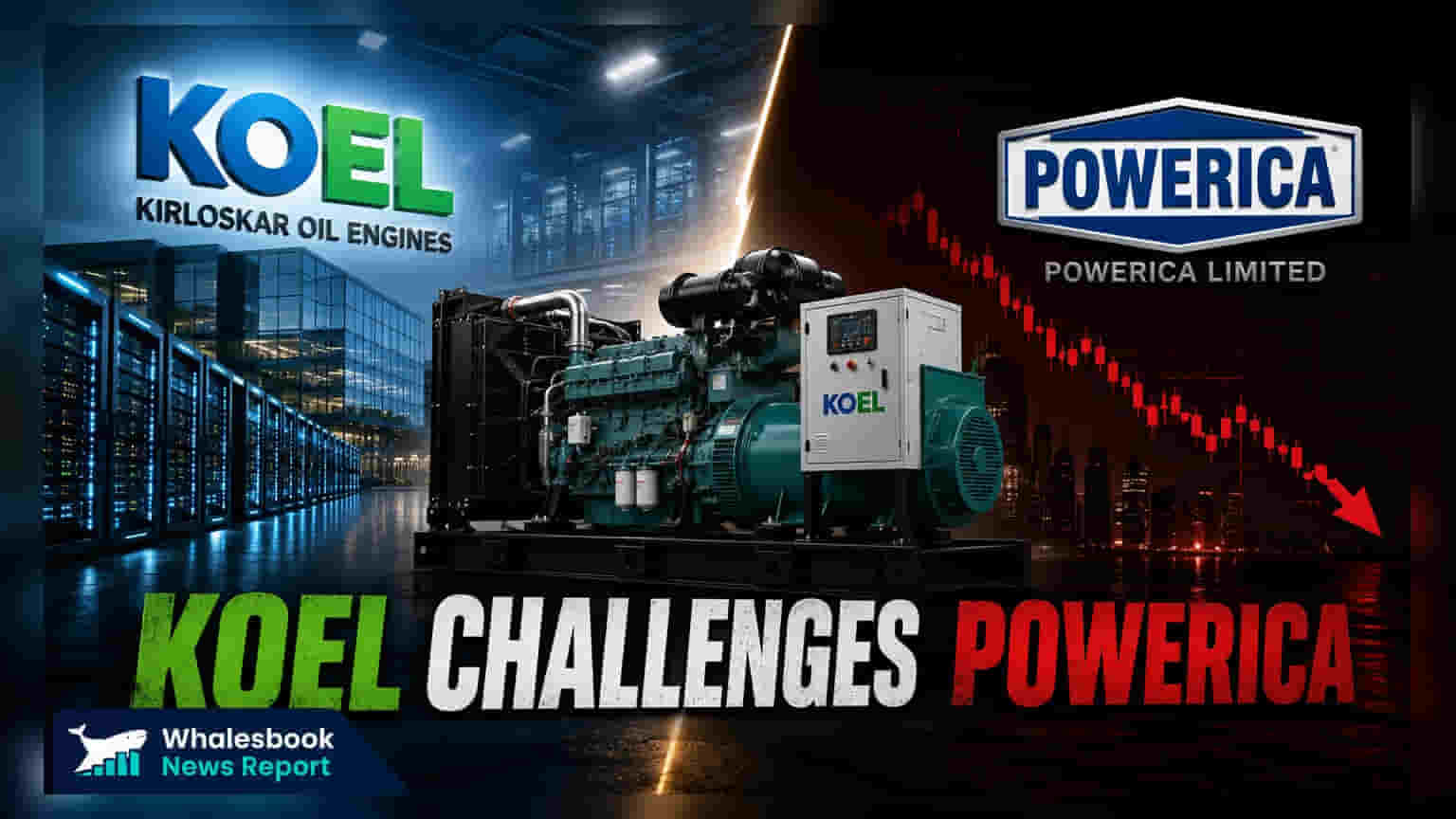
Kirloskar Oil Engines (KOEL) has moved into the high-horsepower data center generator market, securing a 192MW order from HyperNext. This expansion challenges the current market leadership of Cummins India and impacts competitive dynamics for OEMs like Powerica. Investors are focusing on how this shift affects market share and margins in the growing digital infrastructure sector.
What Happened
Kirloskar Oil Engines Limited (KOEL) has officially entered the high-horsepower (HHP) generator set market, specifically targeting the data center sector. The company secured a 192MW order from hyperscaler HyperNext. This move marks a strategic shift for KOEL, as it looks to capture a larger share of India’s rapidly growing digital infrastructure power needs. Historically, this high-horsepower segment has been dominated by Cummins India, which holds a significant majority of the market share. By entering this space, KOEL is diversifying its product offerings beyond its traditional industrial and agricultural power solutions.
The Data Center Growth Opportunity
India’s data center industry is seeing massive investment driven by cloud computing, artificial intelligence, and data localization mandates. Projections indicate that the country’s data center power capacity could reach 4.7 GW by the financial year 2030. This growth creates a recurring and high-value demand for reliable backup power solutions, which are critical for continuous data center operations. For companies like KOEL, the move is an attempt to capture a portion of this infrastructure spending, which offers more stable and long-term revenue compared to traditional consumer or agricultural segments.
Impact on OEMs and Powerica
Companies like Powerica Limited, which operate as Original Equipment Manufacturers (OEMs) for major brands like Cummins, are closely watched following this development. Powerica has seen significant interest following its April 2026 stock market debut, driven by its alliance with Cummins and regulatory changes. Specifically, government mandates regarding CPCB IV+ emission standards and the use of retrofitted emission control devices (RECD) have boosted demand for compliant generator sets. While Powerica benefits from its established partnership, the entry of a large, vertically integrated player like KOEL into the high-horsepower segment could influence competitive pricing and market share distribution in the coming years.
Financial Context and Competitive Dynamics
KOEL has demonstrated strong past performance and has been actively planning capital spending to scale its production capabilities. In contrast, Powerica has focused on improving its balance sheet, including efforts to reduce debt. While Cummins India continues to hold an estimated market share of over 80 percent in the high-horsepower category, the entry of new competitors usually leads to a more balanced market. Investors will need to monitor how KOEL scales its execution of the HyperNext order and whether it can achieve similar reliability benchmarks as the long-standing market leaders.
What Investors Should Track Next
The success of this entry will depend on KOEL’s ability to execute large-scale projects without significant cost overruns. For stakeholders in the genset sector, the key monitorables include the pace of data center project commissioning, any changes in pricing power due to increased competition, and how well incumbents like Cummins maintain their technological edge. Additionally, tracking the financial impact of this capital-intensive expansion on KOEL’s margins and debt levels will be essential to understanding the long-term viability of this new business frontier.