

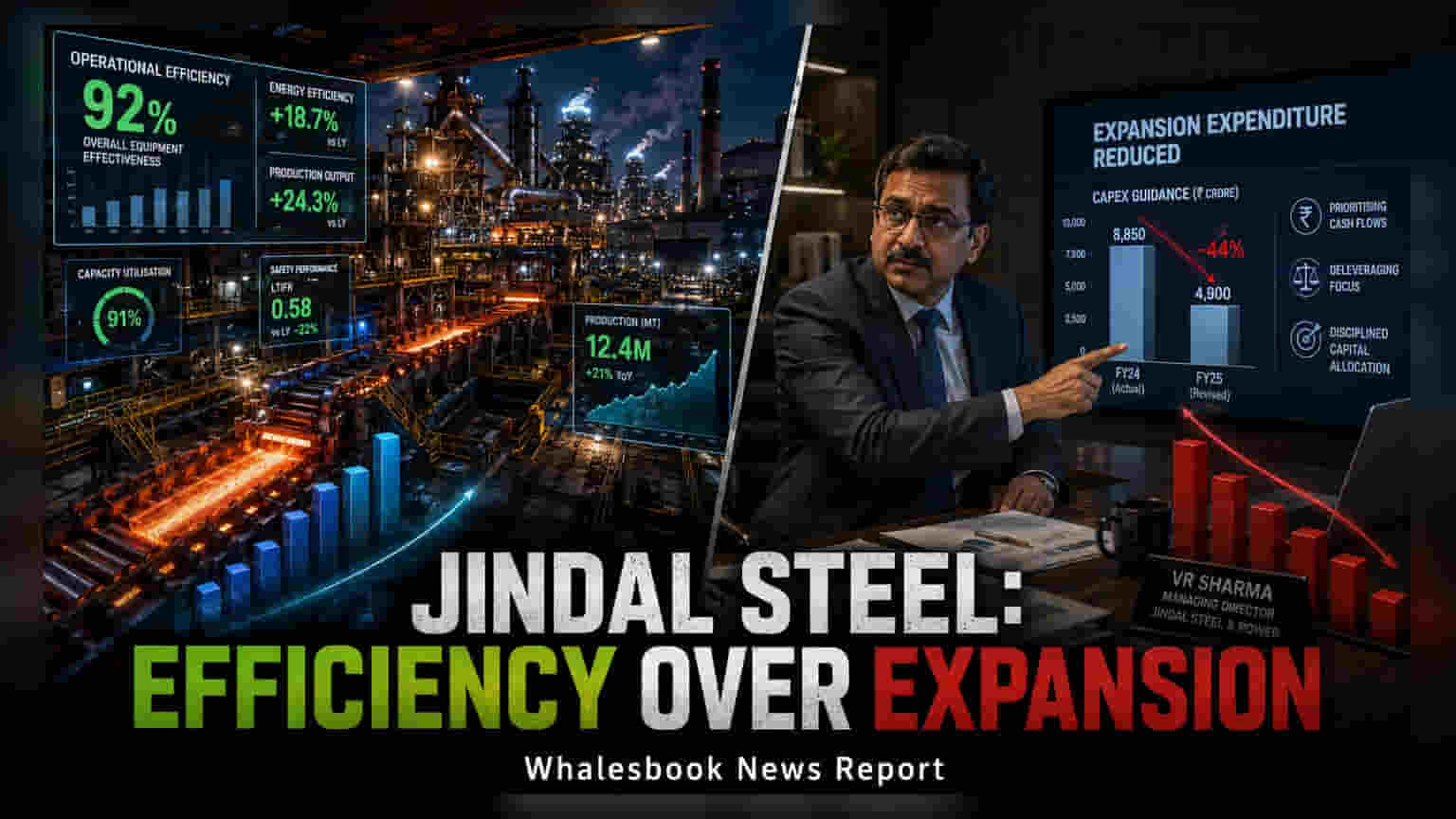
Jindal Steel and Power Limited is prioritizing internal cash generation to improve efficiency rather than taking on new debt for capacity expansion. The company has lowered its capital spending guidance to ₹8,500 crore for the fiscal year. This disciplined approach focuses on maximizing existing plant output, contrasting with larger competitors currently pursuing aggressive expansion through heavy borrowing.
Jindal Steel and Power Limited is moving away from debt-heavy expansion plans, shifting its focus toward optimizing current production facilities and generating growth through internal earnings. Managing Director V.R. Sharma confirmed that the company intends to avoid taking on new loans, aiming instead to fund its requirements through existing cash flow. This strategy seeks to enhance financial stability while the company works toward achieving full capacity utilization at its current plants.
Strategic Focus and Financial Discipline
The company has revised its capital spending plan to ₹8,500 crore for the current fiscal year, marking a reduction from its previous estimates. This decision reflects a broader management goal to prioritize the efficiency of its existing operations before committing to large-scale new projects. A core component of this strategy involves the upcoming commissioning of a new slurry pipeline, which is projected to reduce logistics costs by approximately ₹700 per tonne. Furthermore, the company expects to see improved margins by sourcing more coal from its own captive mines, reducing its dependence on expensive external procurement.
Comparison with Sector Peers
This conservative financial path marks a departure from the strategies recently adopted by other major players in the Indian steel industry, such as JSW Steel and Tata Steel. While competitors have announced significant increases in their capital spending to aggressively expand production capacity, JSPL is concentrating on scaling its output at the Angul plant. The company currently operates with an annual capacity of 15.6 million tonnes and has set a target to produce 11.50 million tonnes in the current financial year, rising from 9.25 million tonnes in the previous fiscal year.
For investors, this approach suggests a focus on strengthening the balance sheet and improving profitability through better operational control. The key monitorable for the coming quarters will be the company’s ability to successfully reach full capacity utilization and realize the expected cost savings from its efficiency projects. Success in these areas will determine how effectively the company can improve its margins without the pressure of additional debt repayments. Investors may continue to track updates on the commissioning of the slurry pipeline and the actual output achieved compared to the company’s production targets.