
Strategic Push for Energy Security
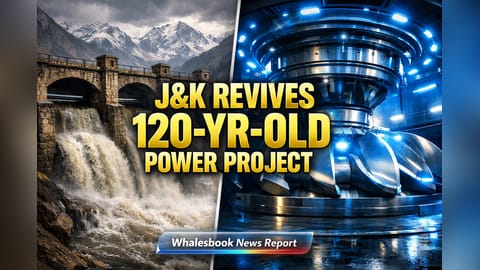
The Jammu and Kashmir government's decision to revive the 120-year-old Mohra Power Project is a key part of its broader energy security plan. This initiative gains immediate strategic importance after India decided to place the Indus Water Treaty (IWT) in abeyance following the April 2025 Pahalgam terror attack. Pausing the IWT, which has historically governed water-sharing between India and Pakistan, creates a new approach to water resources in the region. The revival of Mohra, along with accelerating other hydro projects, signals a determined effort to boost generation capacity and reduce reliance on external power sources. This strategic pivot is crucial as the Union Territory aims to triple its installed power generation capacity from the current 3,540 MW to about 11,000 MW by 2035.
Mohra Project: History and Technical Details
Commissioned in 1905, the Mohra Power Project on the Jhelum River in the Uri sector is one of India's pioneering hydroelectric facilities. Originally a 5 MW run-of-the-river project, its capacity dropped to around 3 MW after severe flood damage in 1992, leading to its shutdown. A distinctive feature is its over 10 km wooden water channel, showcasing early engineering ingenuity. While the proposed 10.5 MW capacity is modest, it won't solve the region's power deficit. However, its revival carries substantial historical and symbolic weight, preserving part of Kashmir's engineering heritage. Plans for its renovation, modernization, and operation will involve appointing a transaction adviser through a limited tender inquiry.
J&K's Ambitious Energy Goals
J&K has an estimated hydropower potential of around 18,000 MW, with nearly 15,000 MW identified. The region's current harnessed capacity of approximately 3,540 MW is only about 24% of its identified potential. The government's roadmap aims to bridge this gap by developing numerous projects, with significant capacity expected from ongoing constructions and future tenders. Projects like Pakal Dul (1,000 MW), Kiru (624 MW), and Rattle (850 MW) are in advanced stages. The 11,000 MW target by 2035 reflects a strategy to make J&K an energy hub, enhancing energy security and potentially becoming a net power exporter. This aggressive expansion contrasts with hydropower's declining share in India's energy mix.
Challenges and Risks Ahead
The ambitious energy drive faces significant challenges. The abeyance of the Indus Water Treaty, while potentially enabling greater Indian control over river resources, adds geopolitical uncertainty and questions about regional stability and water sharing. Furthermore, the region's infrastructure is vulnerable to security threats, especially after recent attacks on infrastructure and workers. Climate change poses another risk; studies indicate altered rainfall and faster glacial melt in the Jhelum River basin, potentially increasing flood risks and affecting water availability for hydropower. The region is also in a high seismic zone, posing structural risks for large infrastructure projects. Globally, hydropower projects often face delays, cost overruns, and environmental concerns, including displacement and ecological impact, which could affect J&K's development pipeline. The Mohra project's revival, while symbolic, makes a small contribution to the energy deficit compared to larger projects.
Future Outlook
The revival of the Mohra Power Project, though small in capacity, is a symbolic sign of J&K's commitment to aggressively pursuing its ambitious energy goals. The accelerated development of hydroelectric projects, driven by geopolitical needs and a vision for energy self-sufficiency, highlights the region's strategic focus. However, the success of this broader agenda hinges on navigating complex geopolitical challenges, mitigating security and environmental risks, and efficiently executing large projects amid structural and climate uncertainties. The increase in energy generation will be watched as a sign of regional stability and economic progress.