 Whalesbook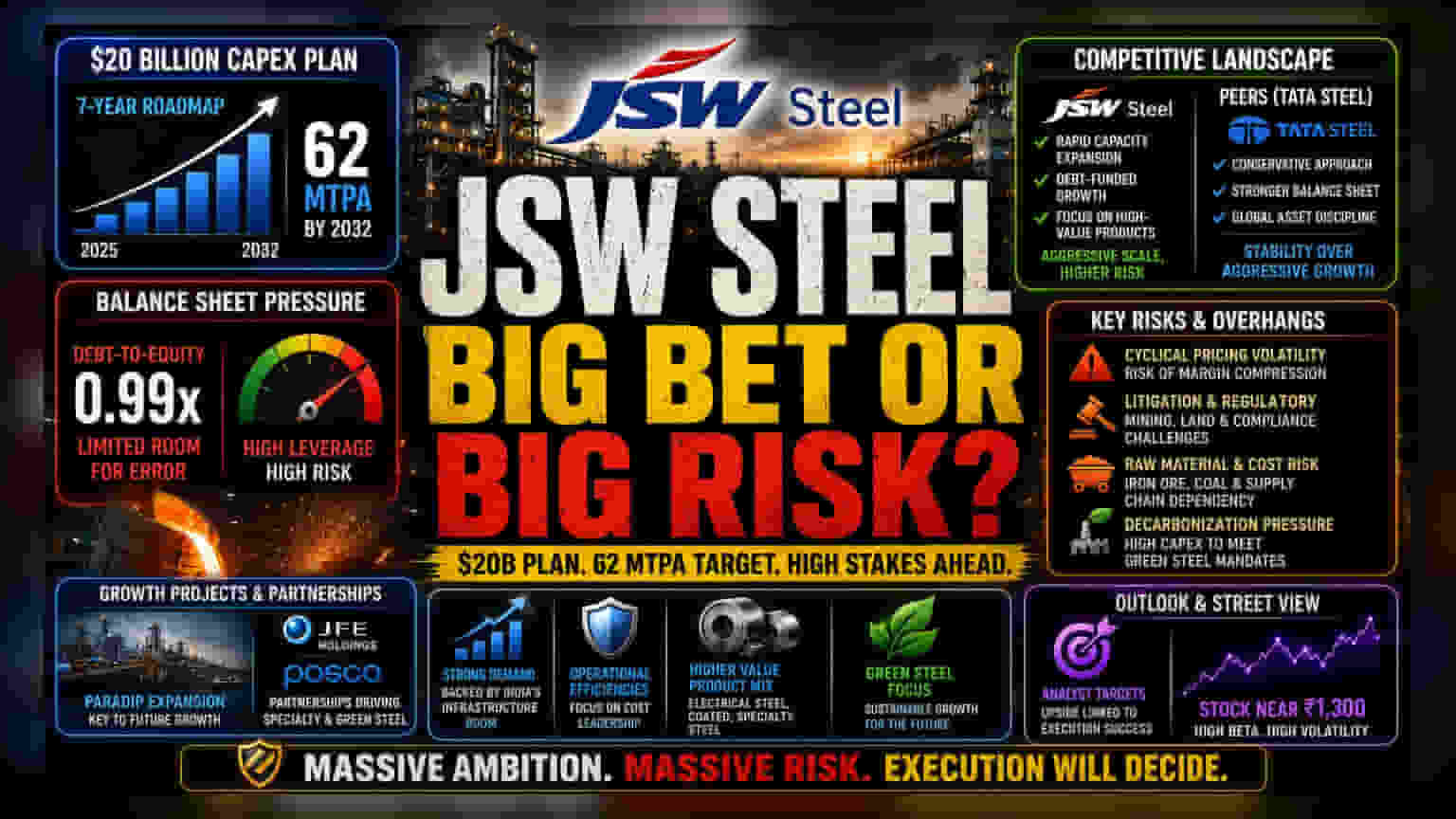


The Capacity-Capex Trap
JSW Steel’s aggressive $20 billion capital expenditure plan, spanning the next seven years, marks a definitive shift toward a “scale-at-all-costs” strategy. By aiming for a massive 62 million tonne per annum (MTPA) capacity by 2032, the company is betting heavily on the sustained momentum of India's infrastructure boom. However, the market’s reaction to this, reflected in the stock’s current price range near ₹1,300, suggests a growing caution regarding the balance sheet. While management highlights operational efficiencies and strong domestic demand, the reality is that the company is carrying a debt-to-equity ratio of approximately 0.99, which leaves little room for error if cyclical steel prices face a sharp downturn.
Competitive Benchmarking and Sector Dynamics
Unlike its peers, specifically Tata Steel, which maintains a more conservative approach to global expansion and legacy asset integration, JSW Steel is leaning into rapid, debt-funded brownfield growth. The company’s strategic partnerships with JFE Holdings and POSCO indicate a pivot toward specialized, high-margin products like electrical steel. Yet, this strategy faces intense pressure from domestic rivals like Jindal Steel & Power and AM/NS India, who are also racing to capture market share. With the industry currently operating under significant global pricing volatility, JSW Steel’s reliance on capital-intensive expansion makes it uniquely vulnerable compared to more asset-light competitors or those with lower leverage ratios.
The Forensic Bear Case
From a risk-averse perspective, the primary concern is the potential for severe margin compression. The steel industry is notoriously cyclical, and JSW Steel’s heavy reliance on debt to fund this $20 billion expansion means that interest coverage ratios could deteriorate if earnings fail to grow at the projected 1.5x GDP multiple. Furthermore, past litigation and regulatory hurdles regarding iron ore mining operations and land acquisition for greenfield sites remain an overhang. Investors should also be wary of the company’s dependency on captive raw material security; any failure in the supply chain or an increase in coal costs could erode the very EBITDA margins that management is trying to protect with these new investments.
Future Outlook
Analyst consensus remains cautiously optimistic, with long-term price targets contingent on the successful commissioning of projects in Paradip and the realization of cost synergies from the newer joint ventures. However, in a risk-off macro environment, the company’s high beta exposure to the Indian economy means it is likely to face volatility whenever foreign institutional inflows shift. Success will depend less on raw production volume and more on the company’s ability to manage its debt-to-EBITDA ratio while effectively transitioning to green steel production to satisfy stringent carbon mandates.