

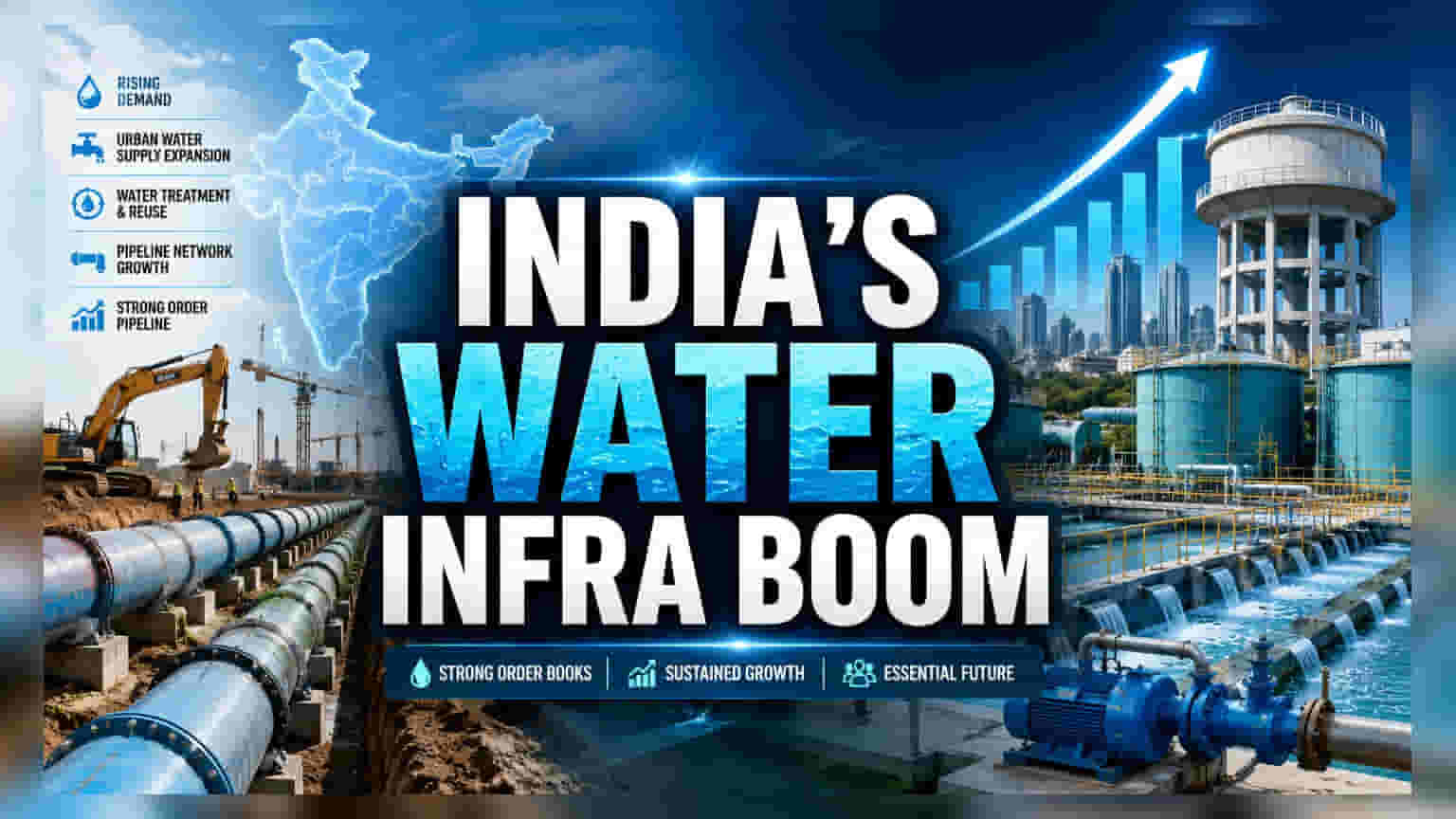
India's water infrastructure market is projected to reach up to ₹6.51 lakh crore by FY29, fueled by the Jal Jeevan Mission and urban demand. While WPIL and Welspun Enterprises demonstrate strong order books and margin improvements, companies like EMS are managing revenue pressure from payment delays. Understanding these distinct operational paths is essential for tracking the sector's performance.
What Happened
India's water infrastructure sector is entering a period of significant growth. Industry data from CRISIL Intelligence projects the market to expand from an average of ₹3.95 lakh crore between FY20 and FY24 to a range of ₹6.31–6.51 lakh crore for the FY25–FY29 period. This expected growth is driven by rising urban demand, industrial needs, and major government initiatives like the Jal Jeevan Mission (JJM) Phase 2. Several listed companies are positioning themselves to capture this demand, though their performance varies based on execution, order intake, and payment cycles.
WPIL: International Strength And Acquisitions
WPIL, which provides pumps and water solutions, has maintained resilience despite domestic challenges. The company reported a 3% year-on-year revenue growth to ₹1,855 crore in FY26. A key driver for this stability is its international business, which now accounts for over 61% of total revenue. Operating profit rose 9% to ₹318.3 crore, with margins improving to 17.2%. The company’s order book of ₹4,936 crore is supported by its recent expansion into South Africa and government projects under the Jal Jeevan Mission.
Welspun Enterprises: Large Order Book Visibility
Welspun Enterprises has established a significant footprint in the water vertical, which now represents 70% of its total order book of ₹19,739 crore. The company focuses on complex engineering projects, including water treatment plants. In FY26, despite a minor 2% dip in revenue to ₹3,615 crore, the company saw a 16% rise in operating profit to ₹845 crore. Its margins also expanded, reaching 23%. With a water-specific order book valued at over ₹13,800 crore, the company has secured long-term revenue visibility, provided it can execute these projects efficiently.
EMS: Navigating Payment Challenges
EMS Limited, which specializes in urban water supply and sewerage, faced a more difficult year. Its revenue declined by 24% to ₹733 crore in FY26. This drop was largely attributed to external financial strains and delays in payments linked to the government’s SPARSH portal. Despite the lower revenue and profit, the company maintains an order book of ₹1,837 crore, which provides about two years of work. Management has indicated a target for revenue recovery and margin normalization around 25% for FY27, making the speed of payment receipts a critical factor for the company.
Sector Realities And Investor Monitorables
While the outlook for the water infrastructure sector is positive due to increased government spending, it remains highly dependent on public sector cycles. The transition from holding an order to completing the work and receiving payment is the most significant hurdle. Companies that can manage their cash flow and navigate administrative payment processes, such as those related to government portals, are better placed to sustain growth. Investors tracking this sector may focus on order execution timelines, the impact of payment delays on working capital, and whether companies can maintain their profit margins as competition for new projects increases.