 Whalesbook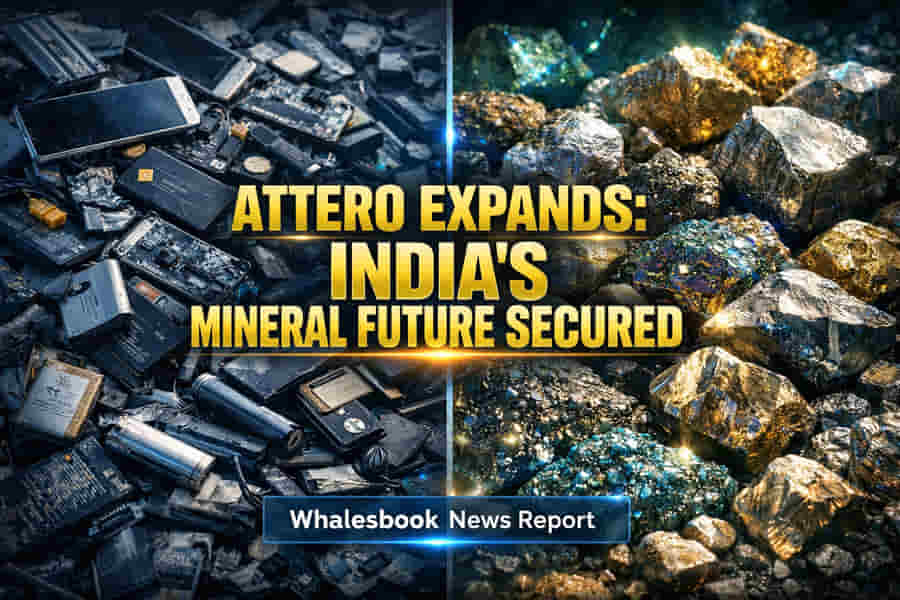
Attero Announces ₹2,000 Crore Expansion for Critical Minerals and Battery Recycling
Attero, a prominent Indian e-waste recycler, has unveiled an ambitious ₹2,000 crore expansion plan set to unfold over the next three years. This strategic investment is geared towards significantly scaling up its battery recycling and critical minerals refining capabilities, aligning with India's national objective of achieving self-reliance in strategic resources.
Scaling Up Rare Earth Recovery
Co-founder and CEO Nitin Gupta stated that the company aims to elevate its rare earth recovery capacity from the current 1 tonne per day to an impressive 100 tonne per day. This substantial increase is crucial for sourcing vital minerals needed in advanced manufacturing sectors. Furthermore, Attero plans to expand its lithium-ion battery recycling capacity to approximately 300,000 tonnes per annum, a nearly fifteen-fold increase from its existing 17,000 tonnes capacity.
Strategic Importance of Recycling
India faces the challenge of sourcing critical minerals essential for batteries, renewable energy components, defense equipment, and IT hardware. Recycling e-waste, of which India generates over 3.8 million tonnes annually, is identified as a key domestic avenue for obtaining these materials. Attero currently recovers valuable elements like neodymium and seramium from used permanent magnets, exporting its recycled products.
Government Initiatives and Market Growth
Gupta anticipates a surge in domestic demand, bolstered by government schemes such as the ₹7,800 crore magnet manufacturing scheme by the heavy industries ministry. The company has already invested around ₹150 crore in expanding its recycling and R&D network, launching new e-waste recycling plants in Pune, Bengaluru, and Faridabad, a copper recycling unit in Rajasthan, and enhancing its R&D centre in Greater Noida. These additions are expected to increase overall planned capacity by 100,000 tonnes per annum.
Future Outlook and IPO Plans
Attero is also preparing for a public listing, with an Initial Public Offering (IPO) planned within the next two to three years. The company reports strong financial performance, with revenue around ₹440 crore in FY24 and a net profit of approximately ₹14 crore in the same fiscal year. Gupta highlighted the company's profitability and consistent year-on-year growth.
Broader Sector Trends
Investor interest in companies focused on critical mineral processing and recycling is on the rise, supported by increasing policy backing. The National Critical Mineral Mission, launched with an outlay of ₹34,300 crore, aims to reduce reliance on China, which currently dominates over 90% of global critical mineral processing. Experts suggest that companies in this space may need foreign collaborations for technology as India's rare earth ecosystem develops.
Impact
This expansion by Attero is set to significantly bolster India's capabilities in the critical minerals and battery recycling sectors. It supports the nation's drive towards self-sufficiency, potentially reducing import dependence for strategic materials and fostering growth in high-tech manufacturing and green energy industries. Increased domestic capacity can create new investment avenues and strengthen the supply chain for essential components.
Impact rating: 8/10
Difficult Terms Explained
- Rare earths: A group of 17 chemical elements essential for many modern technologies, including magnets and electronics.
- Critical minerals: Minerals deemed essential for a country's economy and national security, with potential supply risks.
- E-waste: Discarded electronic devices and electrical equipment.
- Neodymium and Seramium: Specific rare earth elements vital for creating high-strength permanent magnets.
- Permanent magnets: Magnets that retain their magnetism without needing an external magnetic field, used in motors, generators, and electronics.
- Lithium-ion battery: A rechargeable battery commonly used in electric vehicles, laptops, and mobile phones.
- IPO (Initial Public Offering): The process by which a private company first sells shares to the public.
- Self-reliance: The ability of a country to produce its own goods and services without relying on imports or foreign aid.
- Extended Producer Responsibility (EPR): A policy approach where producers are given significant responsibility for the environmental impacts of their products during their life cycle, including after they become waste.