 Whalesbook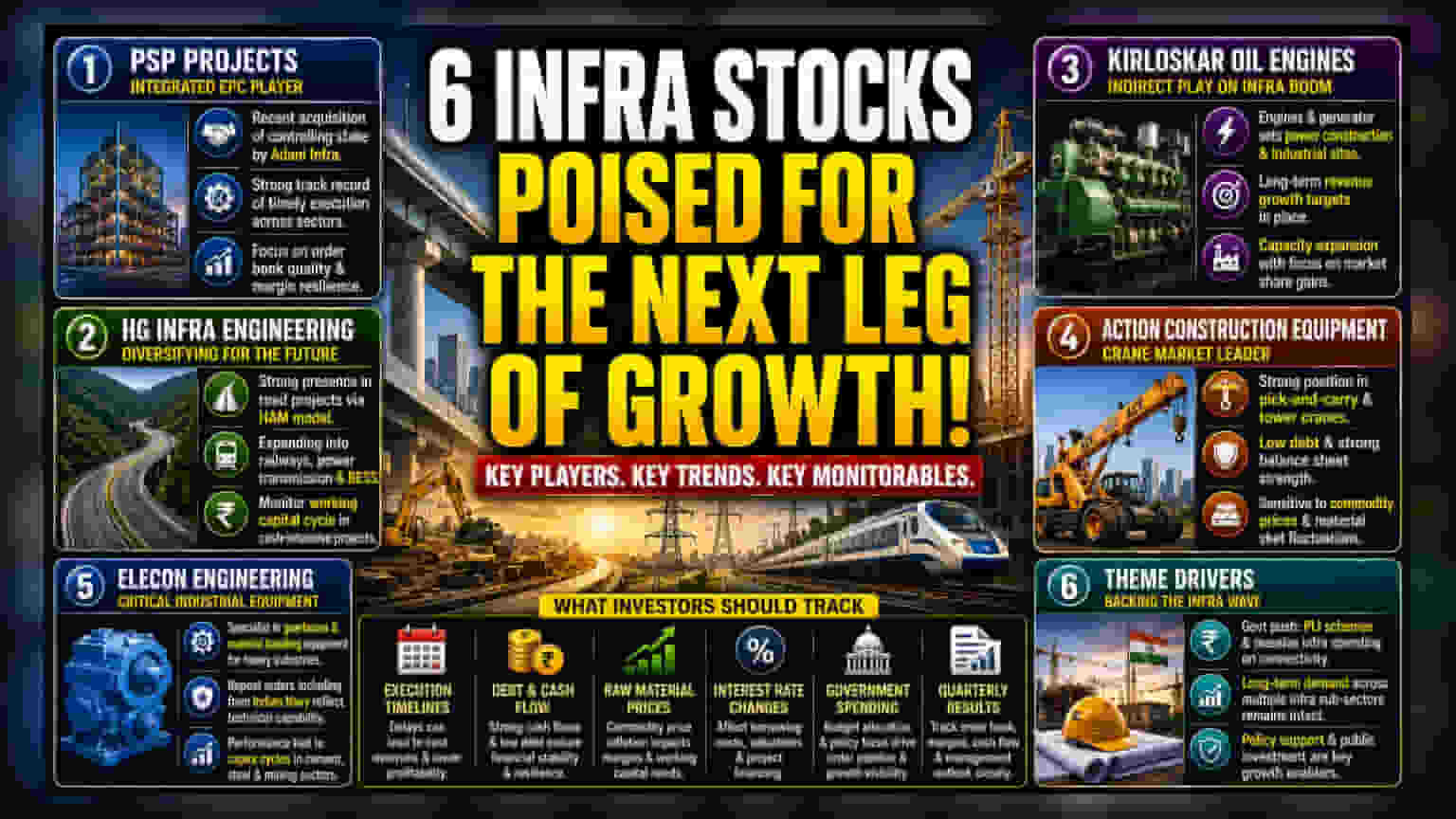


As India accelerates infrastructure spending, five companies—PSP Projects, HG Infra Engineering, Kirloskar Oil Engines, Action Construction Equipment, and Elecon Engineering—have gained attention. Each offers unique exposure to the sector, ranging from construction services to specialized machinery. Investors are tracking these firms based on their order books, project execution track records, and capital discipline.
The Infrastructure Context
India’s push for infrastructure development continues to be a central theme for the economy. Driven by government initiatives like the Production Linked Incentive (PLI) schemes and a sustained focus on national connectivity, companies across the construction and industrial goods supply chain are expanding their operations. The sector, however, is capital-intensive and cyclical, making company-specific performance metrics like order book quality, debt levels, and project execution efficiency critical for investors to monitor.
PSP Projects: A Shift in Ownership
PSP Projects operates as an integrated Engineering, Procurement, and Construction (EPC) firm, managing projects ranging from industrial facilities to institutional buildings. A significant development for the company recently was the acquisition of a controlling stake by Adani Infra, which changed the promoter profile and strategic direction. While the firm has a reputation for timely execution, investors often look at the order book and the company's ability to maintain profit margins amid rising competition in the EPC space.
HG Infra Engineering: Diversifying the Portfolio
HG Infra Engineering is known for its work in road infrastructure, particularly through the Hybrid Annuity Model (HAM). The company has been actively diversifying into sectors such as railways, power transmission, and Battery Energy Storage Systems (BESS) to reduce dependency on traditional road projects. For investors, the key monitorable for companies like HG Infra is the working capital cycle, as HAM projects can be cash-intensive during the construction phase.
Kirloskar Oil Engines: A Proxy Play
Kirloskar Oil Engines provides a unique angle on the infrastructure story. As a manufacturer of internal combustion engines and generator sets, the company benefits indirectly from the infrastructure boom; construction machinery and large project sites require reliable power and equipment support. The company has articulated long-term revenue growth targets, and its ability to expand capacity while maintaining market share remains a central point for analysis.
Action Construction Equipment: The Crane Specialist
Action Construction Equipment (ACE) holds a notable position in the Indian market, particularly in the pick-and-carry and tower crane segments. The firm’s growth has been linked to the demand for heavy construction equipment. Its balance sheet is generally considered a point of strength, with low debt levels. However, because the company relies on manufacturing and material procurement, it is sensitive to fluctuations in commodity prices, which can impact profitability.
Elecon Engineering: Critical Industrial Equipment
Elecon Engineering specializes in industrial gearboxes and material handling equipment, essential components for sectors like cement, steel, and mining. The company’s ability to secure repeat orders, including those from the Indian Navy, is often viewed as a testament to its technical capability. Its performance is heavily tied to the capital spending cycles of the heavy industries it serves, making it a cyclical play on industrial growth.
Investor Monitorables
When evaluating these firms, several factors merit close attention. First, project execution timelines are vital, as delays can lead to cost overruns and lower profit margins. Second, for companies involved in large-scale EPC or manufacturing, debt levels and cash flow management are essential to ensure long-term stability. Finally, macro factors such as interest rate changes, raw material price inflation, and government budget allocation for infrastructure remain the primary external forces that can influence the performance of these companies. Investors typically track these variables alongside quarterly financial updates and management commentary on future order prospects.