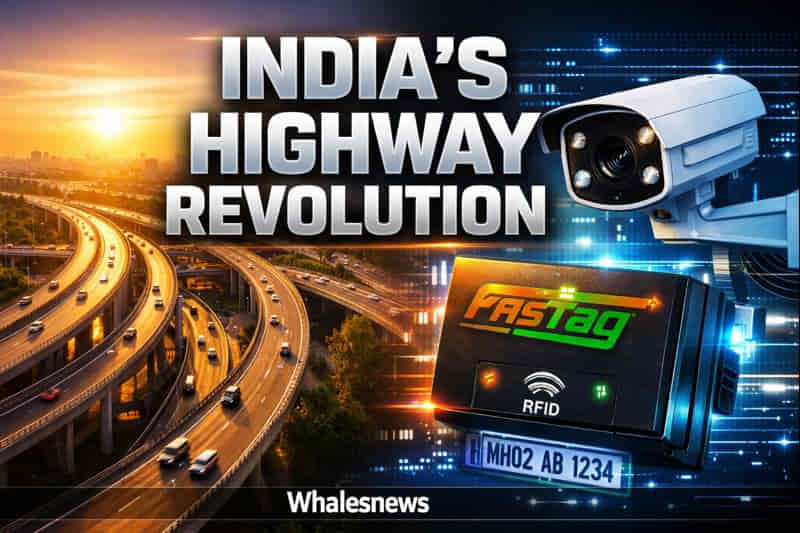
India's road transport ministry is set to transform highway development by 2026. Key initiatives include implementing barrier-free tolling nationwide, significantly reducing toll collection costs and waiting times. A new Road Safety Bill is also being fast-tracked to address alarmingly high accident fatalities. Major expressways like the Delhi-Mumbai corridor are nearing completion, promising faster travel and improved logistics.
India Gears Up for Highway Overhaul by 2026\n\nThe Ministry of Road Transport and Highways in India is spearheading a significant transformation in the nation's road infrastructure, with 2026 marked as a pivotal year for ambitious reforms. The agenda centers on creating seamless, barrier-free tolling across national highways and enacting a crucial new Road Safety Bill to combat the country's high rate of road accident fatalities.\n\n### Ambitious Expressway Completions\n\nSeveral high-profile highway projects are on the cusp of completion, poised to redefine long-distance travel and logistics. The monumental 1,362-km Delhi-Mumbai Expressway is slated for full completion by November 2026. Alongside this, the Amritsar-Jamnagar highway, Bengaluru-Chennai Expressway, Ahmedabad-Dholera Expressway, Indore-Hyderabad highway, and Delhi-Dehradun Expressway are all scheduled for completion within 2026. These corridors are expected to drastically cut travel times and alleviate congestion.\n\n### Zojila Tunnel: All-Weather Connectivity\n\nAnother landmark project, the 13-km Zojila tunnel, is expected to be inaugurated in April next year. Touted as Asia's longest, it will provide vital all-weather connectivity between Srinagar and Leh. This engineering marvel is projected to reduce travel time across the treacherous Zojila pass from three hours to a mere 20 minutes.\n\n### Revolutionizing Toll Collection\n\nMinister Nitin Gadkari announced a comprehensive overhaul of toll collection, moving towards a nationwide barrier-free system. The first phase involves ten tenders for seamless tolling systems. This technological shift, utilizing Automatic Number Plate Recognition cameras and AI analytics alongside RFID FASTag readers, aims to charge vehicles digitally without requiring them to stop. Gadkari estimates that this will reduce tolling costs from approximately 15% to 3% of total collections, potentially saving up to ₹8,000 crore annually on a collection base of ₹50,000-60,000 crore. It will also minimize waiting times and curb revenue leakage.\n\n### Renewed Push for Road Safety\n\nDespite infrastructure expansion, road safety remains a critical concern, with India recording around five lakh accidents annually, resulting in approximately 1.8 lakh deaths. A significant 66% of these fatalities are individuals aged 18-34. Minister Gadkari confirmed that a new Road Safety Bill is being prepared for presentation to Parliament, following previous unsuccessful attempts. The government aims to place it before Parliament in the upcoming session.\n\n### Investment and Execution Challenges\n\nThe ministry plans to award road projects covering 12,000 km in 2025–26 and a higher 13,000 to 13,500 km in 2026–27. A Public Infrastructure Investment Trust (InvIT) is also set to launch before March next year, with the NHAI-sponsored Raajmarg Infra Investment Trust already receiving regulatory approval to unlock value from highway assets. However, the sector continues to face execution hurdles, with 649 highway projects worth ₹4.2 lakh crore currently delayed due to issues like land acquisition, contractor problems, and environmental clearances.\n\n### Impact\n\nThis comprehensive agenda has the potential to significantly boost India's logistics efficiency, reduce travel times, enhance road safety, and attract substantial investment in infrastructure. The focus on technology in tolling and the push for new safety laws could set new benchmarks for the sector. While challenges in project execution persist, the ministry's aggressive targets and reforms signal a strong commitment to developing world-class road infrastructure. This development is highly relevant for infrastructure companies, logistics providers, and the broader Indian economy. Impact rating: 8/10.\n\n### Difficult Terms Explained\n\n* Barrier-free tolling: A system where vehicles pass through toll plazas without stopping, with tolls collected automatically using technology like ANPR cameras and FASTags.\n* Road Safety Bill: Proposed legislation aimed at improving traffic safety and reducing road accident fatalities.\n* Expressway: A major high-speed road, typically with multiple lanes and controlled access, designed for long-distance travel.\n* Zojila tunnel: Asia's longest bi-directional tunnel connecting Srinagar and Leh, providing all-weather connectivity.\n* Automatic Number Plate Recognition (ANPR): Technology that uses cameras to read vehicle license plates.\n* Artificial Intelligence (AI)-based analytics: Using AI to process and interpret data from ANPR cameras for toll collection and violation detection.\n* FASTag: An electronic toll collection tag used on Indian highways, allowing for automatic deduction of toll charges.\n* VAHAN records: India's centralized database for vehicle registration and related information.\n* Public Infrastructure Investment Trust (InvIT): An investment vehicle similar to a mutual fund, which owns income-generating infrastructure assets, allowing investors to invest in them.\n* NHAI: National Highways Authority of India, a statutory body responsible for the development, maintenance, and management of national highways.
Disclaimer:This content
is for educational and informational purposes only and does not constitute investment, financial, or
trading advice, nor a recommendation to buy or sell any securities. Readers should consult a
SEBI-registered advisor before making investment decisions, as markets involve risk and past performance
does not guarantee future results. The publisher and authors accept no liability for any losses. Some
content may be AI-generated and may contain errors; accuracy and completeness are not guaranteed. Views
expressed do not reflect the publication’s editorial stance.