

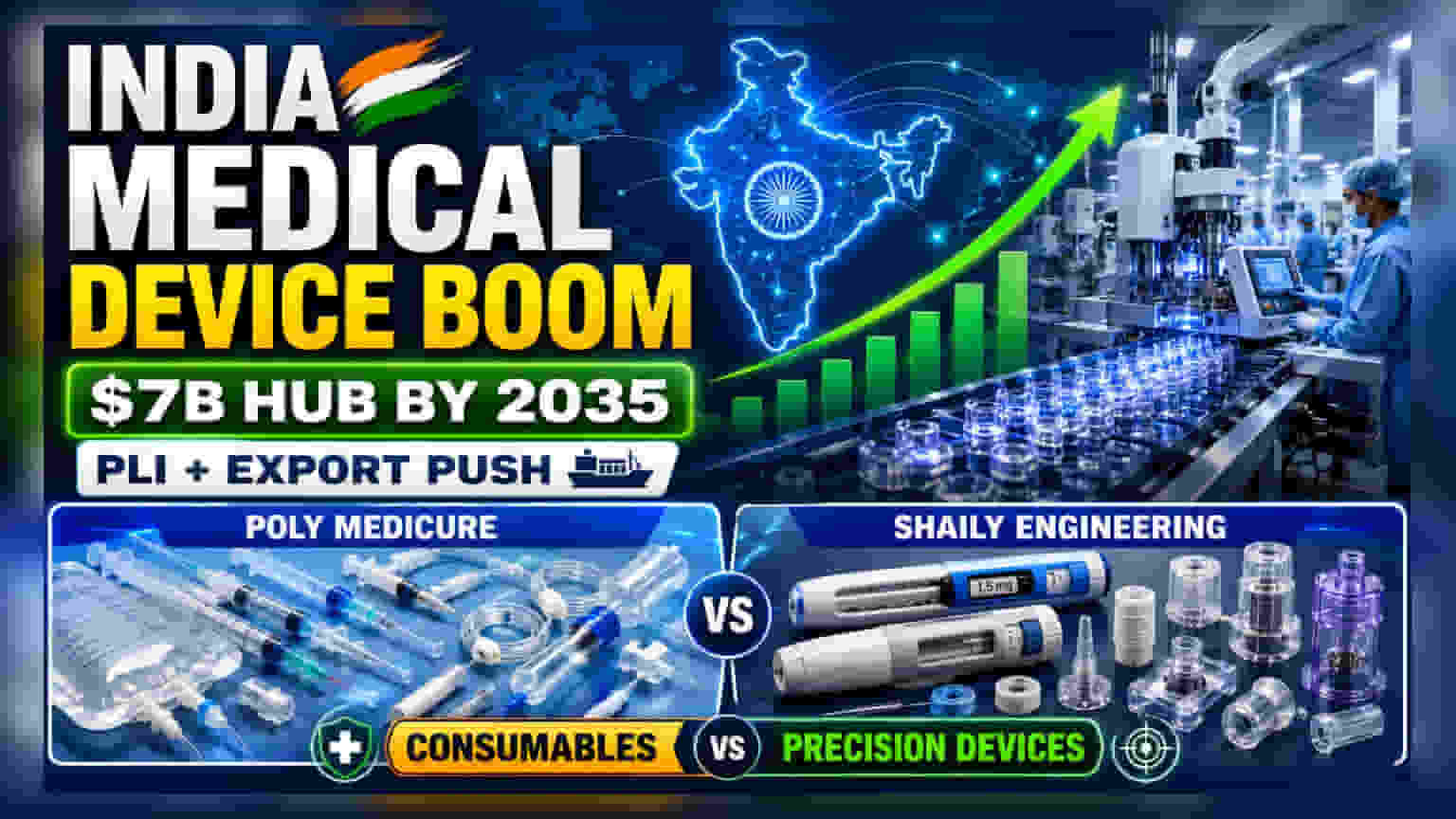
India’s medical device sector is expanding as a global manufacturing hub, driven by government incentives and supply chain shifts. Listed players like Poly Medicure and Shaily Engineering Plastics are taking different paths to capture this growth, each carrying distinct valuation profiles and operational risks.
What Happened
India is increasingly positioning itself as a global hub for medical device manufacturing, moving beyond its traditional strength in generic pharmaceuticals. Government initiatives like the Production Linked Incentive (PLI) scheme and the 2023 National Medical Devices Policy are designed to lower import reliance and boost local production capacity. As global supply chains shift away from China, Indian manufacturers are focusing on precision engineering and regulatory standards to secure international partnerships. Projections suggest the sector could evolve into a $7 billion contract manufacturing hub by 2035.
Contrasting Strategies: Poly Medicure vs. Shaily Engineering
Two listed companies, Poly Medicure and Shaily Engineering Plastics, are often cited as examples of this sector's potential, but they operate with very different business models. Poly Medicure has established itself as an exporter of single-use hospital consumables. With a revenue of ₹1,875 crore in FY26, the company relies heavily on recurring revenue streams from its wide product portfolio, exporting to over 125 countries.
In contrast, Shaily Engineering Plastics has focused its growth on precision injection molding, particularly for drug-delivery devices. This segment is closely tied to the rising global demand for GLP-1 drugs, which are used in treating diabetes and obesity. In FY26, Shaily reported revenue of ₹991 crore, with its healthcare segment contributing ₹393 crore—a segment that grew by 139% year-on-year.
Valuation and Growth Expectations
Investors are currently pricing these companies at premium valuations, likely reflecting optimism about long-term growth in the healthcare manufacturing space. Poly Medicure trades at approximately 51 times its earnings, reflecting its status as an established player in the consumable market. Shaily Engineering, however, trades at a higher valuation of over 80 times earnings. This premium often indicates that the market expects rapid growth, supported by the company’s expansion plans both within India and in international hubs like Abu Dhabi.
Risks and Industry Hurdles
While the sector is growing, it is not without significant business risks. The dependence on government incentives like the PLI scheme creates potential vulnerability if those programs are sunset or modified. Additionally, the industry faces regulatory complexities in international markets, which can impact export volume and profitability.
For companies like Shaily Engineering, there is also technological risk. The pharmaceutical industry is currently exploring oral versions of GLP-1 drugs. If these oral treatments become widely adopted, the demand for traditional injectable drug-delivery devices—a core part of the company's business—could face pressure. Furthermore, building a domestic ecosystem of high-quality suppliers and skilled talent remains a long-term challenge that could affect margins and execution speed.
What Investors Should Track
Investors looking at this sector may want to monitor several key factors. First, tracking the actual utilization of new manufacturing capacity is essential to ensure that growth in revenue translates into sustainable profit margins. Second, monitoring any changes to government policies or incentives will be vital for assessing long-term revenue predictability. Finally, for companies focused on specialized segments like drug delivery, observing global pharmaceutical trends—such as the transition between injectable and oral delivery methods—will provide insight into future demand stability.