

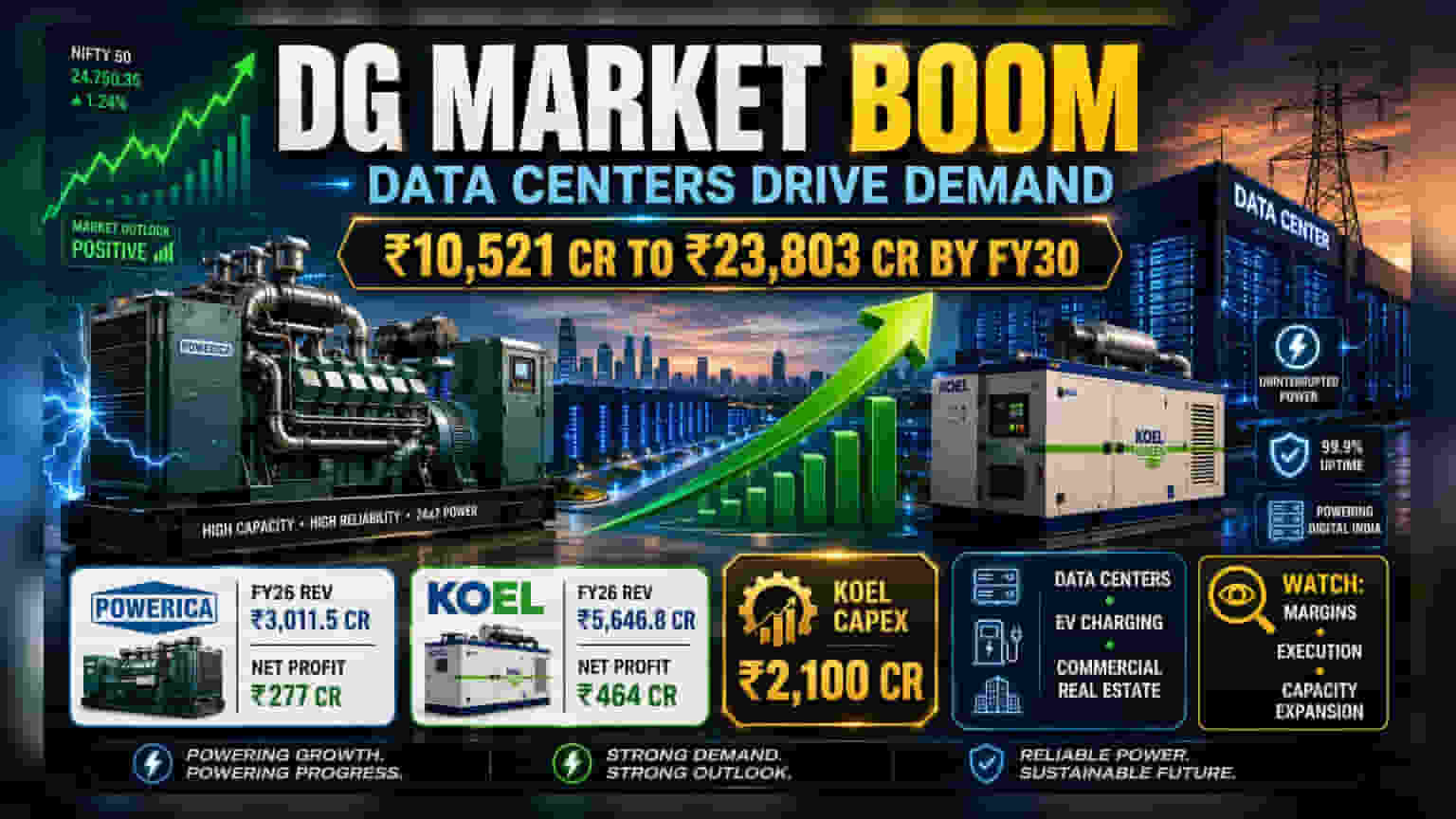
India's diesel generator market is projected to reach ₹23,803 crore by FY30, driven by the critical power needs of data centers. Powerica and Kirloskar Oil Engines (KOEL) are at the forefront, reporting strong revenue growth in FY26. Investors are now monitoring how these companies manage large expansion plans and order execution in this high-demand sector.
What Happened
The Indian diesel generator (DG) market is witnessing a major transformation. Once seen as a standard industrial requirement, these generators are now critical infrastructure for the country’s growing data center sector. Market projections suggest the sector will expand from ₹10,521 crore in FY23 to approximately ₹23,803 crore by FY30. This growth is driven by the need for near-perfect uptime in data centers, where even a brief power cut can cause massive operational losses.
Why Data Centers Are Driving Demand
Data centers require high-capacity, reliable power backups that can activate instantly. This has shifted the demand toward more advanced, high-output generator sets. Beyond data centers, the need for dependable power in electric vehicle charging networks, manufacturing, and commercial real estate is also rising. Powerica and Kirloskar Oil Engines have become key suppliers, moving from standard industrial sales to catering to these specialized, high-uptime facilities.
Powerica’s Market Position
Powerica has established itself as a significant player by focusing on high-capacity DG sets ranging up to 10,000 kVA. In FY26, the company reported record revenue of ₹3,011.5 crore, a 13.5% increase year-on-year. Its net profit grew by 61% to ₹277 crore.
A key aspect of Powerica’s business is its long-standing partnership with Cummins India, dating back to 1984. While this partnership is central to its operations, it also creates a concentration risk, as the company relies heavily on Cummins for engines and alternators. Interestingly, while its DG set business generates the bulk of revenue, the company’s wind power segment, which accounts for 17% of revenue, contributes over 41% to EBITDA, highlighting its higher profitability.
Kirloskar Oil Engines’ Expansion
Kirloskar Oil Engines (KOEL) is aggressively scaling its operations to capture the data center market. The company’s PowerGen division is the primary revenue driver, accounting for 46% of total income. In FY26, KOEL reported revenue of ₹5,646.8 crore, up 25%, with net profit climbing 35% to ₹464 crore.
To support its growth, KOEL is investing ₹2,100 crore in total capital expenditure—₹700 crore to boost engine capacity by 50,000 units and ₹1,400 crore for a new facility. A recent indicator of its competitive position was securing an order from HyperNext for 96 units of its 2500 kVA Optiprime Dual Core systems, which marks a significant high-capacity deployment.
Risks To Consider
While the demand outlook is positive, investors may note specific risks. For Powerica, the primary risk remains its dependence on Cummins for technology and supply, which could impact operations if the partnership dynamics change. For KOEL, the major risk is execution; the company is in the middle of a large ₹2,100 crore capital investment program, and the return on this spending will depend on whether it can maintain its market share and pricing power amidst competition.
What Investors Should Track Next
Investors may monitor the execution timeline of KOEL’s capacity expansion and whether it manages to keep costs under control. For both companies, the key monitorable will be the sustainability of margins in the data center segment. Since this business requires specialized engineering and installation, the ability to deliver these projects on time and within budget will be essential for maintaining profitability in the coming quarters.