 Whalesbook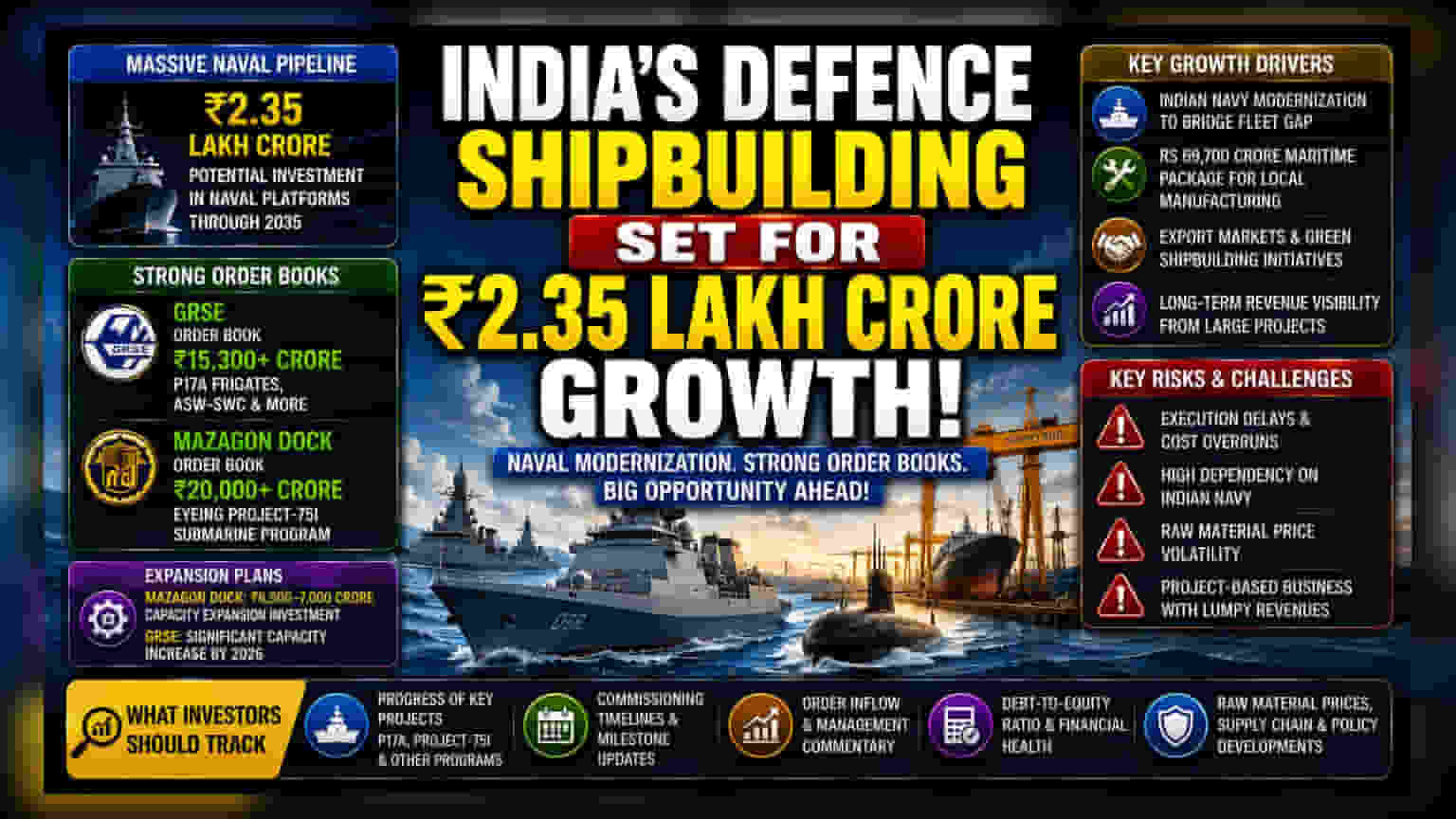


What Happened
India’s defence shipbuilding sector is preparing for a long-term growth phase supported by a massive naval procurement pipeline. The government’s projection suggests a potential Rs 2.35 lakh crore investment in naval platforms through 2035. This demand is driven by the Indian Navy’s modernization plans, which aim to address the gap in naval fleet size compared to regional peers. Companies like Garden Reach Shipbuilders & Engineers (GRSE) and Mazagon Dock Shipbuilders are at the forefront of this expansion, supported by a broader Rs 69,700-crore maritime package designed to boost local manufacturing capabilities.
Order Books and Expansion
For investors, the most critical data point is the 'order book,' which represents the total value of confirmed projects yet to be completed. GRSE currently holds an order book of over Rs 15,300 crore, with significant projects like the P17A frigates and Anti-Submarine Warfare Shallow Water Craft (ASW-SWC) in progress. Mazagon Dock, meanwhile, has an order book exceeding Rs 20,000 crore. The company is positioning itself for major contracts like the Project-75I submarine program, which could substantially add to its long-term revenue visibility. To support this, Mazagon Dock has announced plans to invest Rs 6,500–7,000 crore over the coming years to expand its ship-handling capacity. GRSE is also scaling up, with plans to increase its vessel handling capacity significantly by 2026.
The Business Reality
While the order pipelines look strong, shipbuilding is not a simple manufacturing business. It is a 'project-based' industry. This means that revenue comes in 'lumps' rather than a steady stream. A company's financial performance can fluctuate based on the timing of project milestones. For instance, Cochin Shipyard has seen varied trends in its ship repair segment, which is a reminder that even within a growing sector, different companies have different business cycles. Additionally, these companies are trying to diversify by entering export markets and 'green' shipbuilding (hybrid-powered vessels), which helps reduce total dependence on a single domestic client.
Risks and Execution Challenges
Investors should be aware of the inherent risks in this sector. The biggest challenge is 'execution risk.' Building warships and submarines is complex, and any delay in construction can lead to cost overruns and lower profit margins. Furthermore, these companies are highly dependent on the Indian Navy. This 'customer concentration' means that any change in government defence policy or budget priorities can directly impact their future growth. On the input side, shipyards are sensitive to the prices of steel, electronics, and specialized engines. If global supply chains face disruption or raw material prices spike, the profit margins of these shipbuilders could come under pressure.
How Investors May Read This
When evaluating these stocks, market participants typically look beyond just the size of the order book. The quality of execution—the ability to deliver ships on time and within budget—is what separates successful shipyards from the rest. A large order book is useless if the company cannot build the ships profitably. Investors also track the 'asset turnover' and 'return ratios' to see how efficiently the company is using its new capital spending to generate profit. The current market valuations for these companies often reflect high expectations of future growth, so maintaining that growth rate is essential.
What Investors Should Track
Looking ahead, the most important monitorables are the progress of specific projects like the P17A and the Project-75I. Investors should watch for updates on the commissioning dates of these ships, as delays often hurt share price sentiment. Additionally, tracking the company's 'debt-to-equity' ratio is important, especially since they are spending large amounts of money on expansion. Finally, keep an eye on management commentary regarding order inflow, as new contracts are the lifeblood of this long-cycle industry.