 Whalesbook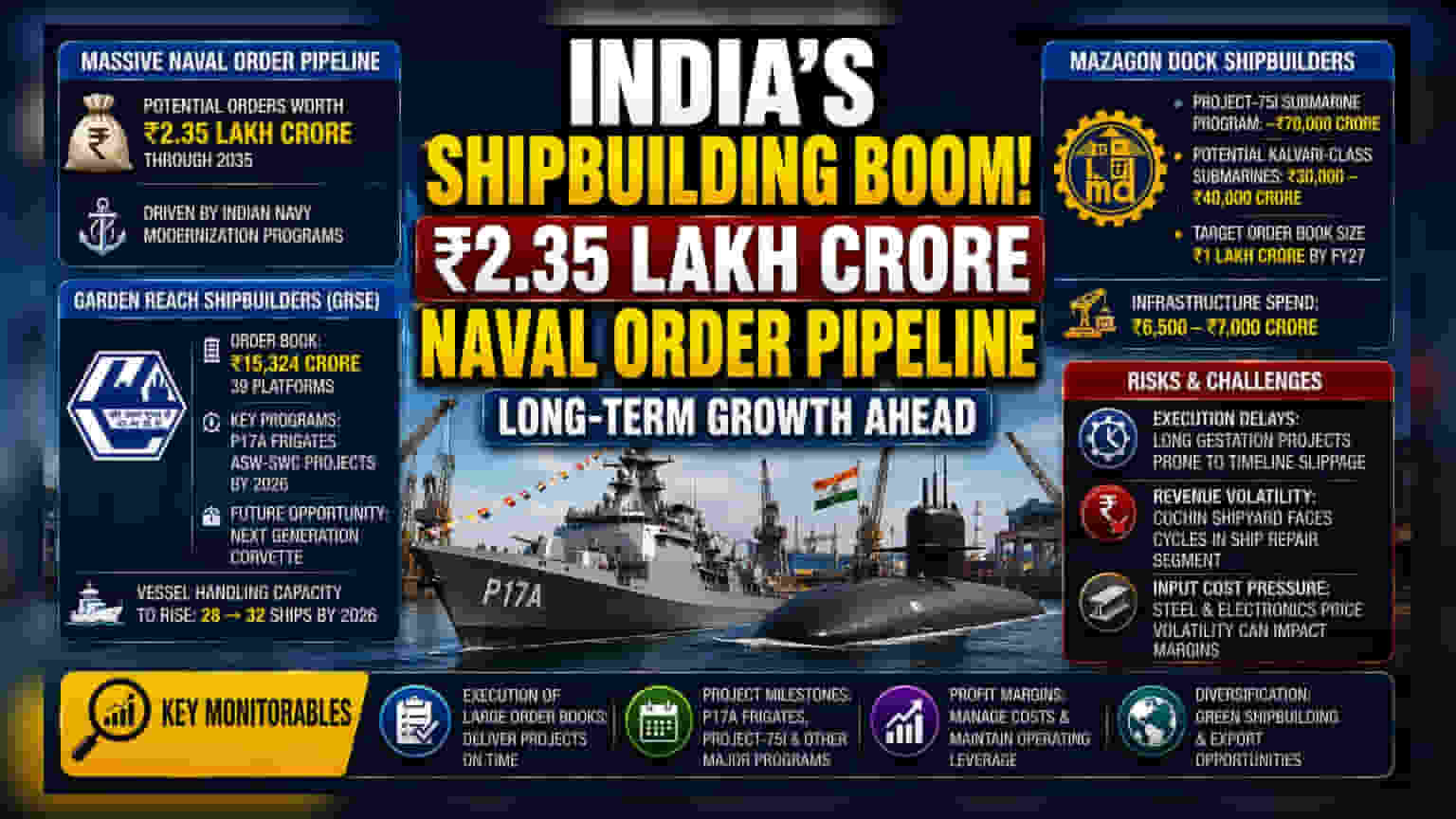


What Happened
India's defence shipbuilding sector is entering a phase of sustained activity, driven by a massive naval procurement pipeline. The industry is looking at potential orders totaling Rs 2.35 lakh crore that are expected to materialize through 2035. This long-term visibility is supported by the Indian Navy's ongoing modernization efforts, which require a steady supply of new vessels, ranging from frigates to submarines.
The Order Pipeline
Major players in the sector, such as Garden Reach Shipbuilders & Engineers (GRSE) and Mazagon Dock Shipbuilders, are seeing their future business secured by large order books. GRSE currently holds an order book of approximately Rs 15,324 crore, covering 39 platforms. The company is focused on completing programs like the P17A frigates and ASW-SWC projects by 2026, while looking forward to the Next Generation Corvette contract.
Similarly, Mazagon Dock is pursuing significant opportunities, including the Project-75I submarine program, which has an estimated value of Rs 70,000 crore. The company has publicly stated a target of reaching an order book size of Rs 1 lakh crore by FY27. Beyond these, potential orders for three Kalvari-class submarines, valued between Rs 30,000 crore and Rs 40,000 crore, could further strengthen its financial position.
Capacity Expansion and Spending
To meet this rising demand, shipyards are ramping up their infrastructure. GRSE has plans to increase its vessel handling capacity from 28 to 32 ships by 2026. Mazagon Dock has also outlined a significant plan to spend between Rs 6,500 crore and Rs 7,000 crore on infrastructure over the next few years. This capital spending is essential to improve execution capabilities, which is a critical factor for companies managing long-gestation projects in the defence sector.
Risks and Market Context
While the outlook is supported by government orders, the sector is not without risks. Execution delays remain the primary challenge for shipbuilding companies. Large naval projects take years to complete, and any delay in the supply chain or technical issues can lead to cost increases and margin pressure.
Additionally, companies like Cochin Shipyard are currently facing some volatility in their ship repair revenue. Unlike the manufacturing of new ships, which is driven by long-term defence contracts, the repair business can be more cyclical and dependent on shorter-term commercial or government maintenance contracts. Investors should note that while manufacturing provides stability, the repair segment may see fluctuations depending on the timing of dry-docking and maintenance schedules.
Furthermore, the sector faces risks related to the pricing of raw materials, particularly steel and electronic components, which are essential for shipbuilding. Any sharp increase in these costs, if not covered by escalation clauses in contracts, could impact profit margins.
What Investors Should Track
For investors, the most important monitorable is the actual execution of these large order books. It is not just about winning orders but delivering them on time. Future updates on project timelines, specifically for major programs like Project-75I or the P17A frigates, will be critical. Additionally, keeping an eye on profit margins will help determine if these companies are effectively managing their input costs and operating leverage. Finally, monitoring the diversification efforts, such as the push for green shipbuilding and export opportunities, will show whether these companies can reduce their dependence solely on domestic naval budgets.