 Whalesbook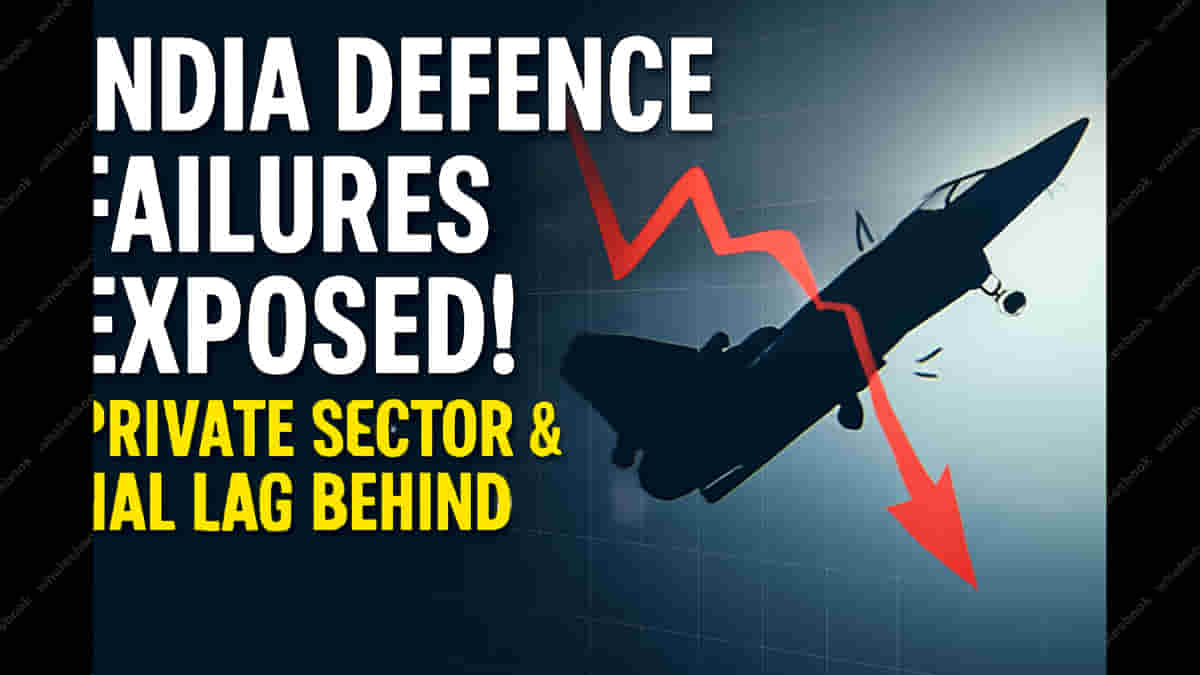


Military Leaders Expose Defence Manufacturing Gaps
Top military brass in India are voicing sharp concerns over the state of the nation's defense manufacturing capabilities, revealing a stark contrast between ambitious self-reliance goals and ground realities. Recent statements indicate significant challenges in timely delivery, component sourcing, and the truthfulness of indigenous content claims.
Private Sector's Broken Promises
Lieutenant-General Rahul R. Singh, Deputy Chief of Army Staff, shared an anecdote where drone manufacturers, initially confident in their ability to deliver equipment, failed completely within a week. This failure was attributed to their reliance on critical components sourced from abroad, which did not materialize. Chief of Defence Staff General Anil Chauhan further criticized the private defense industry for over-promising capabilities and failing to meet delivery timelines, warning that such failures lead to a loss of critical operational capability.
HAL's Persistent Delays
Public sector undertakings are not exempt from criticism. Air Chief Marshal A.P. Singh expressed strong frustration with Hindustan Aeronautics Limited (HAL), citing a lack of confidence and a casual 'Ho jaayega' (it will happen) attitude. The much-delayed delivery of Tejas Mk 1A fighter jets, supposed to be handed over by February 2025, remains pending, highlighting HAL's struggles to operate in a mission mode.
The 'Atmanirbhar Bharat' Rhetoric vs. Reality
These episodes underscore a growing chasm between Prime Minister Narendra Modi's 'Atmanirbhar Bharat' (self-reliant India) initiative and the observable performance of the defense manufacturing sector. Despite a relentless focus on 'Make in India' and localization since 2014, military operations and manufacturing delays repeatedly expose unfulfilled aspirations and broken promises.
Dependence on Foreign Components
Key defense systems critical to recent operations, like the BrahMos missile and the S-400 air defense system, are heavily reliant on Russian components and technology. The BrahMos itself requires Russian parts and support, while the S-400 is entirely Russian-made. The Tejas fighter jet, the centerpiece of India's indigenous fighter program, also depends on imported components, most notably the American General Electric F404-IN20 engine, as India has yet to develop its own combat-worthy modern jet engines. The long-standing Kaveri Project aimed at developing an indigenous engine failed to achieve its objectives.
Future Expectations and Reforms
Addressing this complex 'wicked problem' requires more than slogans. Experts suggest that India must separate design and production accountability, invest massively in research and development, rationalize procurement processes, comprehensively build the industrial base, and instill rigorous institutional discipline. Without these structural changes, the gap between the vision of a self-reliant India and its defense manufacturing reality is likely to persist.
Impact
- This situation poses significant risks to India's national security and strategic autonomy by compromising operational readiness and timely defense equipment availability.
- It may lead to a re-evaluation of defense procurement policies and increased pressure on both private and public sector manufacturers to improve transparency and performance.
- Investor confidence in defense stocks could be affected, with a potential focus on companies demonstrating genuine capabilities and reliable supply chains.
- Government initiatives aimed at boosting indigenous defense production will likely face greater scrutiny.
- Impact Rating: 8
Difficult Terms Explained
- Atmanirbhar Bharat: A government initiative promoting self-reliance in India across various sectors, including defense.
- Indigenous Content: The proportion of components and manufacturing that originates from within India for a product.
- Strategic Autonomy: The ability of a nation to make its own foreign policy and defense decisions independently, without external coercion or undue influence.
- Hindustan Aeronautics Limited (HAL): A government-owned aerospace and defense company in India, responsible for manufacturing aircraft and defense equipment.
- Tejas Mk 1A: A specific variant of India's indigenous light combat aircraft, developed by HAL.
- Ramjet Engine: A type of air-breathing jet engine used in missiles and high-speed aircraft, known for its efficiency at supersonic speeds.
- Turbofan Engine: A type of jet engine commonly used in modern commercial airliners and military fighter jets, known for its thrust and fuel efficiency.
- Kaveri Project: An Indian initiative to develop a turbofan engine for combat aircraft, which faced significant delays and was eventually delinked from the Tejas program.
- Operation Sindoor: A recent military operation mentioned in the text, highlighting the context for discussions on defense capabilities.