 Whalesbook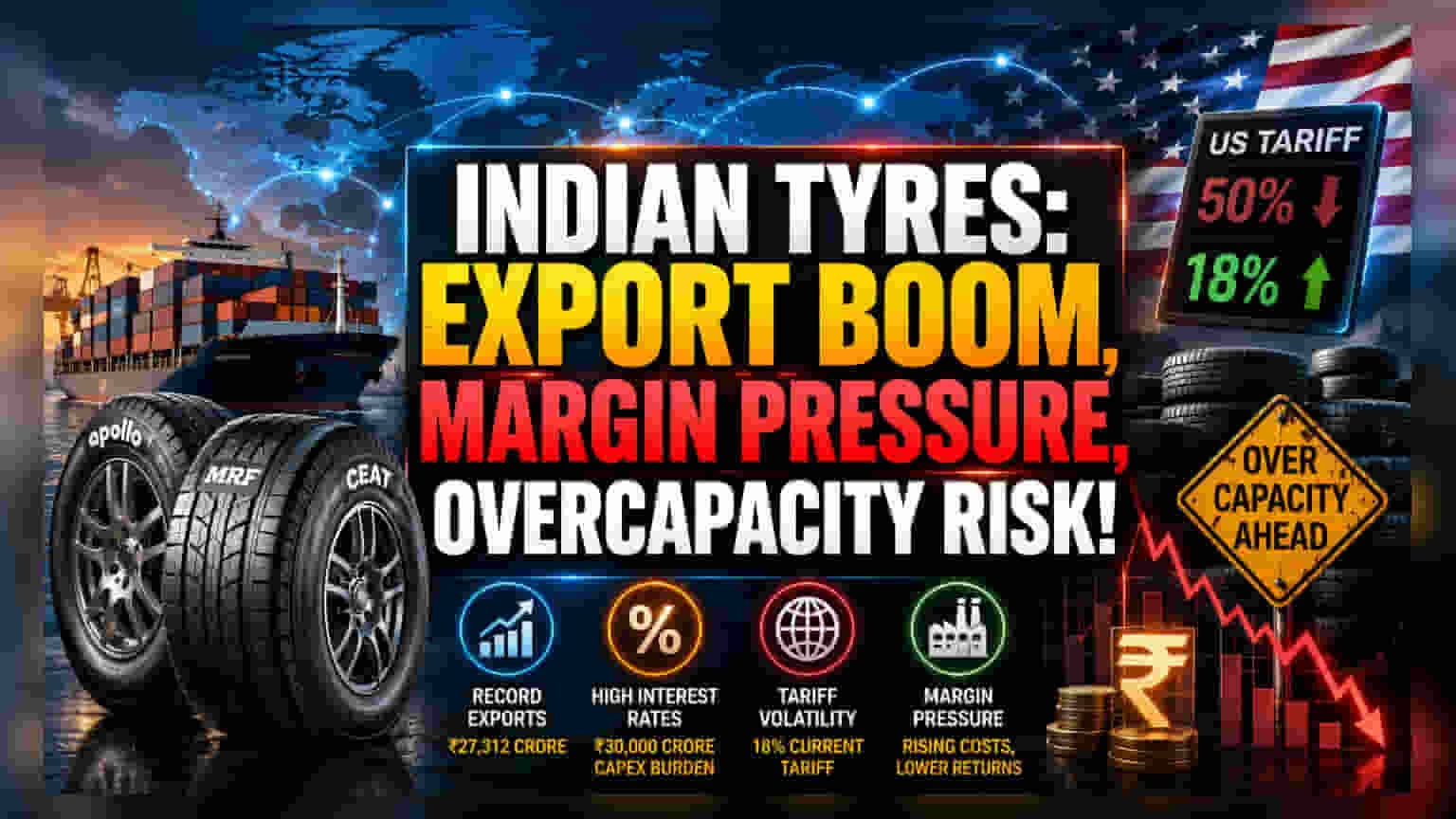


The Valuation of Export Resilience
The record-breaking export figure of ₹27,312 crore masks a complex reality for major domestic players like Apollo Tyres, MRF, and CEAT. While top-line growth remains consistent, the sector is currently grappling with the cumulative effect of high interest rates on the ₹30,000 crore capital expenditure cycle initiated over the last five years. These greenfield and brownfield investments, while necessary for capacity expansion, are now colliding with cyclical cooling in global demand, potentially impacting return on invested capital (ROIC) across the board.
The US Tariff Volatility Trap
Trade policy remains the primary exogenous risk factor. The US market, which currently absorbs 15% of Indian tyre shipments, has been subjected to erratic tariff swings ranging from 50% peaks in mid-2025 to the current 18% floor. This volatility forces manufacturers to maintain higher-than-average inventory levels to hedge against sudden trade shocks, further locking up working capital. Unlike global competitors in Southeast Asia, which benefit from more stable regional trade pacts, Indian firms are forced to absorb higher logistics premiums, narrowing the delta between cost-push inflation and export realizations.
Structural Margin Compression
While the Automotive Tyre Manufacturers Association emphasizes volume growth, a closer inspection of institutional data reveals a squeeze in operating margins. Increased expenditure on synthetic rubber imports, coupled with elevated freight rates in the Red Sea corridor, has consistently offset gains from the weakening rupee. Analysts note that unless these companies can successfully transition their product mix toward high-margin radial tyres for commercial vehicles, the export-led growth narrative may struggle to translate into bottom-line expansion for equity holders.
The Risk of Overcapacity
Beyond external trade barriers, the industry faces an internal challenge regarding supply absorption. The massive capacity additions undertaken by leading firms assume an optimistic trajectory for global vehicle replacement cycles that may not materialize if macroeconomic conditions in the Eurozone deteriorate further. If European export destinations, such as Germany and Italy, pull back on procurement due to an industrial slowdown, Indian manufacturers risk holding significant idle capacity. This leaves firms with elevated debt-to-equity ratios vulnerable to interest rate hikes, creating a structural weakness that could weigh on share price performance through the remainder of the fiscal year.