

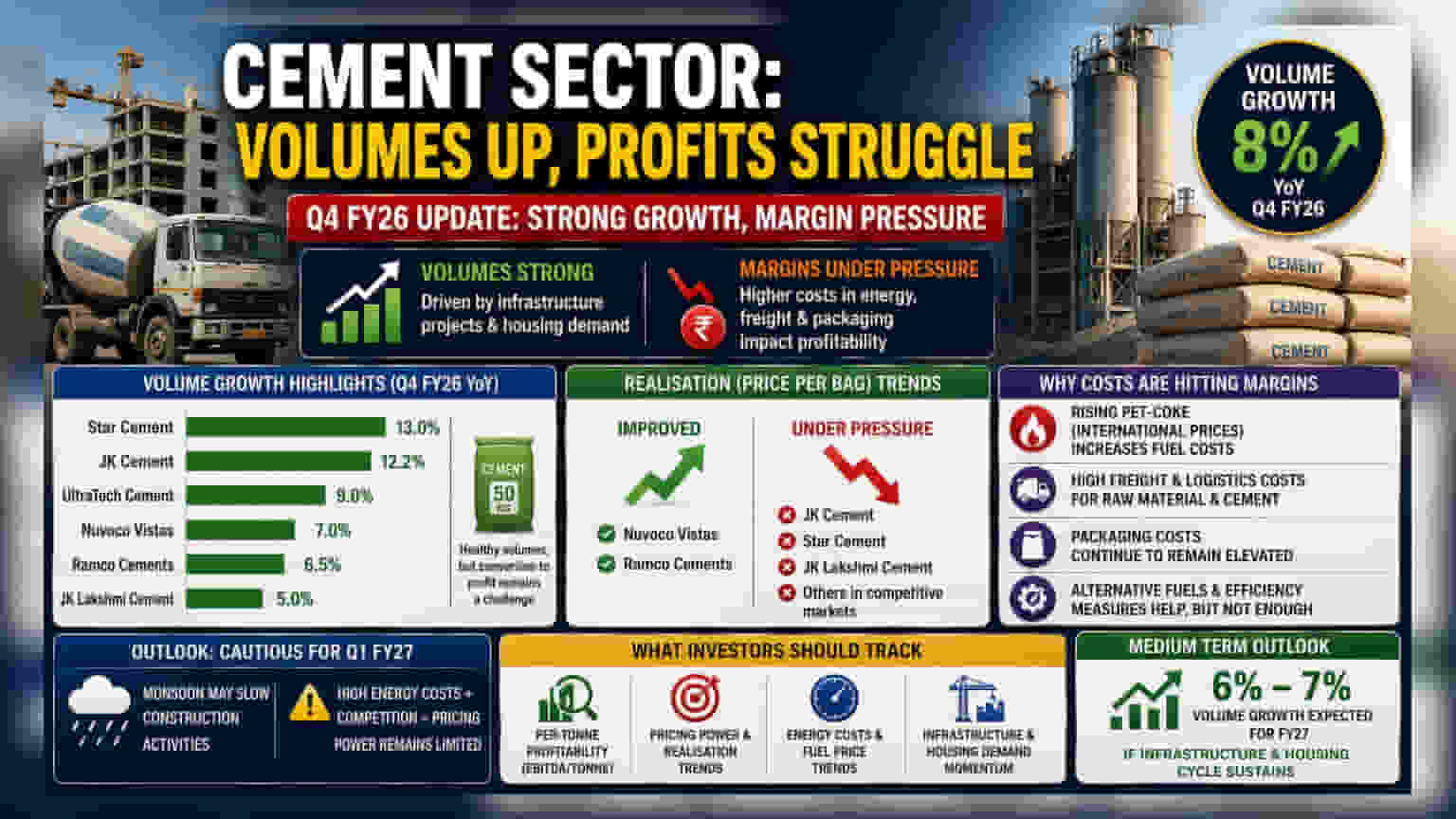
The Indian cement industry recorded nearly 8% volume growth in Q4 FY26, driven by strong infrastructure and housing demand. However, rising fuel, freight, and packaging costs are squeezing profit margins, leading to a cautious outlook for Q1 FY27. Investors are watching whether companies can successfully pass on these input cost hikes to customers.
What Happened
The Indian cement sector reported healthy volume growth of approximately 8% year-on-year for the quarter ending March 31, 2026 (Q4 FY26). This performance was supported by a steady pipeline of infrastructure projects and consistent demand from the housing sector. However, the industry is struggling to convert this strong sales volume into better profits. While revenues grew, higher input costs, particularly for energy, freight, and packaging, acted as a drag on profitability, causing margins to remain under pressure.
The Volume And Profit Disconnect
For cement companies, volume growth is usually a positive sign, but it tells only half the story. The core issue for the industry in Q4 FY26 was the inability to fully pass on rising costs to customers. While companies pushed for price hikes to offset expenses, competitive intensity in certain regions made it difficult to raise prices without losing market share. As a result, even though factories were busier, the profit made on every tonne of cement sold—often referred to as EBITDA per tonne—remained strained for many players.
Performance Highlights Across Players
Growth rates varied significantly among companies during the quarter. Star Cement recorded the highest growth in the group at 13%, supported by expanded capacity and strong demand in its core markets. JK Cement followed closely with 12.2% volume growth. Industry leader UltraTech Cement also saw a solid 9% increase, helped by its large scale and the integration of new capacity from recent acquisitions. While revenue grew for most, realization—the actual price a company receives per bag—showed mixed results. Companies like Nuvoco Vistas and Ramco Cements managed to improve their per-bag realizations, whereas others like JK Cement, Star Cement, and JK Lakshmi Cement dealt with pricing challenges in competitive local markets.
Why Costs Are Pressuring Margins
Profitability is being hit by the rising cost of international pet-coke, a key fuel source for cement kilns. Additionally, logistics costs, including freight for moving raw materials and finished cement, remain high. While some companies are trying to fight these costs by using alternative fuels and optimizing their fuel mix, these efficiency measures are not yet enough to fully absorb the impact of high energy prices. For the broader industry, the cost of packaging material also continues to be a factor that limits profit expansion.
What Investors Should Track Next
The outlook for the current quarter, Q1 FY27, remains cautious. Investors should be aware that the onset of the monsoon season typically leads to a slowdown in construction activities, which may impact volume growth. Furthermore, if international energy prices stay elevated, companies will need to prove they have the pricing power to pass these costs on to consumers. The key monitorable will be whether companies can maintain or improve their per-tonne profitability in the coming months, or if competitive pressure continues to force them to keep prices stable despite high costs. For the medium term, the industry is still expected to see healthy growth of 6% to 7% for FY27, provided that the current infrastructure and housing cycle sustains momentum.