

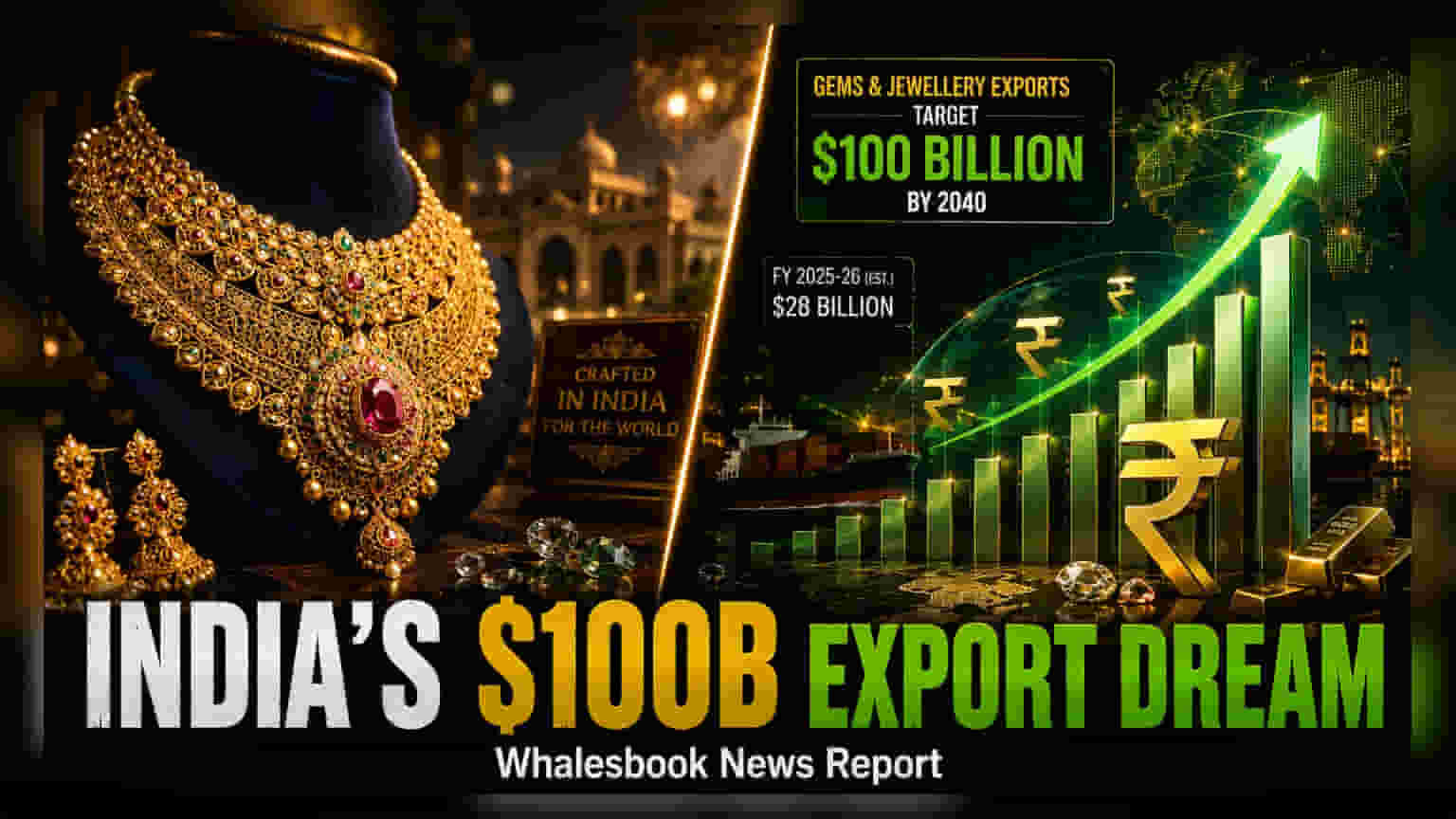
India plans to triple its gems and jewellery exports to $100 billion by 2040, shifting from low-margin manufacturing to high-value branded goods. While the roadmap highlights growth, investors should watch for challenges like gold price volatility, rising freight costs, and the high cost of building global brands.
The Indian government has laid out a long-term strategic plan to transform the country’s gems and jewellery sector, targeting $100 billion in annual exports by 2040. This goal represents a significant jump from the estimated $28 billion recorded in the 2025-26 fiscal year. Commerce Secretary Rajesh Agrawal emphasized that the path to this target requires moving away from the traditional low-margin business model of simply assembling or processing goods for global clients.
Moving Toward High-Value Products
For years, much of India's jewellery export strength has relied on Original Equipment Manufacturing, or OEM, where Indian firms manufacture goods designed by international brands. The new roadmap aims to change this by pushing for "Crafted in India" products. The strategy involves building Indian brands that focus on unique design, high-quality finishing, and heritage value. By shifting to these higher-value, design-led products, the industry aims to move up the value chain, aiming for a 14% share of India's total merchandise exports and a 1.2% contribution to the national GDP by 2040.
To achieve this, the sector is looking to adopt advanced technology, including artificial intelligence and 3D printing, to improve design efficiency and production speed. This transition is expected to require significant investment in research and development and marketing to establish these brands in global markets.
Current Sector Performance
While the 2040 target is ambitious, the immediate sector performance provides context on the challenges ahead. Data from April to July 2026 showed a modest growth of 2.44% in USD terms. This growth was largely supported by value-added segments such as studded gold and silver jewellery. In contrast, the traditional cut and polished diamond segment, which has historically been a major part of India's export basket, continues to face demand struggles, highlighting the need for the diversification the government is now promoting.
Risks and Market Realities
Investors looking at this sector should note that transitioning from volume-based processing to brand-based value addition comes with clear risks. Companies in this space are currently navigating several pressures. Freight and insurance costs have risen, and the shift in trade routes—moving away from cost-effective hubs like Dubai to more expensive destinations—has added to margin pressure.
Furthermore, supply chain bottlenecks remain a recurring issue. Regulatory hurdles regarding the availability of gold for export manufacturing can limit operational capacity for many exporters. Geopolitical tensions, particularly in West Asia, have also created trade disruptions, often leading to a lower presence of buyers in traditional trading hubs.
Additionally, gold price volatility remains a constant risk. When gold prices rise sharply, demand in price-sensitive markets often contracts, which can impact the revenue of jewellery exporters. Building a global brand also requires a long-term commitment of capital, which could impact the cash flow of companies that have historically focused on lower-margin, high-volume trading.
The key monitorable for investors moving forward will be the execution of this strategy. Tracking how efficiently companies manage raw material costs, navigate regulatory gold supply rules, and successfully market Indian-branded products in competitive global markets will be essential for assessing long-term performance.