

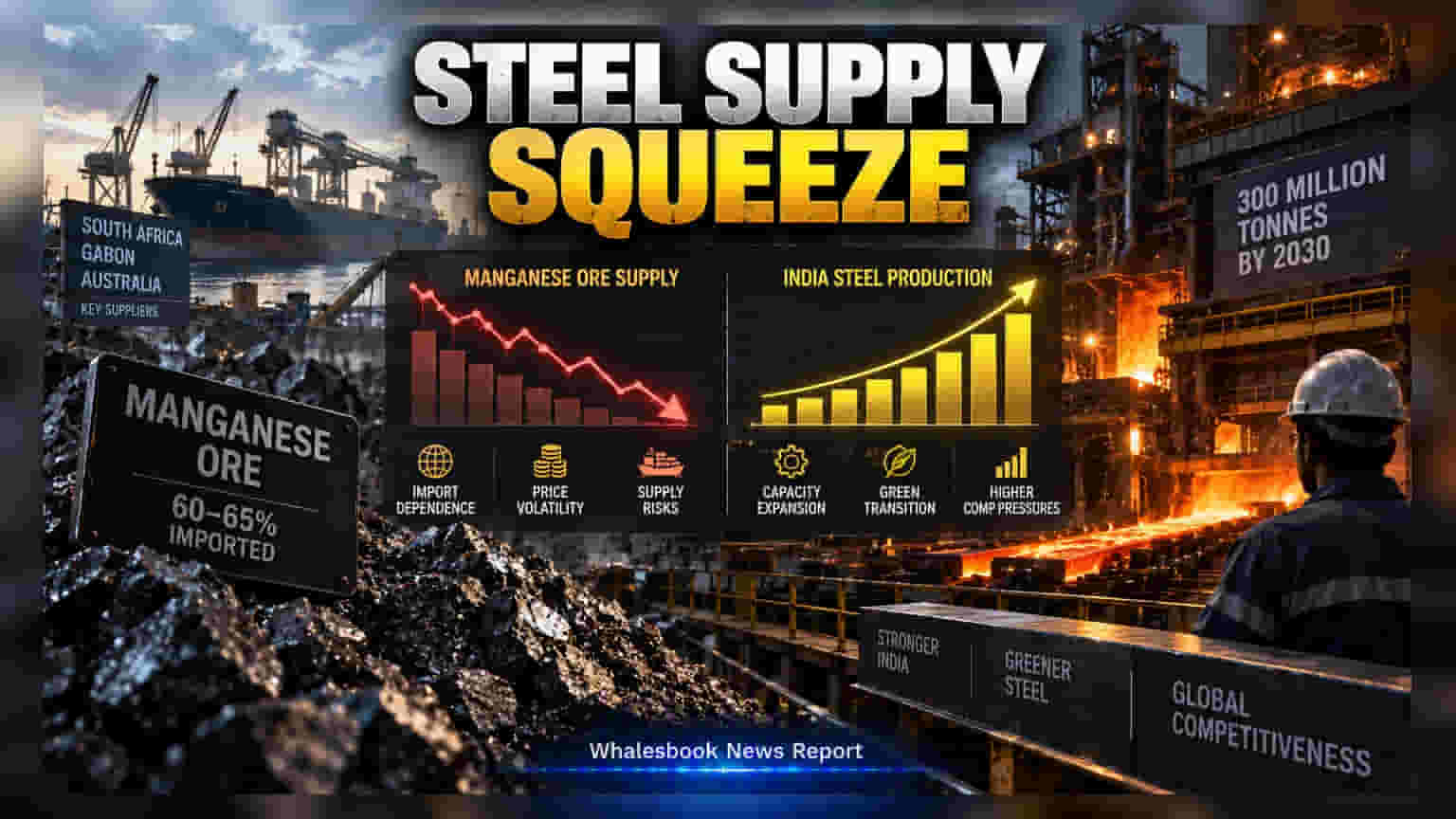
India’s ambitious target to produce 300 million tonnes of steel by 2030 faces a raw material hurdle due to a shortage of manganese ore. Heavy reliance on imports makes steel makers vulnerable to global price swings, while high domestic mining auction premiums add further cost pressure on companies.
The Indian steel industry is moving aggressively toward its goal of producing 300 million tonnes of steel annually by 2030, a significant jump from current levels. While the country has abundant iron ore and coal, a supply bottleneck is emerging in manganese ore, a critical component used to improve the strength and toughness of steel. This dependency on outside suppliers poses a structural risk to profit margins as the industry expands.
Import Dependence and Price Risks
Unlike iron ore, which is largely available domestically, India imports roughly 60 to 65 percent of its required manganese ore. Key suppliers are international markets, particularly South Africa, Gabon, and Australia. This high reliance creates a dual problem for Indian steel companies. First, it exposes domestic manufacturers to global price volatility. When international prices rise, the cost of producing steel increases, often forcing companies to absorb the cost or pass it on to consumers, which can be difficult in a competitive market. Second, as more countries prioritize their own resource security, the long-term availability of these international supplies may become less certain.
Impact of Mining Auction Premiums
Beyond raw material imports, the cost structure of domestic steel producers is also being tested by the current mining auction model. In states like Odisha, mining blocks have been awarded at very high premiums in recent competitive auctions. When companies pay a high price to secure a mine, it adds a fixed cost burden that remains even if steel prices fall. This creates a challenging environment where the high cost of acquisition competes with the need for operational profitability. If these premiums remain unsustainable, it could force companies to re-evaluate their mining assets or production timelines.
The Cost of Green Transition
Adding to the raw material and cost challenges, the industry is also preparing for the European Union’s Carbon Border Adjustment Mechanism (CBAM). This policy imposes a carbon tax on goods imported into Europe, meaning Indian steel exporters must lower their carbon footprint to remain competitive. Many companies are now forced to shift capital toward green energy, such as solar power and waste-heat recovery systems. While these investments are necessary to maintain export market access, they require significant upfront cash spending. For investors, this creates a complex scenario where companies must manage high capital needs for green initiatives while simultaneously navigating the rising costs of traditional raw materials like manganese.
The most important monitorables for the sector in the coming quarters will be the movement in global manganese prices, which directly impact operating margins. Additionally, investors will be tracking the company-wise allocation toward green technology versus core expansion to see how debt levels and cash flow are managed during this growth phase. Future exchange filings regarding mining output and raw material procurement costs will also provide clearer insight into whether the industry can successfully manage these supply constraints without hurting profitability.