 Whalesbook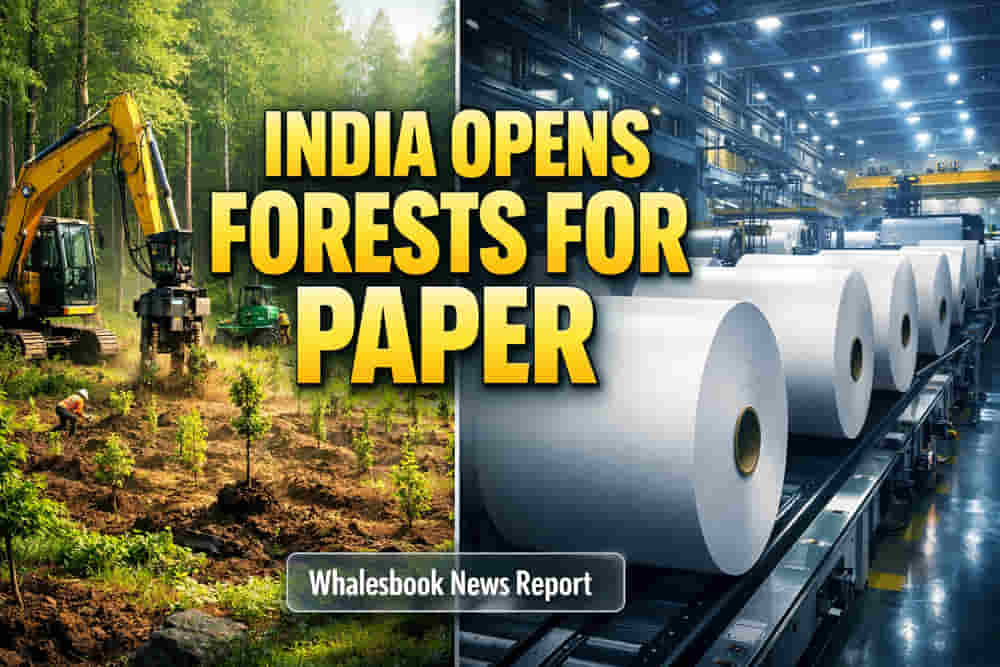
THE SEAMLESS LINK
The newly amended Van (Sanrakshan Evam Samvardhan) Adhiniyam, 1980, enacted on January 6, 2026, signals a significant policy pivot for India's paper and pulp sector. This change permits commercial plantations directly on forest land, a concession the industry has lobbied for since the 1970s. The move is seen as a crucial step to bridge the substantial gap between domestic wood availability and escalating demand, a deficit that has historically constrained production and inflated costs.
The Core Catalyst: Unlocking Raw Material Access
The amendment's immediate impact lies in providing easier access to raw materials for paper manufacturers. Previously, guidelines from November 2023, largely formulated for mining projects, imposed conditions like Net Present Value (NPV) and Compensatory Afforestation (CA) payments, which the paper industry deemed unviable. Rohit Pandit, secretary general of the Indian Paper Manufacturers Association (IPMA), clarified that the industry's proposal focused on increasing green cover through large-scale, short-rotation plantations, arguing that such activities should be exempt from NPV and CA charges. The revised rules, treating assisted natural regeneration, afforestation, and plantations as "forestry activities," offer this much-needed relief. Industry stakeholders now look to state governments for swift implementation. This policy change could directly influence the operational capacity and cost structures of companies like JK Paper Ltd. (JK PAPER) and West Coast Paper Mills Ltd. (WSTCSTPAPR), which have faced raw material constraints. JK Paper, with a market capitalization of ₹5,387.84 Cr and a P/E ratio of 13.15, and West Coast Paper Mills, with a market cap of ₹2,580.20 Cr and a P/E of 8.29, are positioned to potentially benefit from improved domestic wood supply [25, 35].
The Analytical Deep Dive: Bridging the Deficit and Global Scrutiny
India faces a considerable annual wood deficit, estimated by IPMA at around two million tonnes (9 million tonnes available versus 11 million tonnes demanded). This shortfall has driven a heavy reliance on imports, particularly from Southeast Asian nations, China, and Indonesia, which have surged significantly in both volume and value. Pavan Khaitan, vice-president of IPMA, highlighted that imported paper from ASEAN countries is often priced at approximately $40 per tonne, compared to $110 per tonne domestically, exacerbating price pressures. The increase in imports, which saw a 33% volume jump from China in 2024-25 alone, has led to domestic paper production falling by 5.1% in FY24, with over 300 mills remaining inoperable. Major players like JK Paper and West Coast Paper Mills have seen their stock prices fluctuate, with JK Paper trading at ₹318.05 and West Coast Paper Mills at ₹390.65 as of January 27, 2026.
Simultaneously, the industry is linking this policy shift to India's climate commitments, such as bringing 25-30 million hectares of degraded land under forest cover by 2030. However, this development occurs amidst global concerns over forest resource pressure. A report by environmental non-profit Canopy noted increasing stress on global forests due to rising paper demand, particularly for packaging driven by e-commerce growth. While commercial plantations can aid restoration, environmental groups emphasize the need for careful monitoring to prevent added strain on existing ecosystems. The history of forest policy in India has often involved balancing industrial needs with conservation, with past policies sometimes prioritizing commercial exploitation over local livelihoods.
The Future Outlook: Balancing Growth with Sustainability
The revised forest land access policy is projected to help bridge the wood deficit and contribute to national greening targets. IPMA estimates that around 500,000 farmers are involved in growing species used by the paper industry, with 1.2 million hectares currently under plantations. This amendment could invigorate the sector, which comprises over 900 mills, of which only about 550 are operational. Jay Deepak Shah, CEO of Jay Wood Industry, noted that consistent timber access has been a challenge, impacting long-term planning and efficiency for wood-dependent sectors. The India State of Forest Report 2023 identified nearly 93,000 sq km as suitable for upgradation, with significant carbon sequestration potential. The industry anticipates improved raw material availability, reduced import dependence, and a potential revival of underutilized capacities, aligning with growing packaging demand driven by e-commerce, projected to reach $46.43 billion by 2030. However, the sector must navigate the ongoing global scrutiny regarding forest resources and sustainable land use practices to ensure long-term viability.