

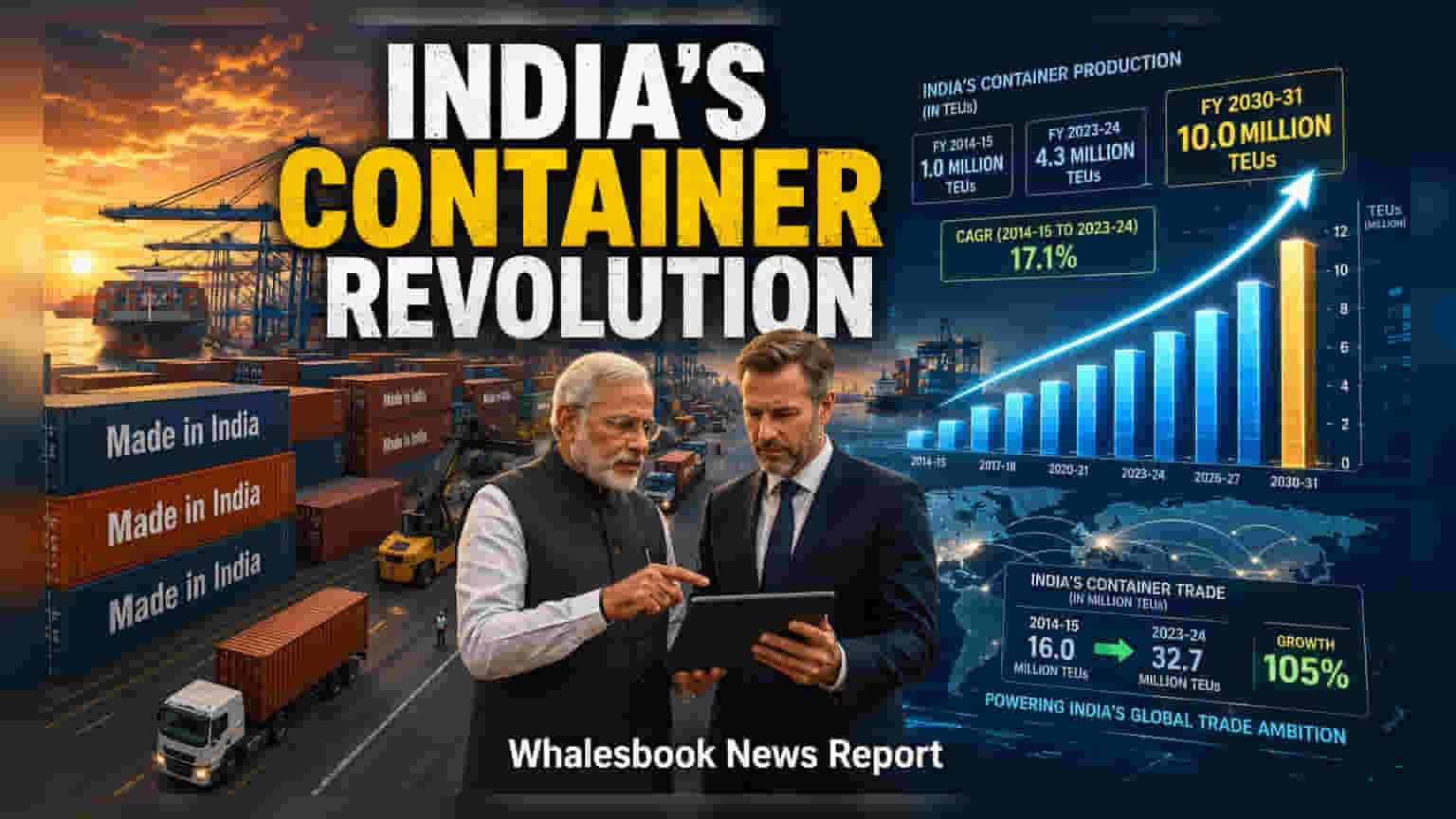
India has introduced the ₹10,000 crore Container Manufacturing Assistance Scheme to reduce reliance on imports. With 2 million containers imported annually, the plan aims to reach a production capacity of 7.5 lakh units. The move has seen early traction with a 1,000-container order placed by Maersk with DCM Shriram Group.
The Indian government has launched the Container Manufacturing Assistance Scheme (CMAS), allocating ₹10,000 crore over five years to build a local manufacturing base for shipping containers. This initiative aims to address a critical supply chain weakness: India currently relies on the import of nearly 2 million empty containers every year to support its export trade. By encouraging domestic production, the government intends to improve logistics efficiency and protect the economy from global container shortages and high freight costs.
The scheme aims to increase annual domestic manufacturing capacity to 7.5 lakh TEUs (Twenty-foot Equivalent Units), which is a standard measure for shipping container size. Support will be provided for setting up new factories, upgrading existing facilities, and improving testing infrastructure to ensure containers meet international quality standards.
Early Industry Interest
The initiative has already seen initial success in the market. In July 2026, A.P. Moller–Maersk unveiled the first EXIM-grade shipping container manufactured in India. Following this development, the company placed an order for 1,000 containers with the DCM Shriram Group. This move serves as a testing ground for whether Indian-made containers can meet the rigorous quality and cost requirements of global shipping lines.
Competition and Execution Risks
While the government support is intended to stimulate the industry, domestic manufacturers face a significant hurdle. Global container manufacturing is highly concentrated, with manufacturers in China controlling over 95% of the global market. These established players benefit from massive scale and deeply integrated supply chains, which allow them to keep costs low. For Indian firms, success will depend on their ability to achieve similar operational efficiency and scale their capacity quickly.
Investors monitoring this sector should also consider the impact of raw material costs. The manufacturing process is heavily reliant on inputs like Corten steel and specialized wooden parts, and fluctuations in global commodity prices could affect profit margins. Additionally, the success of this initiative relies on smooth coordination across port infrastructure, customs clearance, and domestic trade logistics. Any bottlenecks in these areas could delay the project timeline or increase costs for manufacturers.
The CMAS is part of a broader maritime strategy that includes the proposed Bharat Container Shipping Line, which is expected to further boost demand for domestic containers. The key monitorable for the coming quarters will be the pace at which new facilities are commissioned and whether domestic companies can secure repeat, high-volume orders from major global shipping lines to ensure long-term viability.