

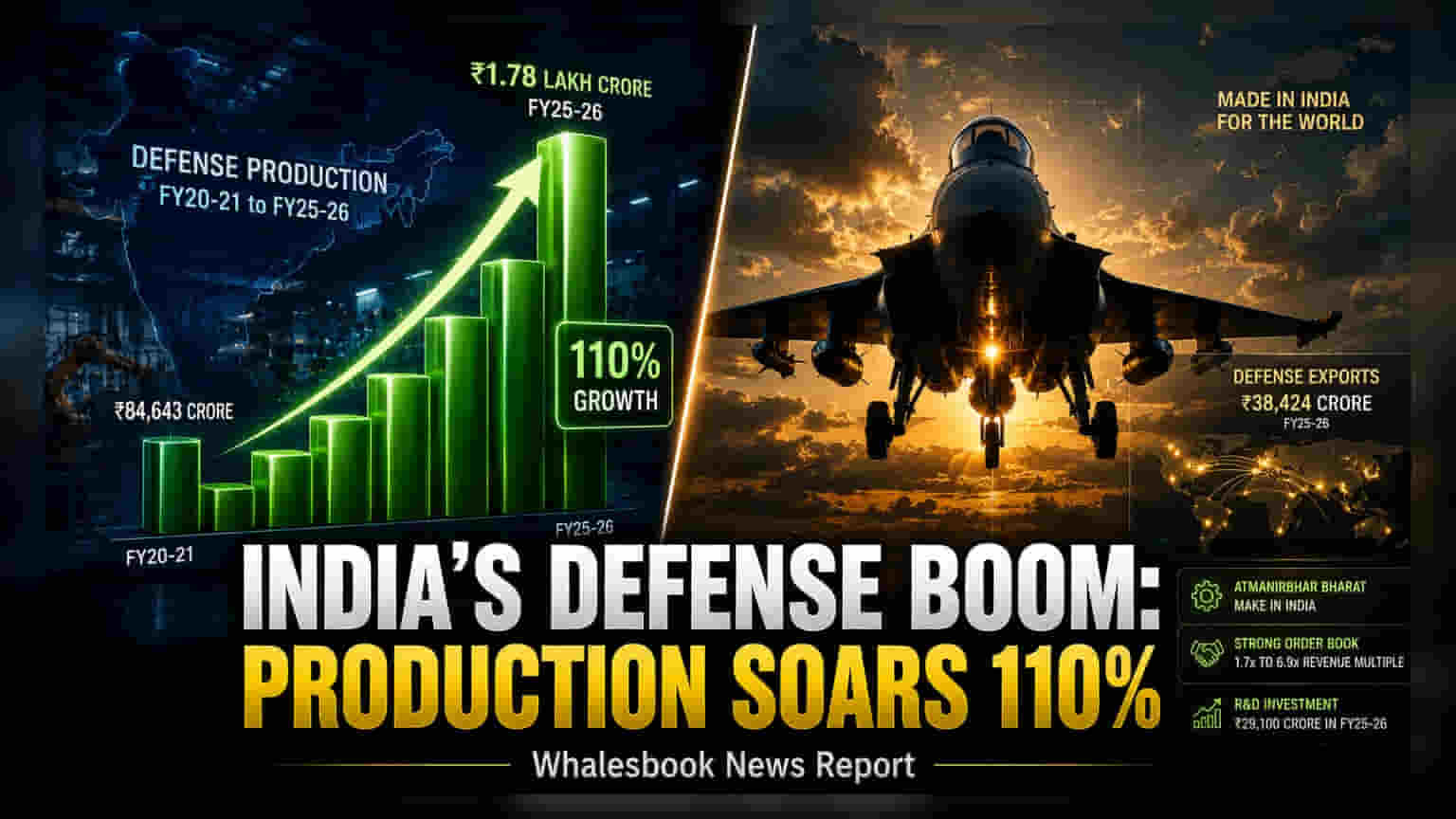
India’s defense manufacturing reached a record ₹1.78 lakh crore in FY26, a 110% increase since FY21, driven by policy shifts. While the sector is benefiting from strong government backing and higher exports, investors should focus on the companies' ability to execute massive order backlogs in the coming years.
India’s defense manufacturing sector has reached a new production high, with output touching ₹1.78 lakh crore in the fiscal year 2025-26. This marks a 110% increase compared to the ₹84,643 crore produced in FY20-21, reflecting a significant strategic shift for the country. For decades, India relied heavily on importing military equipment, but recent policies under the 'Aatmanirbhar Bharat' and 'Make in India' initiatives have aimed to turn the nation into a global exporter.
Production and Export Growth
The growth has been driven by a combination of policy reforms, increased capital expenditure, and a focus on indigenisation. Public Sector Undertakings (DPSUs) continue to form the backbone of this output, contributing roughly 76% of the total production. However, the private sector is steadily expanding its footprint, now accounting for 24% of the total manufacturing output. Exports have also shown strong momentum, reaching ₹38,424 crore in FY26, with private firms playing a substantial role by contributing over 45% of these export revenues.
The Investor Angle: Execution is Key
While the headline numbers show rapid growth, savvy investors look beyond the production figures to the order book. Many defense companies currently hold massive order backlogs, with revenue multiples—the time it would take to finish current orders based on recent sales—ranging from 1.7x to nearly 7x. While a large order book suggests long-term revenue visibility, it also introduces the risk of execution delays. For investors, the critical monitorable is whether companies can scale their operations fast enough to deliver these systems on time without facing cost overruns.
Risks and Sector Context
The defense sector is not immune to global challenges. Manufacturing modern military systems requires complex components, and any disruption in the global supply chain can hinder production timelines. Additionally, while R&D spending has more than doubled since FY15 to ₹29,100 crore, maintaining a technological edge requires consistent and substantial capital allocation. The Nifty Defence Index has seen gains this year, indicating positive market sentiment, but this also means that expectations are high. Any failure to meet delivery targets or a slowdown in policy momentum could lead to volatility in stock prices, as the market has already priced in significant growth.
What Investors Should Track Next
The long-term outlook for the sector depends on three primary factors: sustained policy support, the successful transition of design-to-delivery for complex platforms, and the ability to maintain profit margins while managing large-scale manufacturing. Moving forward, shareholders should watch the management commentary of key defense companies regarding their production schedules and whether they can clear their existing backlogs within the committed timelines. Clear visibility on the actual conversion of orders into revenue will be the true test of this sector’s growth story.