

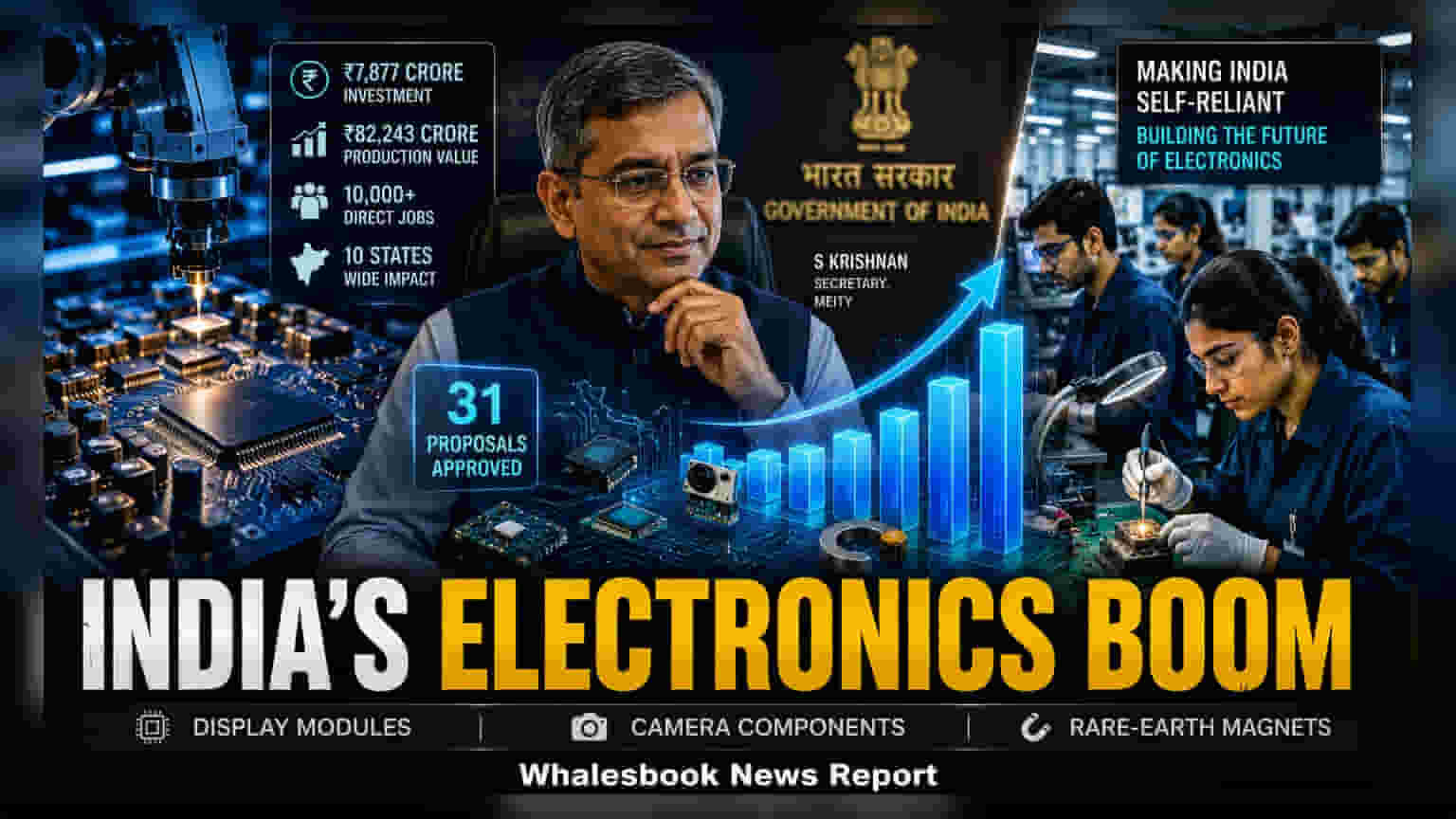
The government has approved 31 proposals under the Electronics Components Manufacturing Scheme to boost local production. This move supports companies like Centum Electronics and Syrma SGS Technology in expanding capacity. Investors should watch how these firms manage the capital spending and project execution timelines in the coming quarters.
The Indian government has officially cleared 31 new proposals for manufacturing electronic components, involving a total investment of ₹7,877 crore. These projects are part of the government’s push to strengthen domestic production capabilities under the Electronics Components Manufacturing Scheme. This program aims to provide financial support to companies setting up facilities to produce critical electronics parts locally rather than relying on imports.
The government expects these initiatives to generate a production value of approximately ₹82,243 crore and create around 10,000 direct jobs across 10 states. Among the participants receiving these approvals are listed entities such as Centum Electronics and Syrma SGS Technology, along with the GX Group. The scope of these projects covers essential components, including display modules, camera parts, and rare-earth magnets, which are vital for the electronics supply chain.
For companies in this sector, these government schemes act as a strategic advantage by providing incentives that can lower the cost of setting up manufacturing units. However, for investors, the transition from an announcement to actual business growth requires careful observation. Setting up electronics manufacturing plants involves significant capital spending. Companies often fund these projects through a mix of debt and equity. A high reliance on borrowing to fund such expansion can lead to pressure on a company’s profit margins, particularly if interest costs rise or if the new facilities take longer than expected to reach full production capacity.
The electronics sector in India is currently seeing rapid policy support designed to decrease dependence on foreign suppliers. While these approvals offer a clear path for potential revenue growth, the ultimate benefit to shareholders will depend on the ability of each company to protect its profit margins while scaling up operations. The electronics market is also sensitive to global commodity prices and demand fluctuations, which means that operational efficiency will be just as important as the initial expansion.
The main factor for investors to monitor in the coming quarters will be the speed at which these companies commission their new plants and how effectively they start production. Shareholders should track future company filings or investor presentations for updates on project timelines. It will also be important to observe if the companies’ debt levels increase as they begin to spend on these new facilities, as this could impact their financial health in the short to medium term.