

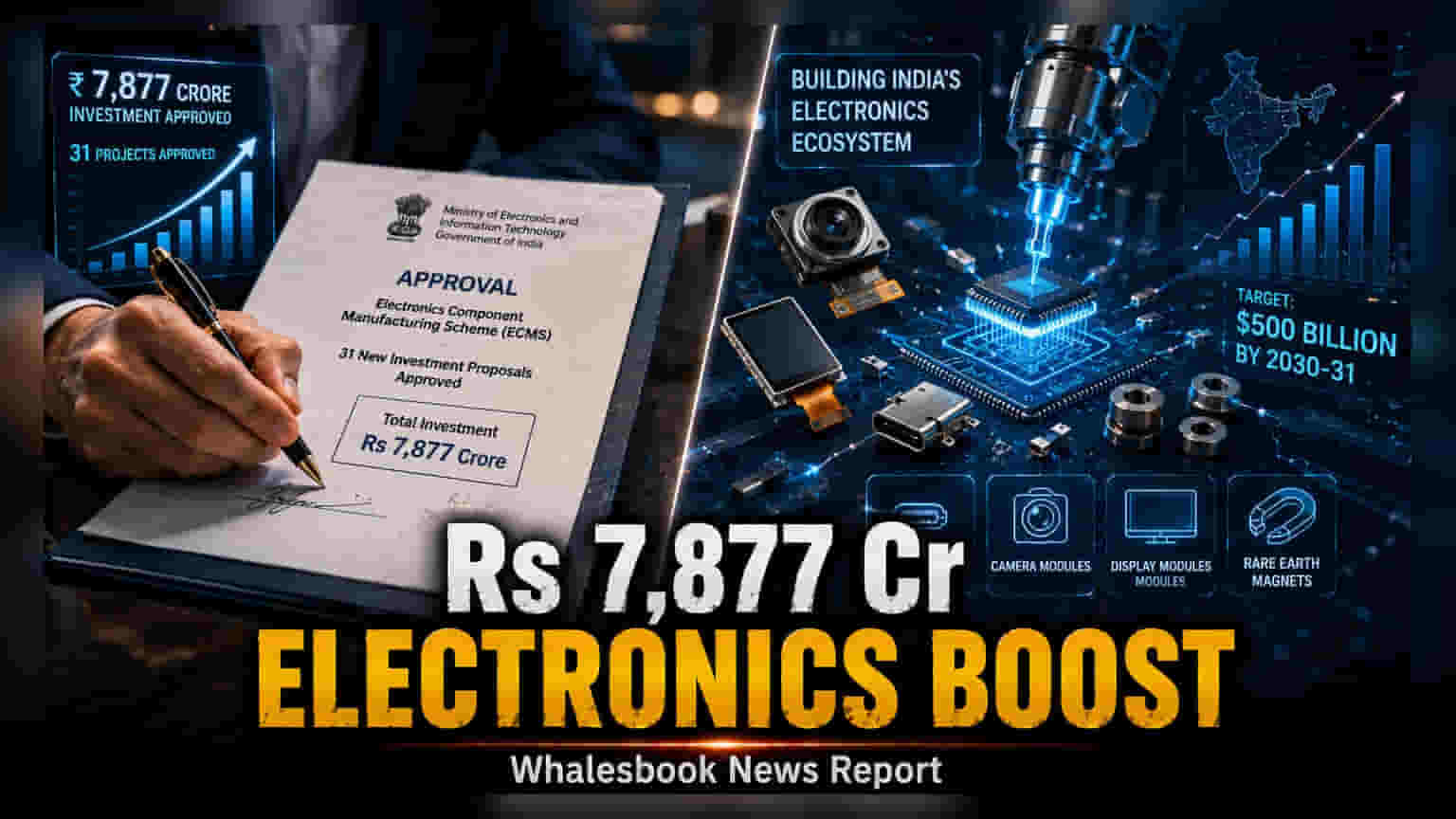
The government has approved 31 new proposals under the Electronics Component Manufacturing Scheme to boost domestic production. This initiative aims to help companies like Dixon and Kaynes Technology move beyond simple assembly to producing high-value electronic parts, reducing dependence on imports.
The Ministry of Electronics and Information Technology has approved 31 new investment proposals under the Electronics Component Manufacturing Scheme (ECMS). These projects represent a total investment of Rs 7,877 crore and are part of the government’s broader roadmap to create a $500 billion electronics manufacturing ecosystem by 2030–31. The focus of this approval is to encourage local production of critical parts, such as connectors, camera modules, display modules, and rare earth magnets, which are currently largely imported.
Moving from Assembly to Manufacturing
For investors, this shift is significant. Historically, many Indian electronics companies focused on assembly, which often brings lower profit margins and less control over the supply chain. By incentivizing the domestic production of components, the government is encouraging companies to move up the value chain. When companies manufacture components in-house or source them locally, they can potentially improve their profit margins and reduce the risks associated with global supply chain disruptions. Major players in the electronics manufacturing space, including Dixon Technologies, Kaynes Technology, Motherson, and Wipro, are expected to play a key role as these new facilities come online.
Understanding the Risks and Execution
While this approval is a positive step for the sector, investors should remain aware of how these schemes work. The financial incentives under the ECMS are performance-based. This means companies do not receive the benefits simply by getting a proposal approved; they must meet strict timelines for commercial production and achieve specific manufacturing targets. If a company faces delays in setting up its factory or struggles to reach the required production volume, the expected payouts may be delayed or reduced. This is known as execution risk.
Furthermore, while the government is pushing for localization, the electronics industry in India still relies heavily on imported raw materials for high-tech components. A company’s ability to successfully compete will depend not just on government incentives, but also on its ability to manage costs, maintain quality, and compete with established global component suppliers.
What to Watch Next
The most important detail for investors in this space will be the execution timeline of these 31 projects. Future updates from companies, particularly regarding the commissioning of new plants and their ability to secure orders for these locally made components, will be the key indicators of success. Investors may also track management commentary on whether these new facilities are contributing to better margins or if initial capital spending creates near-term pressure on cash flows.