 Whalesbook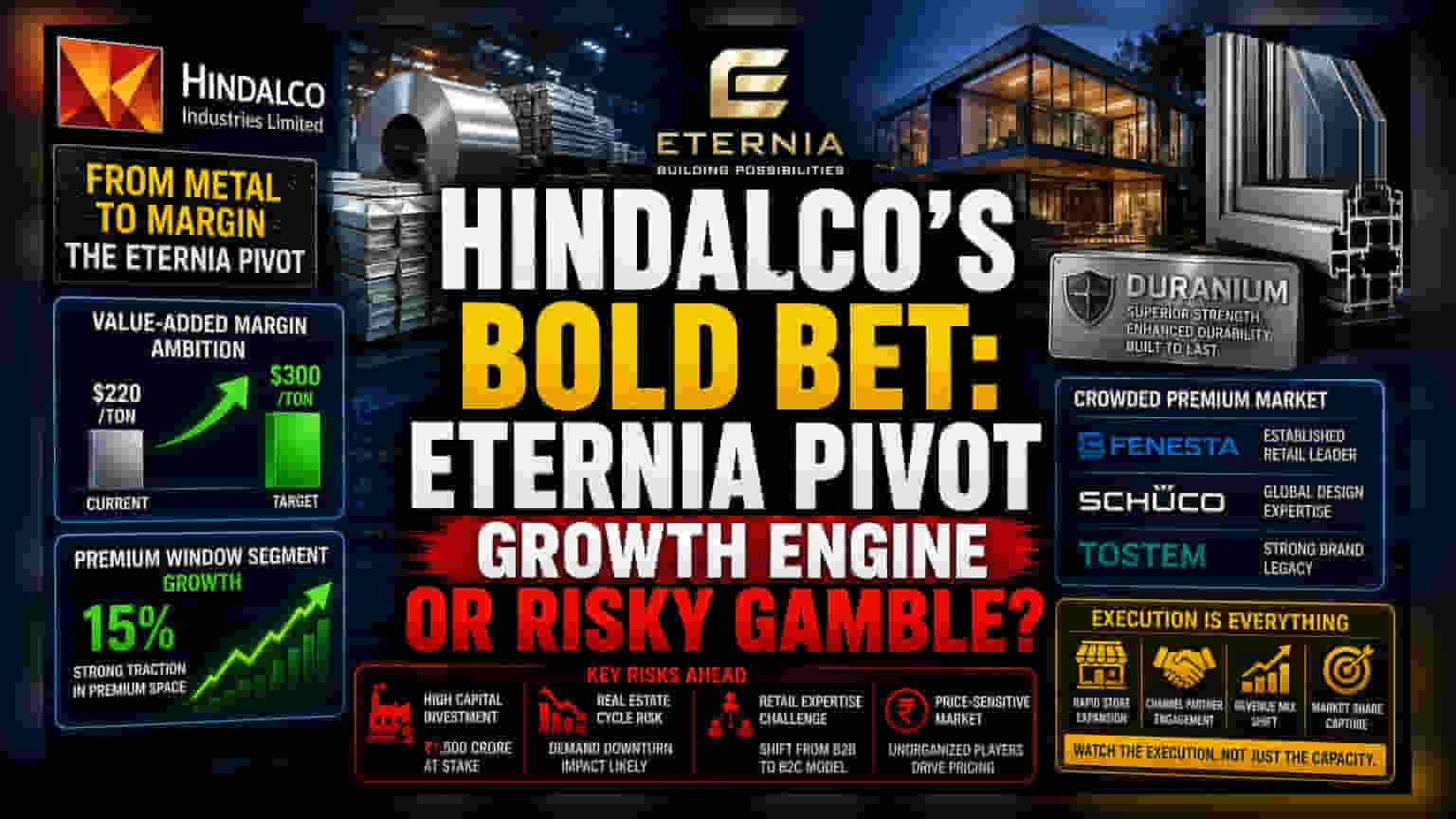


The Margin Pivot
Hindalco’s pivot toward the Eternia brand represents a broader corporate attempt to de-risk its balance sheet from the volatility of global aluminum commodity prices. By converting raw metal into high-margin building solutions, management is attempting to insulate the bottom line from cyclical downturns that have historically plagued upstream producers. The strategic goal of increasing value-added product margins from $220 per ton toward $300 per ton is ambitious, yet success hinges entirely on the company's ability to maintain premium pricing power in a market where lower-cost, unorganized players often dictate regional dynamics.
Competitive Landscape and Market Reality
While the company points to a 15% growth rate in the premium window segment, it is entering a space already crowded by established specialists like Fenesta, Schücco, and TOSTEM. Unlike these pure-play competitors, which have spent decades honing retail networks and after-sales service, Hindalco is essentially a commodity giant attempting to master a B2C retail model. The reliance on the proprietary Duranium alloy is a marketing differentiator, yet it remains to be seen if retail consumers, who are notoriously price-sensitive, will assign a meaningful valuation premium to alloy durability over aesthetic design or localized service availability. Furthermore, the company must manage the operational complexity of scaling its manufacturing footprint from existing hubs into a nationwide retail network without seeing overhead costs balloon faster than top-line growth.
The Forensic Bear Case
A cynical view of this expansion reveals significant operational hurdles. The retail segment requires a high degree of customer-centricity that contrasts sharply with the bulk-commodity business model of traditional aluminum smelting. Any disruption in the supply chain or failure to hit retail expansion targets could render the ₹1,500 crore investment a long-term drag on capital efficiency. Additionally, the broader building materials sector is highly sensitive to real estate cycles; should the current demand for premium housing cool, the capital-intensive nature of Eternia’s manufacturing plants could lead to significant underutilization. Management must also contend with the inherent difficulty of penetrating an unorganized market where cost-conscious builders often prioritize short-term savings over the long-term sustainability and quality of aluminum extrusions.
Forward Guidance
Investors should monitor the quarterly progression of store count and channel partner engagement as key indicators of execution. If Hindalco fails to achieve a rapid, measurable shift in its revenue mix, the market may begin to view the downstream expansion as a distraction from its core smelting operations. Guidance suggests a rapid acceleration of physical footprint, but success will likely be measured by the ability to capture market share from local incumbents rather than simply creating capacity.