 Whalesbook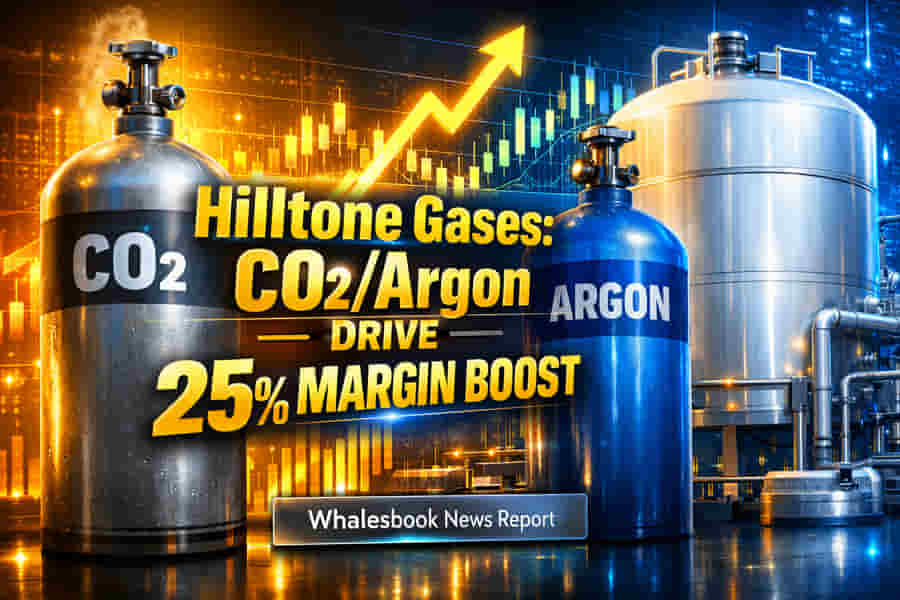
Hilltone Gases Bets on CO2, Argon for 25% Margin Boost and 15% Logistics Cut
Hilltone Software & Gases Limited is set to enhance its Industrial Gases division by adding Carbon Dioxide (CO2) and Argon to its product line, targeting a significant 25% gross profit margin improvement in the vertical. The company anticipates a 15% reduction in logistics costs.
Reader Takeaway: New gases to boost margins; infra completion by May 2026 is key.
What just happened (today’s filing)
Hilltone Software & Gases Limited announced a strategic expansion of its Industrial Gases division. The company plans to add Carbon Dioxide (CO2) and Argon to its product portfolio, which currently includes Oxygen and Nitrogen.
This expansion involves significant investment in new infrastructure. It includes the installation of 19 KL and 20 KL liquid storage tanks, and the procurement of approximately 500 gas cylinders. A truck-mounted liquid gas tank will also be acquired to aid bulk transportation and reduce logistics costs.
The company expects to complete the installation and commissioning of this new infrastructure by May 2026. This move aims to enhance supply reliability, improve customer service, and provide greater control over procurement processes.
Why this matters
Diversifying the industrial gas product range beyond Oxygen and Nitrogen into CO2 and Argon is a key strategic step for Hilltone. This allows the company to tap into new customer segments and applications.
The planned infrastructure upgrades are crucial for improving operational efficiency. Owning more of the supply chain, from storage to bottling and transport, is expected to yield substantial benefits in terms of cost savings and service quality.
Ultimately, the company anticipates these changes will lead to a considerable improvement in profitability, with a target of a 25% gross profit margin increase in the Industrial Gases vertical.
The backstory (grounded)
Hilltone Software & Gases Limited has been in the industrial and medical gases business for over 15 years, with established experience in Oxygen and Nitrogen. The company also has interests in software and eco-energy solutions.
In December 2025, the company completed a preferential allotment of 22,47,800 equity shares. This move likely aimed to raise capital to fund such expansion initiatives and strengthen its financial position.
What changes now
- Product Diversification: The industrial gas offerings will expand from two gases (Oxygen, Nitrogen) to four, adding CO2 and Argon.
- Supply Chain Control: In-house liquid storage and bottling infrastructure will improve control over procurement and supply reliability.
- Customer Service Enhancement: Greater control and improved logistics are expected to boost customer service capabilities.
- Profitability Boost: A target of approximately 25% gross profit margin improvement is projected for the Industrial Gases segment.
- Cost Efficiency: Logistics costs are anticipated to reduce by around 15% following the acquisition of new transport equipment.
Risks to watch
- Execution Risk: Timely completion and commissioning of the new infrastructure by May 2026 is critical for realizing the projected benefits.
- Market Competition: The industrial gases market in India is competitive, with major players like Linde India and Air Liquide.
- Commodity Price Volatility: Fluctuations in raw material or energy prices can impact production costs and margins.
- Recent Stock Volatility: The company's stock has experienced significant selling pressure and decline in recent months, indicating potential market concerns.
- Financial Health: Past financial indicators showed a low interest coverage ratio and low return on equity.
Peer comparison
Linde India Limited is a dominant player in India's industrial gas market, boasting a market capitalization of approximately ₹57,998 Cr as of February 2026. It offers a comprehensive range of gases including Oxygen, Nitrogen, Argon, Helium, and Carbon Dioxide, catering to diverse industrial needs with extensive infrastructure.
National Oxygen Limited, with a market capitalization around ₹37 Cr as of February 2026, primarily produces and supplies Oxygen and Nitrogen gases. Its product range is more focused compared to Linde India.
Context metrics (time-bound)
- Gross profit margin improvement in the Industrial Gases vertical is targeted at approximately 25% (FY26-FY27 estimated).
- Logistics costs are expected to reduce by approximately 15% (FY26-FY27 estimated).
- Installation and commissioning of new infrastructure are planned for completion by May 2026.
What to track next
- Monitor the timely completion and operational readiness of the new CO2 and Argon infrastructure by May 2026.
- Track the actual realization of the targeted 25% gross profit margin improvement in the Industrial Gases segment.
- Observe the impact of the logistics upgrades on the company's operational costs and efficiency.
- Analyze customer uptake and market penetration for the newly added CO2 and Argon products.
- Keep an eye on the company's overall financial performance and any further strategic announcements regarding its gas division.