

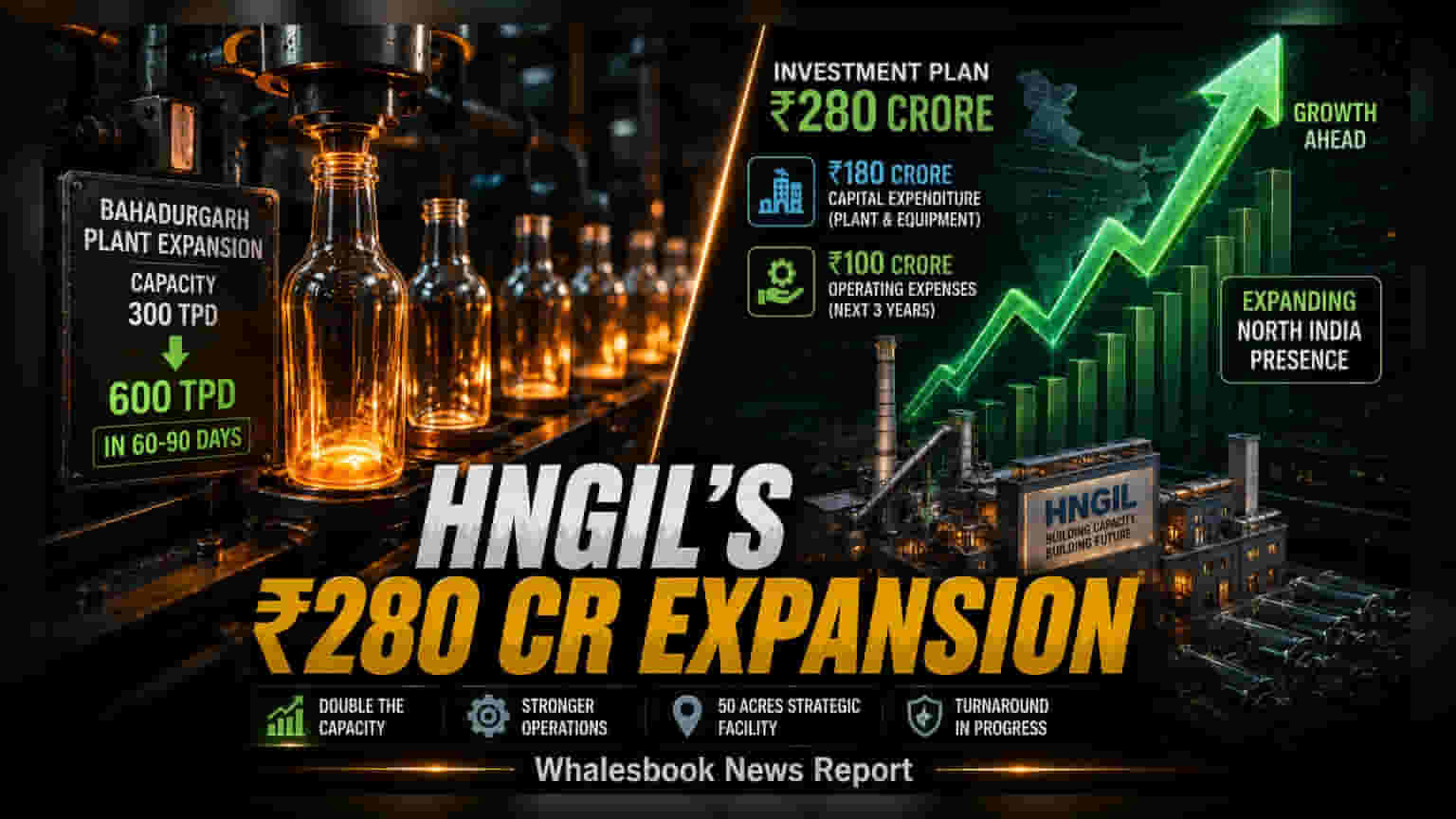
Hindusthan National Glass & Industries Ltd (HNGIL) will invest ₹280 crore to double production capacity at its Bahadurgarh unit in Haryana. This capital spending is part of a turnaround strategy following the company's exit from insolvency. Investors may monitor how this investment influences the company’s operational recovery and financial stability.
Hindusthan National Glass & Industries Ltd (HNGIL) has announced a ₹280 crore investment plan to expand its manufacturing operations in Bahadurgarh, Haryana. The company aims to double the plant's production capacity from 300 tonnes per day to 600 tonnes per day. According to the company, this increase in capacity is expected to be achieved within the next 60 to 90 days.
The investment is divided into two parts: ₹180 crore allocated for capital spending on plant infrastructure and equipment, and ₹100 crore designated for operating expenses over the next three years. This project is a central part of the company's efforts to rebuild its manufacturing presence and improve market output.
HNGIL is currently under the management of the Independent Sugar Corporation Limited (INSCO), a part of the Madhvani Group. This leadership change followed the company's exit from the Corporate Insolvency Resolution Process (CIRP) under India's bankruptcy laws. The current management is focusing on operational turnaround, and the Bahadurgarh facility—which occupies about 50 acres—remains a key hub for the company’s North Indian operations.
While this expansion signals an attempt to restart growth, investors may also look at the company's challenging financial history. HNGIL has faced significant financial stress in recent years, with past reports indicating negative net worth and difficulty in managing debt. Additionally, the company has dealt with a high level of promoter pledging, which is a common area of focus for shareholders monitoring governance and ownership stability. The successful execution of this capacity expansion will be critical, as the company works to improve its sales and profit performance from a position of historical financial weakness.
The key monitorable for investors will be how effectively the company can execute this expansion without putting further pressure on its strained balance sheet. Future updates regarding the stabilization of production at the higher capacity level, along with improvements in financial metrics like cash flow and debt management, will be important for understanding the company's long-term recovery trajectory.